

The global logistics industry is in the middle of a sea change. With rising consumer expectations and increased environmental challenges, businesses are coming to realize that conventional logistics models cannot meet demands anymore. Sustainable and green logistics has become the future, not some passing trend, but as a basic necessity for long-term growth, compliance, and global competitiveness.
In today’s world, reduction in carbon impact, optimization of energy use, and eco-friendly practices are taking center stage in logistic operations globally. Let’s analyze the potential reasons why green logistics is shaping the future of supply chains.
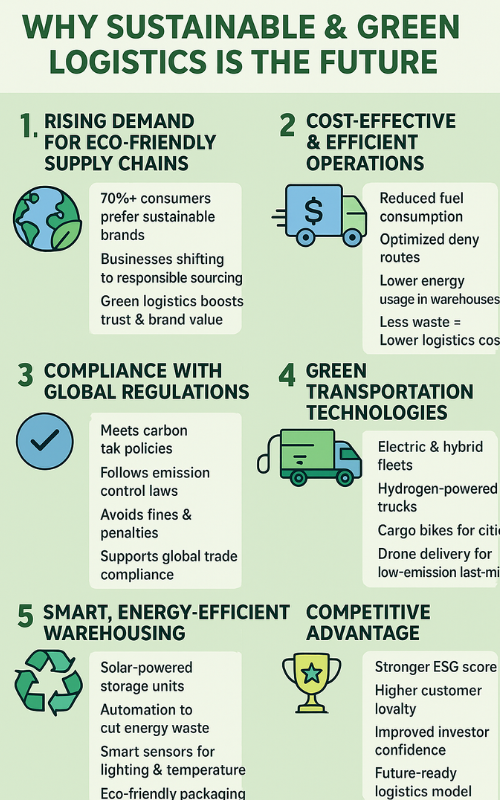
- Growing Global Demand for Eco-Friendly Supply Chains
Today, customers and businesses alike expect brands to be eco-considerate. Indeed, more than 70% of consumers point out that they would prefer companies committed to sustainability.
Consequently, ethical sourcing, responsible packaging, and carbon-conscious delivery partners have all become the brands’ top priorities.
Green logistics help organizations achieve the following:
- Reduce carbon emissions
- Improve brand reputation
- Meet customer expectations about eco-friendly operations
- Operational Efficiency Cost Savings
After all, sustainability is not only good for the planet but also for profits.
With route optimization, using energy-efficient warehousing, and cleaner fuels, the providers of logistics services can significantly reduce operational costs.
Green logistics decreases costs by:
- Fuel-efficient transportation
- Reduced waste and packaging optimization
- AI-powered smart routing
- Energy-saving storage facilities
Over time, sustainable systems become more efficient and reduce overall spending on logistics.
- Conformity with International Environmental Requirements
Environmental laws and regulations are being tightened up by governments worldwide. Businesses failing to adopt responsible practices are now confronted with heavy penalties.
Sustainable logistics means conformance with
- Carbon tax regulations
- Green supply chain policies
- Waste reduction and recycling mandates
- Emission control standards
Companies that transition early into green logistics will be better positioned to operate globally without legal or compliance challenges.
- Adoption of Green Transportation Technologies
A large share of global emissions come from the transportation sector, and to such a backdrop, the industry is fast adopting modern, eco-friendly fleet technologies.
Examples include:
- Electric and hybrid delivery vehicles
- Hydrogen-powered trucks
- Cargo bikes for urban delivery
- Drone delivery for faster, low-emission last-mile operations
These innovations are cleaner, quieter, and cheaper to maintain.
- Smart Warehousing & Automation Reduce Environmental Impact
Warehouses are increasingly adopting intelligent and energy-efficient systems.
Sustainable warehousing adopts:
- Solar-powered facilities
- Automatic systems that reduce energy waste
- Smart sensors for temperature and lighting control
- Eco-friendly packaging and recycling units
Greater automation leads to increased warehouse efficiency and less carbon footprint.
- Circular Supply Chain Models Are Becoming Mainstream
Green logistics fosters circular economy principles, in which resources are utilized and not wasted.
The following are some circular models:
- Returnable packaging
- Reverse Logistics
- Recycling and material recovery
- Refurbishment and redistribution
Consequently, it reduces dependence on raw materials and minimizes waste generation.
- Competitive Advantage for Forward-Thinking Companies
Sustainability is no longer optional; it is a competitive advantage.
Businesses using green logistics have the following benefits:
- Higher customer loyalty
- Stronger investors’ trust
- Better access to international markets
- Improved brand value and ESG scores
Speed, reliability, and environmental responsibility will characterize the companies leading the supply chains of the future.
Conclusion: The Future Is Green
The logistics landscape is rapidly changing, with sustainability playing the lead role in this transformation. From high-tech transportation systems to environmentally-friendly warehousing and responsible packaging, green logistics redefines how the world moves goods. Companies that move towards sustainable logistics today will be the leaders in efficiency, compliance, innovation, and environmental responsibility tomorrow.