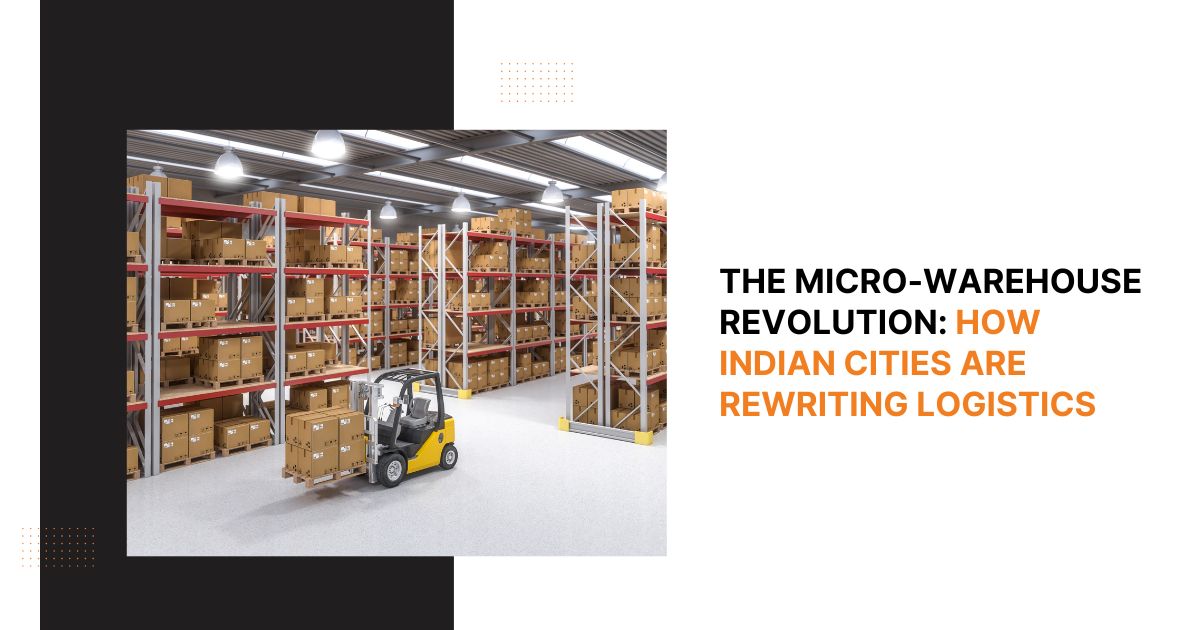
As India’s cities grow and its shoppers increasingly demand instant gratification, the logistics playbook is changing fast. Those massive, centralized warehouses on the outskirts of towns, the supply chain mainstay for decades, are no longer enough. In their place, a quiet revolution is underway: the rise of the urban micro-warehouse.
Why Micro-Warehouses Are Becoming Essential
Urban lifestyles demand speed: For customers in today’s India, it is fast-moving orders, same-day delivery, or even delivery within a few hours. The traditional warehouse, set up 25-40 km outside of city cores, cannot hope to manage such turnaround times, especially with city congestion. Similarly, micro-warehouses within a few kilometers of consumers greatly reduce last-mile distance.
Real estate and cost pressures in cities: As urban real estate costs go up, it is rarely practical to operate large-format warehouses inside the limits of a city. Micro-warehouses are far more practical-usually 2,000 to 10,000 sq ft-allowing warehouses to scale discretely and adapt to demand.
Multi-channel retail requires distributed inventory: New-age retailers are balancing e-commerce, quick commerce, physical retail, B2B orders, and D2C shipments. A single central warehouse cannot serve all channels with efficiency. Distributed micro-warehouses give flexibility to do faster last-mile delivery, restocking, and channel-specific dispatch.
What’s Different Inside a Micro-Warehouse
Operating a micro-warehouse is not simply a small version of a large warehouse; rather, it’s a very different operational model:
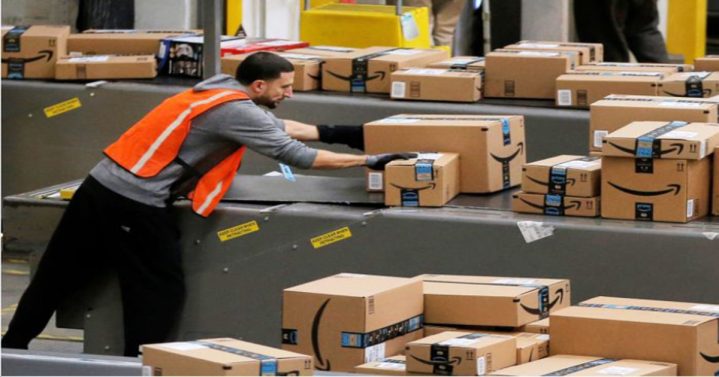
- Instead of bulk storage and infrequent large shipments, micro-warehouses put the focus on flow efficiency: high SKU turnover, rapid picking & packing, frequent inbound and outbound movements, and tight manpower/route scheduling.
- Technology-real-time inventory management, route optimization, AI/ML forecasting, and smart slotting-becomes critical. These are tools which guarantee high in-stock rates, reduce delays, and optimize order fulfillment in high-congestion city environments.
Advantages: Why Brands and Consumers Both Win
Faster delivery means happier customers: With inventory closer to demand centers, items can reach customers in a matter of hours-and sometimes in under 30 minutes-especially for quick commerce or essential goods.
Lower transportation and inventory costs: Shorter routes reduce fuel and labor costs, while smaller warehouses lower overhead and allow businesses to manage stock levels more effectively.
Flexibility & Agility: Micro-warehousing will enable brands to respond promptly to changing demand, localize inventory for specific neighborhoods, and facilitate multiple sales channels without any significant investment in large facilities.
Challenges Within the Indian Urban Context
Of course, micro-warehouses come with their own set of challenges:
- Infrastructure bottlenecks in the cities: Most Indian cities, especially the older ones, have narrow lanes, unpredictable traffic, irregular loading/unloading zones, and lack space for delivery vehicles. Such complications attend consistent fulfillment operations.
- Need for skilled manpower: Efficient micro-warehousing operation necessitates well-trained pickers, packers, supervisors, and riders-personnel accustomed to quick turnarounds and high volume dispatches. In many cities, talent availability remains a challenge.
- Inventory management and forecasting complexity: Distributing inventory across multiple micro-nodes increases the risk of stockouts or overstock. Without strong demand forecasting and replenishment systems, costs and inefficiencies can creep in.
- Real estate vs. rental cost tradeoffs: while small warehouses are cheaper than large ones, the former often command a much higher per-sqft rental price – especially in high-demand neighbourhoods – which drives up per-order costs as throughput is low.
What It Means for Indian Cities and Businesses
The move toward micro-warehouses presages a shift in how city supply chains will function. Over the next few years:
- Expect distributed, city-wide warehouse networks, not just a few large ones at the fringes. Businesses, especially retail, e-commerce, FMCG, grocery, and quick commerce, will need to revamp their logistics strategies-emphasizing speed and responsiveness over the storage capacity alone.
- Technology & data systems-inventory management, demand forecasting, routing, rider scheduling-will be foundational for logistics rather than optional upgrades.
- To customers, this means quicker deliveries, greater product availability-even for perishable and urgent items-and enhanced service reliability.
Conclusion:
The rise of urban micro-warehouses is more than just a logistics upgrade; it is a paradigm shift. With continued growth in Indian cities, both in headcount and consumption, micro-warehousing affords an opportunity to meet consumer expectations without buckling under infrastructure constraints. For businesses that adapt quickly, this isn’t just a convenience play; it’s a competitive advantage. In other words, the future of Indian urban logistics is not in bigger warehouses, but in smarter, smaller, faster fulfilment nodes spread across the city.