
Shipping commercial cargo from the UAE to India involves more than arranging transportation between two countries. Businesses also need to consider cargo preparation, documentation, export procedures, freight selection, Indian customs clearance, and final delivery.
Whether you are importing products for resale, sending machinery to an Indian facility, replenishing warehouse stock, or moving commercial goods between business locations, choosing the right logistics process can help avoid unneeded delays and unexpected costs.
This guide explains how to ship commercial cargo from the UAE to India, what documents you may need, how to choose between sea and air freight, how customs clearance works, and what businesses should check before dispatching their cargo.
For a broader overview of UAE–India shipping options, costs, transit times, documentation and customs, see our complete guide to shipping from UAE to India.
What Is Commercial Cargo?
Commercial cargo generally refers to goods being transported as part of a business transaction or commercial activity.
Examples include:
- Products imported for resale
- Wholesale goods
- Retail inventory
- Industrial equipment
- Machinery
- Spare parts
- Electronics
- Furniture
- Construction materials
- E-commerce inventory
- Manufacturing components
- Business equipment
Commercial shipments differ from personal shipments because they may require extra documentation, customs declarations, and import compliance.
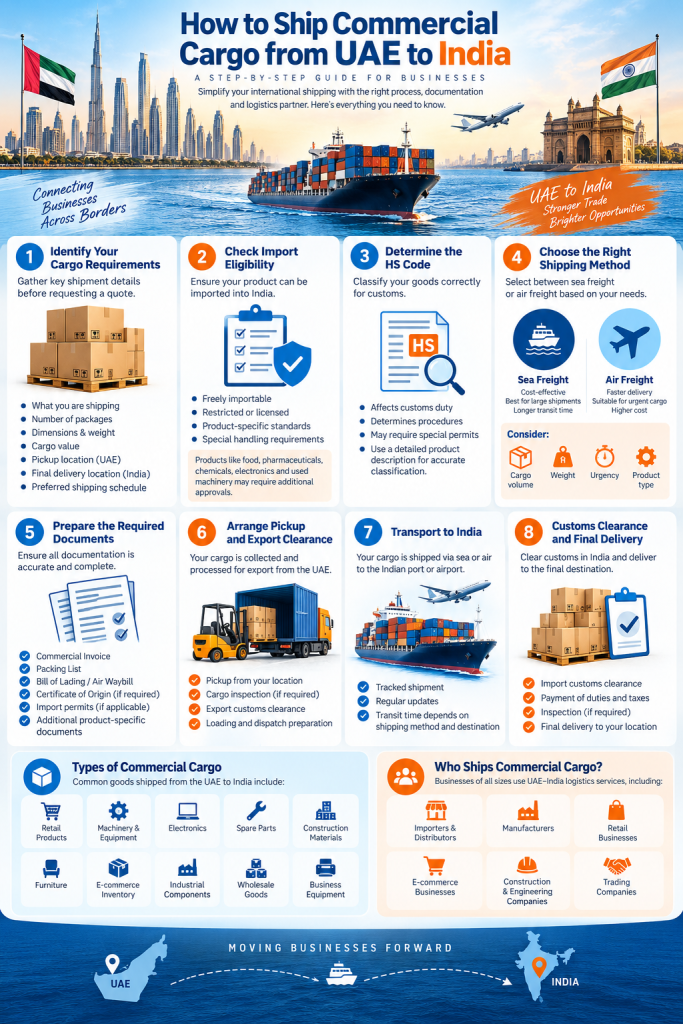
Who Ships Commercial Cargo from the UAE to India?
Businesses of many sizes use UAE–India logistics services.
Common examples include:
Importers and Distributors
Companies may source products from the UAE and distribute them through Indian warehouses, retailers, or dealers.
Manufacturers
Manufacturers may move machinery, components, or raw materials to Indian production facilities.
Retail Businesses
Retailers can import inventory from UAE suppliers or distribution centers.
E-commerce Businesses
Online sellers may move stock from UAE warehouses to India for local fulfillment.
Construction and Engineering Companies
Large equipment and machinery may need specialized freight arrangements.
Trading Companies
UAE-based trading companies frequently ship commercial products to Indian customers and business partners.
Step 1: Identify Your Cargo Requirements
Before contacting a freight forwarder, gather basic shipment information.
You should know:
- What you are shipping
- Number of packages
- Package dimensions
- Gross weight
- Cargo value
- Pickup location in the UAE
- Final delivery location in India
- Preferred shipping schedule
For example, instead of requesting:
“I need to send some products from Dubai to India.”
provide:
“We have 10 cartons, each measuring [dimensions], total gross weight [weight], containing , to be delivered to [location] in India.”
This gives the logistics provider enough information to evaluate the shipment properly.
Step 2: Check Whether the Product Can Be Imported
Not every product can be treated in the same way.
Before shipping, businesses should check whether the goods are:
- Freely importable
- Restricted
- Subject to licensing
- Subject to product-specific standards
- Subject to extra documentation
- Subject to special handling requirements
Certain product categories may have additional regulatory requirements in India.
Examples can include:
- Food products
- Pharmaceuticals
- Chemicals
- Electronics
- Medical equipment
- Cosmetics
- Agricultural products
- Used machinery
- Batteries
- Hazardous materials
The requirements depend on the specific product and applicable Indian regulations.
Do not dispatch commercial cargo until you understand the applicable import requirements.
Step 3: Determine the HS Code
The Harmonized System (HS) code classifies goods for customs purposes.
Correct classification is important because it can affect:
- Customs duty
- Import procedures
- Required documents
- Regulatory requirements
- Applicable restrictions and authorizations
The product name alone may not be enough to determine the correct classification.
For example, “machine,” “electronic equipment,” or “plastic product” may be too broad to classify a particular item accurately.
Businesses should provide a clear product description and verify the appropriate classification before shipment.
Step 4: Choose the Right Shipping Method
Commercial cargo from the UAE to India can generally be transported by sea freight or air freight.
The decision should be based on:
- Cargo volume
- Weight
- Urgency
- Product type
- Budget
- Destination
- Required delivery date
Sea Freight
Sea freight is generally suitable for:
- Large shipments
- Heavy cargo
- Machinery
- Bulk inventory
- Non-urgent commercial goods
Firms can choose between:
FCL — Full Container Load
and
LCL — Less than Container Load
FCL
FCL means booking a complete container for the shipment.
It suits larger volumes or cargo that benefits from dedicated container space.
LCL
LCL allows smaller shipments to share container space with other cargo.
It can be useful when your shipment does not justify a full container.
Air Freight
Consider air freight when delivery speed matters more than transportation cost.
It can be suitable for:
- Urgent inventory
- Small commercial shipments
- Spare parts
- Samples
- High-value products
- Time-sensitive goods
For a business facing a production delay because a critical spare part is unavailable, the additional cost of air freight may be justified by the time saved.
Step 5: Prepare the Commercial Invoice
The commercial invoice is a key document used in international trade.
It provides information about the transaction and the goods being shipped.
Depending on the shipment, it may contain information such as:
- Seller
- Buyer
- Product description
- Quantity
- Unit price
- Total value
- Currency
- Country of origin
- Applicable trade information
- Shipping terms
The invoice should accurately represent the actual commercial transaction.
Avoid vague product descriptions or inconsistent values.
Step 6: Prepare the Packing List
The packing list provides details about how the cargo is packed.
It may include:
- Number of packages
- Package type
- Weight
- Dimensions
- Contents
- Package identification
For larger commercial shipments, an accurate packing list can simplify cargo handling and customs handling.
The information must match the commercial invoice and physical shipment.
Step 7: Arrange Cargo Pickup in the UAE
Once the shipment is ready, pickup can be arranged from locations such as:
- Dubai
- Abu Dhabi
- Sharjah
- Ajman
- Other UAE locations
The pickup requirements depend on the cargo.
For example, heavy machinery may require a truck with suitable loading capacity, while palletized cartons can normally be handled using standard freight transportation equipment.
Before pickup, confirm:
- Pickup address
- Loading time
- Number of packages
- Cargo dimensions
- Weight
- Loading equipment requirements
- Contact person
Step 8: Complete UAE Export Procedures
Commercial cargo leaving the UAE must follow the applicable export procedures.
The freight forwarder can coordinate the relevant transportation and paperwork requirements based on the shipment.
Accurate documentation at the UAE origin helps reduce avoidable problems later in the shipping process.
Step 9: International Transportation
Once export procedures and origin handling are completed, the cargo is transported to India.
The transportation method may be:
Sea freight
or
Air freight
For sea shipments, the cargo may move as FCL or LCL depending on the shipment.
For air freight, the shipment is transported through the applicable cargo network.
Transit time depends on the specific route, carrier schedule, destination, and operational circumstances.
Step 10: Indian Customs Clearance
Once the cargo arrives in India, it must undergo the applicable import customs procedures.
Customs authorities may examine information including:
- Importer details
- Product description
- HS classification
- Quantity
- Declared value
- Country of origin
- Applicable duties
- Required approvals
Certain shipments may require additional inspection or records.
Accurate information matters
If the physical cargo does not match the documentation, customs clearance can become more complicated.
Typical problems include:
- Incorrect quantity
- Incorrect product description
- Incorrect valuation
- Incorrect HS classification
- Missing documents
- Inconsistent information between documents
Preparing the shipment correctly before dispatch can help prevent these problems.
Step 11: Pay Applicable Duties and Taxes
Commercial imports may be subject to customs duties and other applicable taxes or charges.
The amount depends on the product and the applicable Indian regulations.
Factors can include:
- HS classification
- Customs value
- Country of origin
- Product category
- Applicable exemptions or concessions
- Import regulations
Businesses should estimate import costs before shipping rather than discovering them after the cargo arrives.
Step 12: Final Delivery in India
After the applicable customs process is completed and the shipment is released, the cargo can be transported to its final destination.
The final destination could be:
- Warehouse
- Factory
- Retail store
- Office
- Distribution centre
- E-commerce fulfillment facility
- Customer location
Firms can choose a logistics arrangement that covers only international transportation or an end-to-end solution that includes final delivery.
What Documents Are Required?
The exact documentation depends on the cargo and transaction.
Common documents can include:
- Commercial Invoice
- Packing List
- Bill of Lading for sea freight
- Air Waybill for air freight
- Certificate of Origin, where applicable
- Purchase Order
- Import-related documents
- Product-specific certificates
- Insurance documents, where applicable
Some products may require additional licenses, certificates, or regulatory approvals.
A freight forwarder can help identify the documentation required for the specific shipment, but the importer should also ensure that the information is accurate and complete.
How Much Does It Cost to Ship Commercial Cargo from UAE to India?
Commercial shipping costs differ considerably from one shipment to another.
The quotation may depend on:
Cargo volume
Important for sea freight, particularly LCL shipments.
Cargo weight
Especially relevant to air freight and heavy cargo.
Shipping method
Sea freight and air freight have different cost frameworks.
Origin
Pickup distance and location within the UAE can affect the cost.
Destination
Delivery location in India affects inland transportation.
Cargo type
Specialized or sensitive cargo may require additional handling.
Customs and destination services
Clearance, handling, and local delivery may add to the overall landed cost.
Packaging
Special packaging or crating can increase the shipment cost.
What Is the Cheapest Way to Ship Commercial Cargo?
No single option is cheapest for every shipment.
For a large, non-urgent shipment, sea freight may provide better value than air freight.
For smaller shipments, LCL can avoid the cost of booking an entire container.
For urgent shipments, air freight may cost more but can reduce the financial impact of delayed inventory.
Instead of asking only:
“What is the cheapest freight rate?”
businesses should ask:
“What is the lowest total cost for getting this cargo delivered safely and on time?”
This includes freight, handling, customs-related charges, delivery, and other applicable costs.
How Long Does Commercial Shipping from UAE to India Take?
The overall delivery timetable depends on:
- Shipping method
- Origin location
- Indian destination
- Carrier
- Sailing or flight schedule
- Documentation
- Customs clearance
- Cargo handling
- Final delivery
Sea freight generally takes longer than air freight.
However, the quoted international transit time should not be treated as the complete door-to-door delivery period.
Allow time for:
Pickup + export processing + origin handling + international transportation + customs clearance + destination delivery
A freight forwarder should provide an predicted timeline based on the actual origin, destination, and cargo requirements.
How to Eliminate Delays When Shipping Commercial Cargo
- Prepare documents before pickup
Don’t wait until the cargo reaches the port or airport.
- Use accurate product descriptions
Avoid vague descriptions that don’t clearly identify the goods.
- Verify quantities and dimensions
Make sure the physical cargo corresponds to the paperwork.
- Check import requirements
Identify licenses, approvals, or certificates before dispatch.
- Confirm the HS classification
Incorrect classification can lead to customs queries.
- Choose suitable packaging
Cargo should withstand transportation and handling.
- Plan ahead
Last-minute shipments can limit your transportation options.
Common Mistakes When Shipping Commercial Cargo from UAE to India
Mistake 1: Choosing a Freight Method Based Only on Price
The cheapest freight rate may not provide the lowest total cost.
Mistake 2: Giving Incomplete Cargo Details
Missing dimensions or incorrect weights can lead to revised quotations.
Mistake 3: Ignoring Indian Import Requirements
A product that is easy to export from the UAE may still have specific requirements when imported into India.
Mistake 4: Underestimating Destination Charges
Ask whether the quote includes destination handling, customs clearance, and final delivery.
Mistake 5: Incorrect Documentation
Small inconsistencies can create unnecessary questions during customs inspection.
Mistake 6: Leaving Shipping Until the Last Minute
Urgent shipping can cost significantly more when there is limited time to compare options.
How Businesses Can Cut Commercial Shipping Costs
Consolidate Shipments
Where practical, combine smaller shipments into a larger planned shipment.
Compare LCL and FCL
Once your cargo volume increases, FCL may become more competitive.
Plan Inventory Replenishment
Regular businesses are able to create shipping schedules instead of relying on emergency shipments.
Optimize Packaging
Reduce unnecessary volume without jeopardizing cargo protection.
Compare Door-to-Door and Port-to-Port Options
The right choice depends on whether your business has its own logistics capability at the destination.
Work With an Experienced Freight Forwarder
A freight forwarder can help coordinate multiple stages of the shipment and identify suitable transportation options.
When Should You Use a Freight Forwarder?
A freight forwarder can be particularly useful when:
- You are shipping internationally for the first time.
- Your cargo is large or complex.
- You regularly import commercial goods.
- You need customs coordination.
- You require door-to-door delivery.
- You are shipping machinery or project cargo.
- You don’t have an internal logistics department.
Instead of coordinating separate providers for pickup, international transportation, customs, and final delivery, a freight forwarder can manage multiple parts of the logistics process.
UAE to India Commercial Shipping: A Simple Example
Imagine a Dubai-based distributor needs to send several pallets of commercial products to a warehouse in India.
If your shipment is specifically originating in Dubai, see our detailed guide to shipping from Dubai to India, including costs, transit times and the shipping process.
The business would typically:
- Measure and weigh the cargo
↓
- Provide cargo details to the freight forwarder
↓
- Compare LCL, FCL, or air freight
↓
- Confirm the quotation and service scope
↓
- Prepare the invoice and packing list
↓
- Arrange pickup from Dubai
↓
- Complete export procedures
↓
- Transport the cargo to India
↓
- Complete Indian customs clearance
↓
- Arrange final delivery to the warehouse
This is why international shipping should be planned as an end-to-end process, not simply as booking a container or flight.
Why Choose DDU Express for Commercial Cargo?
DDU Express provides freight forwarding and logistics solutions for businesses moving cargo internationally.
Depending on your requirements, services can include:
- Sea Freight
- Air Freight
- Freight Forwarding
- Customs Clearance
- Warehousing
- Project Cargo
- E-commerce Logistics
- Door-to-Door Logistics
For businesses shipping commercial cargo from the UAE to India, DDU Express can help coordinate the logistics process based on the cargo type, shipment volume, destination, and required delivery timeline.
Whether you are shipping cartons, pallets, a full container, machinery, or specialized commercial cargo, the right solution starts with understanding the shipment requirements.
Planning to ship commercial cargo from the UAE to India?
Contact DDU Express with your cargo details and destination to discuss the most suitable freight solution.
Frequently Asked Questions
How do I ship commercial cargo from UAE to India?
You can ship commercial cargo by sea or air freight. The process generally involves cargo preparation, documentation, UAE export procedures, international transportation, Indian customs clearance, and final delivery.
What is the best way to ship commercial goods from UAE to India?
It depends on the cargo. Sea freight is generally suitable for larger or less urgent shipments, while air freight works well for urgent or smaller consignments.
Can I ship commercial cargo from Dubai to India?
Yes. You can ship commercial goods from Dubai to India, provided the shipment meets the applicable UAE export and Indian import requirements.
What documents are needed for commercial shipping from UAE to India?
Depending on the shipment, documents can include a commercial invoice, packing list, bill of lading or air waybill, certificate of origin, and product-specific documentation.
Is customs clearance required?
Commercial imports generally need to undergo the applicable Indian customs procedures before the goods can be released.
Can I ship machinery from UAE to India?
Yes. Machinery can be shipped by sea or air depending on its size, weight, urgency, and handling requirements. Large machinery may require specialized transportation and securing.
Is LCL suitable for commercial cargo?
Yes. LCL can be useful when the shipment does not require a full container. The carrier consolidates cargo with shipments from other businesses.
When should I choose FCL?
FCL is suitable when your cargo volume is large enough to justify a dedicated container or when you prefer dedicated container space.
How can I get an accurate shipping quotation?
Provide the pickup location, Indian destination, cargo description, number of packages, dimensions, gross weight, and cargo value. Also specify whether you require sea freight, air freight, or door-to-door service.
Can a freight forwarder arrange door-to-door delivery?
Yes. Depending on the service, a freight forwarder can coordinate pickup in the UAE, international transportation, customs clearance, and delivery to the final destination in India.
Conclusion
Shipping commercial cargo from the UAE to India becomes much easier when you plan the shipment before the goods leave the UAE.
Start by understanding your cargo, checking the applicable import requirements, preparing accurate documentation, and selecting the right transportation method. For larger shipments, sea freight and FCL or LCL options can provide practical solutions. For urgent cargo, air freight may be more appropriate.
Most importantly, don’t compare freight rates alone. Consider the complete logistics cost, delivery timeline, customs requirements, and final destination.
With the right freight forwarding partner, businesses can coordinate the journey from UAE pickup to Indian delivery more efficiently and reduce the risk of avoidable delays.
Need help shipping commercial cargo from UAE to India? Contact DDU Express for a tailored freight forwarding solution.

Weiworld is an experienced logistics and shipping professional with more than 20 years of industry experience, with extensive knowledge of international shipping, freight forwarding, cargo movement, and logistics operations.
Over the course of his career, he has developed deep practical expertise in Middle East logistics and operations, including shipping processes, international cargo transportation, customs-related procedures, and supply chain coordination.
At DDU Express, Weiworld shares practical insights and industry knowledge to help businesses better understand international shipping, freight forwarding, DDP services, cargo transportation, and logistics solutions across the Middle East and global markets.
His extensive industry experience provides valuable perspective for businesses looking to simplify international shipping and make informed decisions when moving cargo between countries.