For businesses that need to move large amounts of goods, machinery, inventory and other non-urgent cargo from Dubai to India by sea, shipping is a sensible choice.
Sea freight is one of the most practical options for businesses moving larger or regular shipments between the UAE and India. If you’re comparing the available shipping methods, documentation, customs requirements and delivery options, our complete guide to shipping from UAE to India provides a broader overview.
Sea freight is usually chosen over air freight when the volume of the shipment is large and when the speed of delivery is not important. The companies can select between FCL (Full Container Load) and LCL (Less than Container Load) according to the size and characteristics of the shipment.
Booking ocean freight is only one element of the process; businesses must also take into account cargo preparation, the necessary documentation, the UAE export procedures, port handling, clearance by Indian customs, and the final delivery.
The guide outlines the way in which sea freight from Dubai to India operates, when it is appropriate to select FCL or LCL, what documents might be needed, the factors that influence shipping costs, and how businesses can more efficiently plan their shipments.
What is the sea freight from Dubai to India?
Sea freight from Dubai to India refers to shipping goods by vessel from cargo facilities in Dubai or the UAE to a port in India, after which customs clearance is obtained and the goods are delivered to their final destination.
It can be suitable for:
● Commercial inventory
● Wholesale goods
● Retail products
● Machinery and equipment
● Industrial components
● Construction materials
● Furniture
● Spare parts
● E-commerce inventory
● Manufacturing materials
● Large or heavy shipments
The shipping arrangement that is actually used will vary according to the type of cargo, its volume and weight, the place of origin, the place of destination, the required delivery time and the applicable regulations.
For businesses which are sending smaller or more urgent consignments, air freight from Dubai to India might be the more suitable option.
What is the reason for selecting sea freight from Dubai to India?
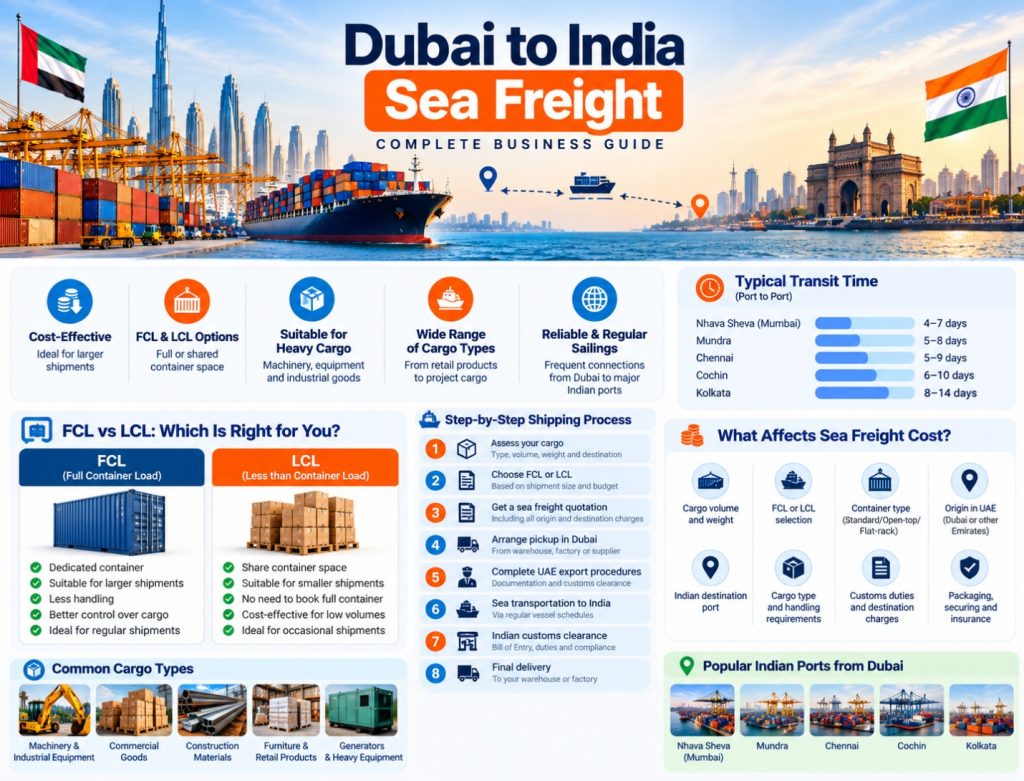
Sea freight is especially useful in the case where the goods are too large, heavy, or otherwise too costly to send by air. For example, a company which imports industrial machinery or large amounts of retail goods from Dubai to India might find that shipping by sea is more cost-effective and practical than using air transport because of the size and weight of the cargo as well as the more flexible cost structure.
- Suitable for larger shipments
Companies that are shipping pallets, several cartons, or cargo in container size may choose sea freight rather than paying the higher transportation costs that are linked with air freight. - FCL and LCL options
It is not necessary for businesses to fill a whole container.
Depending on cargo volume, they can choose:
● FCL — dedicated container
● LCL — shared container space - Suitable for heavy cargo
Machinery, industrial equipment, and other heavy articles are generally more appropriate for being transported by sea, depending on the way the goods are handled and the requirements of the cargo. - Useful for planned inventory movements
Companies which regularly restock Indian warehouses or distribution centres can schedule their sea shipments according to their inventory needs rather than having to depend on urgent transport. - Supports different cargo types
Sea freight can handle a wide variety of commercial cargo, though cargo that is restricted, hazardous, oversized or specialised may necessitate extra approvals, equipment or handling arrangements.
How is sea freight from Dubai to India carried out?
Most shipments include a number of stages.
Step 1: Assess the cargo
Before requesting a quotation, prepare:
● Cargo description
● Number of packages
● Dimensions
● Gross weight
● Cargo value
● Pickup location
● Indian delivery location
● Preferred delivery schedule
Having accurate cargo information enables the freight forwarder to select the appropriate shipping method and to estimate the total logistics requirements.
Step 2: Choose FCL or LCL
Then you need to decide if the cargo should be shipped as FCL or LCL.
FCL refers to the situation where a dedicated container is used for the shipment.
LCL refers to cargo coming from various shippers being combined into one container.
The decision between using FCL and LCL should be based on the volume of the cargo, the related costs, the handling requirements, and the desired shipment schedule. For instance, a business sending a large amount of goods which completely fills a container might discover that FCL is more economical and secure since it provides dedicated space and reduces the need for handling. On the other hand, a company with a smaller shipment could benefit from choosing LCL, as it enables the cargo to be consolidated with those of other consignments and thus leads to lower costs, even though it does involve extra handling and longer processing times. Hence, the choice should be made after a thorough evaluation of these factors in light of the particular shipping situation.
Step 3: Request a sea freight quotation
A freight quotation may consider:
● Origin pickup
● Ocean freight
● Container type
● LCL consolidation, where applicable
● Export documentation
● Origin handling
● Port charges
● Destination charges
● Customs clearance
● Indian inland transportation
● Final delivery
● Special cargo requirements
Which is why looking at only the ocean freight rate will not reveal the full shipping cost.
What is better for shipping from Dubai to India, FCL or LCL?
FCL — Full Container Load
A business arranges for a container when using FCL to carry its cargo.
It can be suitable when:
● Cargo volume is relatively large
● The shipment requires dedicated container space
● The cargo needs reduced handling
● A business regularly ships substantial quantities
● The shipment can justify a full container
Common container options include standard dry containers. Other equipment is available, depending on cargo needs.
Advantages of FCL
● Dedicated container
● Fewer consolidation points
● Suitable for larger shipments
● Better control over container loading
● Useful for regular commercial shipments
LCL — Less than Container Load
LCL enables small consignments to share the space in a container with goods from other companies.
It works for shipments that do not need a full container.
Typical LCL cargo can include:
● Cartons
● Pallets
● Small commercial consignments
● Spare parts
● Retail inventory
● E-commerce stock
Advantages of LCL
● No need to book an entire container
● Suitable for smaller volumes
● Can be useful for businesses with less frequent shipments
● Lets businesses to move cargo without waiting to accumulate a full container
Since LCL requires consolidation and deconsolidation, the entire process may involve a greater amount of handling than in the case of a dedicated FCL shipment.
What documentation is needed when shipping by sea from Dubai to India?
The documentation required depends on the type of cargo, the transaction and the relevant regulations.
When importing goods into India the DGFT considers a number of documents as essential, such as the Bill of Lading, the Commercial Invoice together with the Packing List and the Bill of Entry. However, in the case of restricted or product-specific goods extra documents may be required.
Common documents may include:
● Commercial invoice
● Packing list
● Bill of Lading
● Certificate of Origin, where applicable
● Import-related documents
● Product-specific certificates
● Insurance documents, where applicable
● Purchase order or commercial transaction documents
Before shipping, make sure that the documentation is accurate, particularly when it comes to regulated products.
HS Codes and Product Classification
Before sending commercial cargo to India, companies should become aware of the correct HS classification for their products.
The HS code can affect:
● Customs procedures
● Applicable duties
● Import restrictions
● Required documentation
● Regulatory requirements
An explanation such as “machine”, “electronic item”, or “equipment” might not contain enough details to allow for proper classification.
Before sending out the goods, businesses must clearly describe them and check that the correct classification applies.
Dubai Export Procedures Before the Shipment
Before any cargo leaves the UAE, it has to go through the relevant export procedures.
The specific requirements will vary according to the nature of the cargo, the exporter, and the way in which it is being shipped.
The freight forwarder may coordinate:
- Cargo pickup
- Export documentation
- Customs procedures
- Container arrangements
- Port handling
- Shipping instructions
- Vessel booking
- Container gate-in
- International transportation
With regard to exports by container, shipping companies may also have particular requirements and deadlines concerning the shipping instructions, the verified gross mass and the container gate-in.
How long does sea freight from Dubai to India take?
There is no one transit time for every shipment from Dubai to India.
The overall delivery time frame can depend on:
● Indian destination port
● Shipping line
● Vessel schedule
● Transhipment requirements
● FCL or LCL
● Cargo readiness
● Export processing
● Port handling
● Customs clearance
● Final delivery location
More importantly, the time taken for ocean transport is not equal to the total door-to-door delivery time.
A business should consider:
Pickup → Export processing → Port handling → Ocean transportation → Indian port handling → Customs clearance → Inland delivery
Hence, when planning their inventory, companies should ask the freight forwarder for an estimated total timeline rather than merely considering the vessel’s sailing time.
What influences the sea freight cost from Dubai to India?
The cost of sea freight differs from shipment to shipment.
Important factors include:
Cargo volume
For LCL the cargo dimensions and cubic volume can have a great effect on the quotation.
Cargo weight
Weight is particularly important in the case of heavy cargo and in certain types of transport arrangements.
FCL or LCL
The prices vary depending on whether the shipment is full container or consolidated.
Container type
Standard cargo may use standard equipment. Specialised cargo may need different equipment.
Origin location
The cost of inland transportation may be influenced by the pickup location being in different parts of Dubai or the UAE.
Destination
The total logistics costs depend on the Indian port and the place where the final delivery is made.
Cargo type
Cargo which is hazardous, fragile, oversized or special may need extra handling.
Customs and destination charges
The total cost when the goods arrive can consist of charges relating to customs, handling at the destination and inland transport.
Packaging
Although special packing, palletisation, or crating may lead to a higher total cost, they could still be necessary for the purpose of protecting the cargo.
Is sea freight cheaper than air freight?
Sea freight is often more economical than air freight when it comes to large and non-urgent commercial shipments.
It does not follow that the cheapest method of transport will always have the lowest total logistics cost.
For example, a business should consider:
Freight + handling + customs + delivery + inventory carrying cost + time
A shipment which is cheaper to transport but takes much longer to arrive might not be the best choice when it comes to inventory that is time-sensitive.
In the case of urgent deliveries, the higher transportation cost of air freight can be justified on the grounds of the shorter delivery time.
Dubai to India Sea Freight: Port-to-Port vs Door-to-Door
Enterprises can arrange sea freight in different ways.
Port-to-port
The freight forwarder handles transportation between the origin and destination ports, while the customer may arrange some additional services.
This suits businesses with their own logistics arrangements at one or both ends.
Door-to-door
A door-to-door solution can cover more stages of the shipment, such as:
Dubai pickup → Export → Sea freight → Indian customs → Final delivery
This can simplify coordination for businesses that don’t have logistics teams or transport arrangements at the destination.
Shipping Machinery from Dubai to India by Sea
Sea freight can suit machinery and industrial equipment, especially when cargo is heavy or oversized.
Before booking, provide:
● Machinery dimensions
● Weight
● Number of pieces
● Centre of gravity, where relevant
● Loading requirements
● Packaging details
● Pickup location
● Final destination
Large or specialised machinery may require:
● Special equipment
● Suitable container or breakbulk arrangement
● Lashing and securing
● Heavy-duty transportation
● Crane or lifting arrangements
● Route planning
Select the shipping method based on the actual dimensions and handling requirements, not just the cargo description.
How to Prepare Cargo for Sea Freight
Proper preparation can reduce avoidable problems during transportation.
Before pickup:
- Check the packaging
Make sure the cargo is suitable for handling and sea transportation. - Confirm dimensions and weight.
Use accurate measurements rather than estimates. - Prepare documents
Make sure the commercial invoice and packing list match the physical shipment. - Check the HS code
Confirm the applicable classification before shipping. - Check import requirements
Some products may require licences, certificates, approvals or other conformity measures. - Confirm loading requirements
Heavy or unusual cargo may require special loading equipment. - Plan the delivery
Know where the cargo will be delivered after customs clearance.
Common Mistakes in Dubai to India Sea Freight
Choosing FCL or LCL based only on price
The cheapest initial quote may not be the best option once you factor in handling and destination charges.
Providing incorrect dimensions
Incorrect measurements can result in revised quotations or operational problems.
Using vague cargo descriptions
Clear product descriptions help with documentation and customs formalities.
Ignoring destination charges
Ask whether the quotation includes destination handling, customs clearance and inland delivery.
Waiting until the last minute
Limited planning can reduce available sailing and transportation options.
Not checking import requirements.
A product that can leave the UAE may still be subject to specific Indian import requirements.
Dubai to India Sea Freight for E-Commerce Businesses
E-commerce businesses could use sea freight to move larger quantities of inventory from Dubai to India.
For example, a business may consolidate products in Dubai and ship inventory to an Indian warehouse or fulfilment facility.
Sea freight can be considered for:
● Bulk inventory
● Seasonal stock
● Product replenishment
● Wholesale e-commerce inventory
● Non-urgent products
For urgent stock replenishment, businesses may consider air freight instead.
The best method depends on inventory requirements, product value, delivery schedule, and available storage.
How to Choose a Freight Forwarder for Dubai to India Sea Freight
A freight forwarder can coordinate multiple stages of an international shipment.
When comparing providers, ask:
● Do they handle both FCL and LCL?
● Can they arrange pickup from Dubai?
● Do they coordinate export procedures?
● Can they handle Indian customs clearance?
● Can they arrange final delivery?
● Can they handle machinery or specialised cargo?
● Are destination charges clearly explained?
● Can they provide shipment tracking or status updates?
● Can they explain the complete cost rather than only the ocean freight rate?
Good quotations should make clear the range of services so that businesses will know which ones are included and which ones are charged separately.
Dubai to India Sea Freight: Simple Process
The process can be summarised as:
- Assess cargo
↓ - Check import requirements
↓ - Confirm HS classification
↓ - Choose FCL or LCL
↓ - Request quotation
↓ - Prepare documents
↓ - Arrange Dubai pickup
↓ - Complete UAE export procedures.
↓ - Load and ship cargo
↓ - Indian customs clearance
↓ - Pay applicable duties and charges.
↓ - Final delivery
Why Businesses Use DDU Express for Dubai to India Sea Freight
DDU Express provides freight forwarding and logistics services for businesses moving cargo internationally.
Depending on the shipment requirements, services can include:
● Sea freight
● FCL and LCL shipping
● Freight forwarding
● Customs clearance
● Door-to-door logistics
● Warehousing
● Project cargo
● E-commerce logistics
For businesses shipping from Dubai to India, the right solution depends on cargo type, volume, destination, required delivery period, and service scope.
If you are shipping commercial goods from the UAE, our guide on how to ship commercial cargo from UAE to India covers the complete process, including cargo preparation, documentation, freight selection, customs clearance and final delivery.Planning a sea freight shipment from Dubai to India? Share your cargo details, pickup location and Indian destination with DDU Express to discuss the available shipping options.
Frequently Asked Questions
Is sea freight from Dubai to India suitable for commercial cargo?
Yes. Sea freight can suit larger, heavier, or non-urgent commercial shipments, including inventory, machinery, industrial goods, and wholesale products.
What is the difference between FCL and LCL?
FCL uses a dedicated container for one shipment, while LCL combines smaller shipments from multiple businesses in one container.
How much does sea freight from Dubai to India cost?
The cost relies on factors such as cargo volume, weight, FCL/LCL selection, origin, Indian destination, container requirements, handling, customs and final delivery.
How long does Dubai to India sea freight take?
Total delivery time depends on the route, vessel schedule, destination, cargo type, port handling, customs clearance, and final delivery. Ask your freight forwarder for an end-to-end timeline rather than relying only on ocean transit time.
Can I ship machinery from Dubai to India by sea?
Yes. Machinery can often be transported by sea, but the appropriate shipping method and equipment depend on its dimensions, weight, handling requirements and destination.
What documents are required?
Common documents can include a commercial invoice, packing list, Bill of Lading and applicable import documentation. Specific products may require additional certificates or approvals.
Is LCL suitable for small shipments?
LCL can be suitable when the shipment does not require a complete container. The final choice depends on cargo volume, handling requirements and overall cost.
Can I get door-to-door delivery from Dubai to India?
Yes, depending on the service arrangement. A door-to-door solution can coordinate pickup, international transportation, customs clearance and final delivery.
Final Thoughts
Sea freight from Dubai to India can be a good choice for businesses that are transporting commercial cargo, especially in the case of a large volume of shipments and when the delivery does not have to be very time-sensitive.
The key is to look beyond the ocean freight rate.
Before shipping, confirm:
● Cargo specifications
● FCL or LCL requirement
● Documentation
● HS classification
● Import requirements
● Export procedures
● Customs
● Destination charges
● Final delivery arrangements
Planning these items before the cargo leaves Dubai can help businesses avoid avoidable delays and unexpected logistics costs.
Need to ship commercial cargo from Dubai to India? Contact DDU Express with your cargo details and destination for a freight quotation.

Weiworld is an experienced logistics and shipping professional with more than 20 years of industry experience, with extensive knowledge of international shipping, freight forwarding, cargo movement, and logistics operations.
Over the course of his career, he has developed deep practical expertise in Middle East logistics and operations, including shipping processes, international cargo transportation, customs-related procedures, and supply chain coordination.
At DDU Express, Weiworld shares practical insights and industry knowledge to help businesses better understand international shipping, freight forwarding, DDP services, cargo transportation, and logistics solutions across the Middle East and global markets.
His extensive industry experience provides valuable perspective for businesses looking to simplify international shipping and make informed decisions when moving cargo between countries.