For businesses engaged in importing products from China to the United Arab Emirates, selecting an appropriate shipping method requires careful consideration of delivery speed, cargo safety, and the total cost of logistics. Although sea freight remains a practical solution for larger shipments and bulk consignments, air freight provides a more expedient alternative for commercial cargo where timely delivery is a priority.
Air freight between China and the UAE is frequently utilised for the transportation of electronics, machinery components, product samples, medical supplies, fashion items, and other high-value goods. This mode of transport enables businesses to transfer shipments efficiently between principal Chinese manufacturing centres and logistics hubs in the UAE, thereby reducing the waiting times typically associated with ocean freight.
However, the decision to utilise air freight extends beyond a simple comparison of price per kilogram. Importers are advised to develop a comprehensive understanding of factors such as chargeable weight, airport handling procedures, customs clearance requirements, necessary documentation, and final delivery arrangements prior to confirming a shipment.
To help streamline the planning process, importers should consider the following key steps before booking air freight:
– Confirm the accurate cargo dimensions, weight, and packaging with your supplier.
– Gather all required shipping documents (such as commercial invoice, packing list, Air Waybill, and any necessary certificates or permits).
– Verify airline acceptance and any special handling or compliance requirements for your goods.
– Identify the most suitable origin and destination airports based on supplier location and delivery needs.
– Request a detailed quotation covering all charges, including freight, collection, handling, customs clearance, and final delivery.
– Check the estimated transit time and whether the quote covers airport-to-airport or door-to-door service.
– Clarify who will act as the importer of record for customs purposes.
Following this checklist can help ensure a smoother and more predictable air freight experience.
In this guide, we explain how air freight from China to the UAE works, its estimated transit times, cost factors, benefits and important considerations for businesses.
For a broader overview of available transportation methods, read our complete guide to shipping from China to UAE.
1. What Is Air Freight from China to UAE?
Air freight is the transportation of commercial goods by aircraft from an origin airport in China to a destination airport in the UAE.
Air freight is generally characterised by shorter transit times compared to sea freight, making it particularly suitable for businesses that require expedited receipt of products.
A typical air freight shipment involves:
- Collecting goods from the supplier or factory in China.
- Checking cargo dimensions, weight and packaging.
- Preparing export documentation.
- Booking available airline cargo capacity.
- Completing export customs procedures in China.
- Transporting the cargo by air to the UAE.
- Completing UAE import customs clearance.
- Arranging collection or final delivery.
The precise procedures involved are contingent upon the nature of the cargo, the airline’s operational schedule, the selected shipping service, and the applicable customs requirements.
2. When Should Businesses Choose Air Freight?
While air freight does not typically represent the most cost-effective transportation method, it may constitute a practical solution in circumstances where delivery speed is a critical consideration.
Businesses commonly choose air cargo for the following situations.
Urgent Stock Replenishment
Retailers and distributors may encounter situations where rapid inventory replenishment is necessary to prevent stock shortages. In such cases, air freight facilitates the expedited movement of essential products, thereby mitigating the risks associated with delayed ocean shipping.
Electronics and Electronic Components
Electronic accessories, computer components, certain devices, and other high-value products are frequently transported by air, provided that they comply with the relevant airline and import regulations.
Product Samples
Businesses seeking to evaluate products prior to committing to larger orders may utilise air freight to obtain samples promptly, thereby avoiding the extended lead times associated with sea freight shipments.
Machinery Spare Parts
In instances where critical machinery or production lines require replacement components, expedited transportation through air freight can play a significant role in minimising operational downtime.
High-Value Commercial Goods
Air freight is particularly appropriate for products where minimising transportation time, ensuring controlled handling, and reducing inventory holding periods are essential considerations.
Seasonal and Time-Sensitive Products
Businesses preparing for product launches, promotional campaigns, or periods of seasonal demand may employ air cargo services to ensure adherence to planned delivery schedules.
3. How Much Does Air Freight from China to UAE Cost?
The cost structure of air freight from China to the UAE is influenced by a range of factors, including shipment weight, package dimensions, cargo type, the selected origin and destination airports, and the availability of airline capacity.
In contrast to certain sea freight arrangements, standard air cargo pricing is typically determined based on chargeable weight rather than solely on the actual weight of the shipment.
What Is Chargeable Weight in Air Freight?
Airlines and freight forwarders generally compare:
- Actual weight: The physical gross weight of the shipment.
- Volumetric weight: The calculated weight based on the space occupied by the cargo.
The greater of these two values is generally adopted as the chargeable weight, in accordance with the carrier’s applicable rating rules.
A commonly used volumetric calculation is:
Volumetric Weight (kg) = Length × Width × Height (cm) ÷ 6000
The divisor utilised in volumetric calculations may vary depending on the carrier, the specific service, and the shipment arrangement. It is advisable to confirm the relevant calculation method prior to booking.
Example of Air Freight Chargeable Weight
Suppose a shipment contains 5 cartons with the following dimensions:
- Length: 60 cm
- Width: 50 cm
- Height: 40 cm
- Total actual weight: 100 kg
Total volume:
60 × 50 × 40 × 5 = 600,000 cubic centimetres
Volumetric weight:
600,000 ÷ 6000 = 100 kg
In this example:
- Actual weight: 100 kg
- Volumetric weight: 100 kg
- Chargeable weight: 100 kg
If the volumetric weight exceeds the actual weight, the higher value is typically applied for the purpose of freight calculation.
Main Factors Affecting Air Freight Costs
- Shipment Weight and Dimensions
Both gross weight and package dimensions influence the chargeable weight. Large, lightweight packages can attract higher charges because they occupy more aircraft cargo space.
- Origin Airport in China
The supplier’s location and the selected departure airport affect domestic collection, handling and transportation expenses.
- Destination Airport in UAE
The selection of the destination airport, as well as the final delivery location, influences both handling procedures and local transportation expenses.
- Airline Capacity and Seasonal Demand
Cargo rates are subject to fluctuation based on factors such as available aircraft capacity, prevailing fuel costs, peak shipping periods, and overall market demand.
- Cargo Type
Products that are fragile, temperature-sensitive, oversized, hazardous, or subject to regulatory controls may necessitate supplementary handling, specialised packaging, or additional documentation.
- Customs Clearance and Destination Charges
Import declarations, airport handling, inspection, storage, and other destination-related services can contribute to the overall cost of the shipment.
- Final Delivery Requirements
Airport-to-airport transportation and door-to-door delivery are different services. Collection from the airport and delivery to the consignee’s warehouse may involve additional charges.
What Information Is Needed for an Air Freight Quotation?
To receive an accurate quotation, provide:
- Supplier or pickup location in China.
- Product description.
- Number of cartons or packages.
- Gross weight of each package and total weight.
- Length, width and height of each package.
- Cargo readiness date.
- Destination airport or UAE delivery address.
- Any special handling or product compliance requirements.
- Preferred delivery timeframe.
Request a detailed quotation showing the freight rate, origin charges, destination charges, customs clearance and final delivery separately.
Important: Air freight rates fluctuate. A shipment-specific quotation is more reliable than a general online price estimate. The examples in this article explain the calculation method and are not guaranteed DDU Express rates.
Typical air freight costs (for reference only) for shipments from China to UAE are:
– 45–100 kg (small shipments): USD 6–10 per kg
– 100–300 kg (medium shipments): USD 5–8 per kg
– 300–1000 kg (large shipments): USD 4–7 per kg
Please note these are indicative rates only, and actual costs may vary depending on airline capacity, season, route, cargo type, and handling requirements. For precise rates, always request a shipment-specific quotation based on your details.
4. How Long Does Air Freight from China to UAE Take?
Air freight offers a substantially reduced transit time compared to sea freight for international shipments.
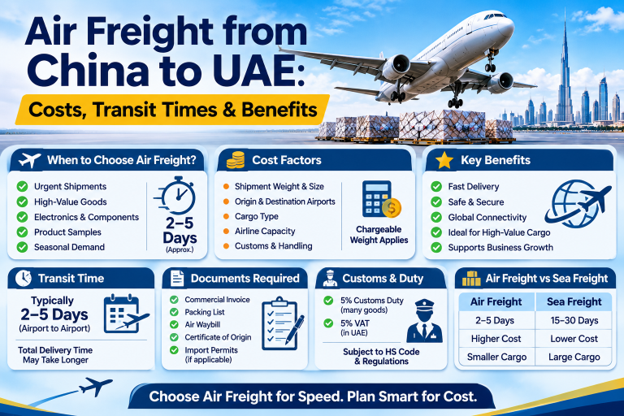
As an indicative planning range, standard air freight from China to UAE may take approximately 2–5 days from airport to airport.
However, this is not the same as the total door-to-door delivery time.
The complete shipment process may require additional time for:
- Supplier collection.
- Export documentation and cargo acceptance.
- Airline booking and departure schedules.
- Transit or connecting flights, where applicable.
- Arrival handling at the UAE airport.
- Import customs clearance.
- Final delivery to the consignee.
Actual transit times depend on the origin and destination airports, airline schedules, cargo availability, customs procedures and handling requirements.
What Can Cause Air Freight Delays?
Even though air freight is faster, shipments can experience delays due to:
- Incorrect or incomplete shipping documents.
- Airline capacity limitations.
- Security screening and cargo inspections.
- Customs queries or product approval requirements.
- Incorrect cargo dimensions or weight declarations.
- Restricted or dangerous goods documentation.
- Weather conditions and flight schedule changes.
Businesses should confirm whether the quoted transit time covers airport-to-airport transportation or the complete door-to-door service. For most door-to-door air freight shipments from China to the UAE, the total delivery time—including supplier collection, export processing, international air transport, customs clearance and last-mile delivery—typically ranges from 4 to 8 days depending on the specific locations, airline schedules, and customs processing times. Providing accurate shipment details and required documentation in advance can help avoid unnecessary delays and ensure a smoother end-to-end delivery process.
5. Major Airports Used for Air Freight from China to UAE
China and the UAE have established international aviation networks supporting commercial cargo transportation.
The most suitable airport depends on the supplier’s location, cargo availability, airline schedules and final delivery destination.
Major Cargo Airports in China
Shanghai Pudong International Airport (PVG)
Shanghai Pudong is an important international aviation gateway serving exporters and manufacturers across eastern China.
Guangzhou Baiyun International Airport (CAN)
Guangzhou is an important cargo gateway for businesses sourcing products from Guangdong and surrounding manufacturing regions.
Shenzhen Bao’an International Airport (SZX)
Shenzhen is relevant for shipments originating from southern China, including electronics and other manufactured products.
Beijing Capital International Airport (PEK)
Beijing supports international passenger and cargo transportation and may be considered for shipments originating in northern China.
Hong Kong International Airport (HKG)
Hong Kong is a major international air cargo hub and may be considered for suitable shipments from southern China, depending on the supplier’s location and export arrangements.
Major UAE Airports for Air Cargo
Dubai International Airport (DXB)
Dubai International Airport is an important destination for international air cargo and businesses serving Dubai and surrounding commercial areas.
Al Maktoum International Airport (DWC)
Located in Dubai South, DWC supports cargo and logistics operations and may be used for suitable freight arrangements.
Zayed International Airport (AUH), Abu Dhabi
Abu Dhabi’s international airport provides another option for cargo destined for Abu Dhabi and other parts of the UAE.
The final routing should be confirmed with the freight forwarder based on airline availability, shipment requirements and total transportation cost.
6. What Documents Are Required for Air Freight from China to UAE?
Proper documentation is essential for international air cargo transportation and UAE customs clearance.
Common documents include:
Commercial Invoice
The commercial invoice provides details of the transaction, including:
- Exporter and importer information.
- Product description.
- Quantity and unit price.
- Total declared value.
- Country of origin.
Packing List
The packing list describes how the cargo is packaged. It generally includes package quantities, dimensions, gross weight, net weight and product details.
Air Waybill (AWB)
The Air Waybill is the primary transport document for air cargo. It contains shipment information, origin and destination details, shipper and consignee information, and transportation details.
Certificate of Origin
A Certificate of Origin identifies the country where the goods originate. It may be required depending on the shipment and applicable customs procedures.
Import Permits and Product Approvals
Certain regulated products may require additional approvals, certificates or permits before import into the UAE.
Examples include:
- Telecommunications and wireless equipment.
- Food and beverages.
- Cosmetics and personal care products.
- Pharmaceuticals and medical products.
- Electrical and electronic equipment.
- Chemicals and hazardous materials.
The exact requirements depend on the product classification and applicable UAE regulations. Not every shipment requires every document listed above.
Dangerous Goods Documentation
Some products, such as lithium batteries, chemicals, and other regulated materials, fall under the scope of dangerous goods transportation regulations and must comply with specific handling and documentation requirements.
Depending on the nature and classification of the product, airlines and relevant authorities may require supplementary declarations, specialised packaging, appropriate labelling, and additional supporting documents.
Importers should confirm cargo acceptance requirements before dispatching the goods from the supplier.
7. UAE Customs Clearance for Air Cargo from China
All commercial imports into the UAE are subject to compliance with the established customs procedures, which are designed to ensure the lawful and efficient entry of goods into the country.
Upon arrival of an air freight shipment, it is generally the responsibility of the importer or an authorised customs representative to complete the import declaration and submit all necessary supporting documentation.
The process may involve:
- Receiving the shipment arrival notification.
- Preparing the commercial invoice and packing list.
- Providing the Air Waybill.
- Submitting the applicable import customs declaration.
- Providing additional permits or certificates, where required.
- Paying applicable customs duties and taxes.
- Completing any required inspection.
- Obtaining customs release and arranging cargo collection.
UAE Customs Duty
Many goods imported into the UAE mainland are subject to a standard customs duty of 5% of the customs value, commonly calculated using the CIF value.
However, the actual duty depends on the product’s HS code, applicable tariff classification, exemptions and relevant customs rules.
UAE VAT
The UAE applies a standard Value Added Tax (VAT) rate of 5 percent to most goods and services.
The applicable import VAT treatment depends on the nature of the transaction, customs valuation and the importer’s VAT registration status. Eligible VAT-registered businesses may account for import VAT through the applicable mechanism, subject to the relevant conditions.
Businesses should verify the applicable customs duty and VAT treatment before calculating the total landed cost.
8. Air Freight vs. Sea Freight from China to UAE
Air freight and sea freight serve different business requirements. The best option depends on shipment size, urgency, product value and logistics budget.
Comparison | Air Freight | Sea Freight |
Transportation | Aircraft | Cargo vessel |
Transit speed | Faster | Slower |
Cost per kg | Generally higher | Generally lower for suitable bulk shipments |
Best suited for | Urgent and smaller cargo | Large and heavy shipments |
Weight calculation | Chargeable weight | Depends on FCL/LCL pricing rules |
Cargo capacity | Subject to aircraft capacity and restrictions | Suitable for large-volume cargo |
Typical use | Samples, electronics, spare parts | Machinery, furniture, bulk goods |
When Is Air Freight Better?
Choose air freight when:
- Products are urgently required.
- Delivery time is a priority.
- Cargo is relatively small or high-value.
- A business needs to replenish stock quickly.
- Waiting for ocean transportation would affect business operations.
When Is Sea Freight Better?
Sea freight may be more suitable when:
- You are importing large quantities.
- Cargo is heavy or bulky.
- Delivery deadlines are flexible.
- Transportation cost is a major consideration.
- You need FCL or LCL container shipping.
For a detailed explanation of FCL, LCL, container options and ocean freight procedures, read our Sea Freight from China to UAE: Complete Business Guide.
9. Air Freight vs. Express Courier: What Is the Difference?
Air freight and express courier services both use aircraft for international transportation, but they are designed for different shipping requirements.
Standard Air Freight
- Commonly used for commercial cargo and larger consignments.
- Pricing generally depends on chargeable weight.
- Cargo may require airport collection and separate customs or delivery arrangements.
- Suitable for businesses importing regular commercial shipments.
Express Courier
- Commonly used for documents, samples and smaller packages.
- Often includes integrated collection, customs processing and delivery arrangements.
- Usually offers convenient end-to-end tracking.
- May become expensive for heavier commercial shipments.
Businesses should compare both options based on the total cost, delivery arrangement and cargo requirements.
10. How Does Door-to-Door Air Freight from China to UAE Work?
Door-to-door air freight is a logistics arrangement where cargo is collected from the supplier in China and delivered to an agreed address in the UAE.
Depending on the agreed service, it may include:
- Collection from the supplier’s factory or warehouse.
- Cargo receiving and handling.
- Export documentation and customs formalities.
- International air transportation.
- UAE import customs clearance.
- Final delivery to the consignee’s address.
This arrangement can simplify coordination for businesses that prefer to manage their shipment through one logistics provider.
Before confirming a booking, clarify:
- Whether supplier collection is included.
- Which airport and airline routing will be used.
- Whether destination handling is included.
- Who will complete the UAE import declaration.
- Whether customs duty and VAT are included or excluded.
- Whether final delivery is included.
- Who will act as the importer of record.
- Whether insurance and special handling are included.
The quotation should clearly identify included and excluded charges to avoid unexpected expenses. Common additional charges that may apply include storage fees (if cargo is not collected promptly), terminal or airport handling fees, customs inspection fees, security screening charges, documentation fees, and costs for special handling or delivery arrangements. Importers are encouraged to proactively ask their freight provider to specify all potential extra fees in advance so they can accurately budget for their shipment and prevent any surprises at the time of delivery.
11. How Can Businesses Reduce Air Freight Costs?
Although air freight generally costs more per kilogram than sea freight, businesses can manage expenses through better shipment planning.
Optimise Packaging
Reduce unnecessary packaging space while maintaining adequate product protection. Smaller package dimensions can help reduce volumetric weight.
Consolidate Shipments
If you purchase goods from multiple suppliers, consider consolidating eligible shipments before arranging international transportation.
Compare Complete Quotations
Compare the total cost, not just the advertised freight rate. Include collection, origin handling, international freight, destination charges, customs clearance and final delivery.
Plan Shipments in Advance
Avoid unnecessary urgent bookings wherever possible. Early planning gives businesses more flexibility when selecting available services.
Confirm Cargo Dimensions and Weight
Obtain accurate measurements from the supplier before booking. Incorrect dimensions or weight declarations can result in revised freight charges.
Choose the Right Shipping Method
Not every shipment needs to travel by air. Compare air freight with LCL and FCL sea freight based on cargo size, urgency and total landed cost.
12. Common Challenges in Air Freight from China to UAE
Air freight offers faster transportation, but businesses should be aware of several potential challenges.
Incorrect Cargo Measurements
Incorrect package dimensions or weight information can lead to additional charges after cargo acceptance.
Incomplete Shipping Documents
Missing or inconsistent information in the commercial invoice, packing list and Air Waybill may delay customs clearance.
Restricted or Regulated Products
Certain products require special approvals or may be subject to airline restrictions. Confirm acceptance before dispatch.
Unexpected Destination Charges
Airport handling, storage, customs processing and local delivery may not be included in the initial freight quotation.
Customs Inspection
Customs authorities may inspect shipments or request additional information before granting release.
Flight Schedule Changes
Airline capacity, weather conditions and operational changes can affect planned departure and arrival schedules.
Businesses can reduce these risks by preparing accurate cargo information, checking import requirements and confirming all charges before shipment.
13. Why Choose DDU Express for Air Freight from China to UAE?
Businesses importing from China need a logistics partner who can coordinate cargo transportation, documentation and destination arrangements.
DDU Express provides international air freight solutions for businesses shipping cargo across global destinations.
Its air freight service covers a range of shipment requirements, from document shipments to larger cargo consignments.
Businesses can explore air freight support for:
- International air cargo transportation.
- Shipment booking and coordination.
- Cargo handling arrangements.
- Shipping documentation support.
- Customs clearance coordination.
- Shipment tracking and status updates.
- Delivery planning based on the agreed service.
Selecting an appropriate air freight arrangement is an important consideration for businesses importing electronics, machinery parts, product samples or other commercial goods, as it can play a significant role in supporting overall supply chain objectives.
Learn more about DDU Express international air freight services.
For a shipment-specific quotation, share your supplier location, cargo description, package dimensions, total weight and UAE delivery requirements with the DDU Express team.
Frequently Asked Questions About Air Freight from China to UAE
How long does air freight from China to UAE take?
Standard air freight may take approximately 2–5 days from airport to airport. Total delivery time may be longer when supplier collection, export handling, customs clearance and final delivery are included.
How much does air freight from China to UAE cost?
The cost depends on chargeable weight, cargo type, origin and destination airports, airline capacity and handling requirements. A shipment-specific quotation is required to determine the actual price.
What is chargeable weight in air freight?
Chargeable weight is generally the higher of actual gross weight and volumetric weight. Airlines use this calculation to account for both the weight and the space occupied by cargo.
Which airport is used for air freight from China to UAE?
Common Chinese cargo gateways include Shanghai Pudong, Guangzhou Baiyun and Shenzhen Bao’an. In the UAE, Dubai International Airport and Al Maktoum International Airport are among the available cargo gateways. The suitable route depends on airline availability and shipment requirements.
Is air freight cheaper than sea freight?
Generally, no. Air freight usually has a higher transportation cost per kilogram. However, it may be more practical for urgent, smaller or high-value shipments where delivery speed is important.
Can I ship electronics from China to UAE by air?
Yes, many types of electronic products can be transported by air, subject to airline acceptance, applicable dangerous goods rules and UAE import requirements. Products containing lithium batteries may require additional checks and documentation.
What documents are needed for air freight from China to UAE?
Common documents include a commercial invoice, packing list and Air Waybill. A Certificate of Origin and additional permits or product certificates may be required depending on the shipment.
Can I arrange door-to-door air freight from China to UAE?
Door-to-door arrangements may include supplier collection, export handling, international air transportation, import customs clearance and final delivery. Confirm the exact services and charges included in the quotation.
Is air freight suitable for small businesses?
Yes. Small businesses can use air freight for product samples, urgent inventory, smaller commercial orders and high-value goods. The most suitable option depends on cargo dimensions, weight and delivery requirements.
Can DDU Express arrange air freight from China to Dubai?
DDU Express provides international air freight solutions. Contact the team with your cargo details, supplier location and delivery requirements to discuss suitable arrangements.
Get an Air Freight Quote from China to UAE
Looking for a faster way to transport commercial goods from China to the UAE?
Whether you need to ship urgent inventory, electronics, machinery parts, product samples or other commercial cargo, DDU Express can help you explore suitable international air freight arrangements.
To request a quotation, share the following details:
- Supplier or pickup location in China.
- Product description.
- Number of cartons or packages.
- Total gross weight.
- Dimensions of each package.
- Cargo readiness date.
- Destination airport or UAE delivery address.
- Required delivery timeframe.
Contact DDU Express to discuss your air freight requirements and receive a shipment-specific quotation.
Move your cargo from China to the UAE with an air freight solution that matches your business requirements.

Weiworld is an experienced logistics and shipping professional with more than 20 years of industry experience, with extensive knowledge of international shipping, freight forwarding, cargo movement, and logistics operations.
Over the course of his career, he has developed deep practical expertise in Middle East logistics and operations, including shipping processes, international cargo transportation, customs-related procedures, and supply chain coordination.
At DDU Express, Weiworld shares practical insights and industry knowledge to help businesses better understand international shipping, freight forwarding, DDP services, cargo transportation, and logistics solutions across the Middle East and global markets.
His extensive industry experience provides valuable perspective for businesses looking to simplify international shipping and make informed decisions when moving cargo between countries.