China remains a major global manufacturing and wholesale sourcing destination, supplying a wide range of products to businesses in the UAE. Importing goods such as electronics, machinery, furniture, construction materials, textiles, and consumer products enables UAE enterprises to access a diverse product base and benefit from competitive manufacturing capabilities.
Nevertheless, effective international shipping extends beyond the initial procurement of goods. It requires careful planning for cargo collection, freight transportation, associated costs, customs clearance procedures, import documentation, and final delivery arrangements.
The selection of an appropriate shipping method and logistics partner is a critical factor influencing supply chain efficiency, regardless of whether the shipment involves a small consignment or a full container load.
This guide outlines the main considerations for shipping goods from China to the UAE, including an overview of the shipping process, required documentation, and key factors businesses should evaluate before importing.
Why Do Businesses Import Goods from China to the UAE?
The UAE is a major international trading and distribution centre, connecting businesses across the Middle East, Africa, Asia and Europe. Its advanced logistics infrastructure and strategic access to major shipping routes position it as a favourable location for international product sourcing.
China is still a major sourcing destination for UAE importers because of its extensive manufacturing capabilities and wide product selection.
Some of the key reasons businesses import from China include:
1. Wide Range of Products
Chinese manufacturers supply products across numerous industries, including electronics, machinery, furniture, textiles, construction materials, automotive components and household products.
This lets UAE businesses source different products from multiple suppliers.
2. Competitive Manufacturing Costs
Chinese manufacturers often offer competitive production costs, especially for bulk orders. Businesses can compare suppliers, production specifications and minimum order quantities to choose the most suitable sourcing arrangements.
3. Large Manufacturing Network
China has developed manufacturing centres and industrial clusters that specialise in various product categories. Products may be sourced directly from factories, wholesalers or trading companies.
4. International Shipping Infrastructure
China has major commercial ports and international airports connected to global freight networks. These facilities support regular cargo transportation to destinations including Dubai, Abu Dhabi and other UAE locations.
5. Opportunities for Business Expansion
Importing from China allows UAE distributors, wholesalers, retailers, contractors and manufacturers to broaden their product offerings and develop new business opportunities.
What Are the Different Shipping Methods from China to UAE?
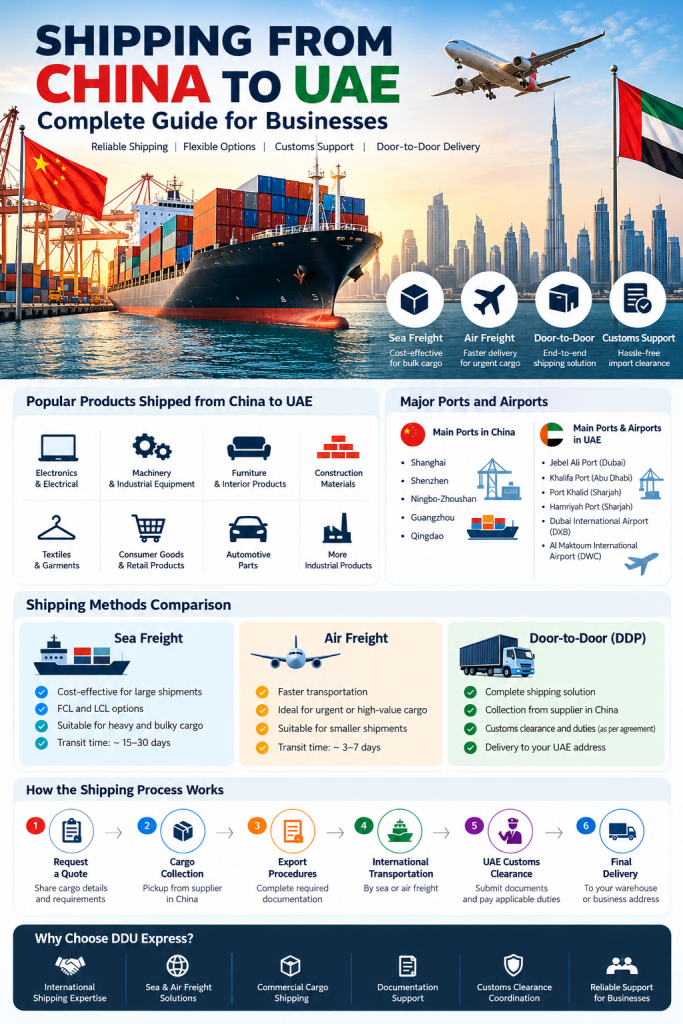
Businesses can transport cargo from China to the UAE using different international freight methods. The right option depends on shipment volume, cargo weight, delivery requirements and budget.
The main shipping options are sea freight, air freight and express shipping.
1. Sea Freight from China to UAE
Sea freight is one of the most commonly considered options for businesses transporting large or heavy commercial shipments.
It is particularly suitable for bulk orders, industrial equipment, machinery, furniture, construction materials and general merchandise.
Businesses can choose between two main container shipping options:
Full Container Load (FCL)
FCL shipping suits businesses with enough cargo to fill an entire shipping container.
Advantages include:
- Exclusive use of the shipping container.
- Suitable for large commercial shipments.
- Better control over container loading.
- Less cargo handling than shared-container arrangements.
Less than Container Load (LCL)
LCL shipping suits businesses that do not have enough cargo to fill an entire container.
Multiple shipments from different customers are consolidated into a common container.
Advantages include:
- Suitable for smaller shipments.
- No need to book an entire container.
- Permits businesses to transport smaller commercial orders.
- Useful for companies importing products from multiple suppliers.
The final cost of sea freight depends on cargo volume, weight, container type, origin, destination, handling charges and other applicable logistics costs.
2. Air Freight from China to UAE
Air freight suits businesses that need faster transport or have urgent shipments.
It is commonly used for electronics, samples, spare parts, valuable products and time-sensitive commercial cargo.
Main advantages include:
- Faster transportation compared with sea freight.
- Suitable for urgent business shipments.
- Useful for smaller and higher-value cargo.
- Access to major international airport networks.
Air freight charges generally depend on the shipment’s chargeable weight, which takes into account both actual and volumetric weight.
Air freight is generally more expensive per kilogram than sea freight, so businesses should compare cost with urgency and the value of their goods.
3. Express Shipping from China to UAE
Express shipping is generally suitable for smaller packages, product samples, documents and urgent deliveries.
International courier services can provide tracking and convenient collection and delivery options.
This option may not be economical for large commercial cargo or heavy shipments. Businesses should compare courier charges with air freight before selecting a service.
Shipping from China to Dubai: Costs, Transit Times and Process
Dubai is a major logistics and commercial destination for businesses importing products from China.
Shipments can travel by sea or air, depending on the cargo type, origin and delivery requirements.
The main factors affecting shipping costs and transit times include:
- Collection location in China.
- Destination port or airport in the UAE.
- Shipment weight and volume.
- Freight transportation method.
- Cargo type and handling requirements.
- Customs clearance and documentation.
- Port handling and local delivery arrangements.
Businesses should obtain a shipment-specific quotation rather than relying on a general price estimate.
DDP Shipping from China to UAE: What Does It Mean?
DDP stands for Delivered Duty Paid. It is an Incoterms rule under which the seller arranges delivery and bears the costs and risks specified under DDP, including import clearance and applicable import duties and taxes, up to the agreed destination.
Under a DDP arrangement, the seller generally manages:
- Transportation from the supplier’s location.
- Export clearance in China.
- International freight transportation.
- Import customs clearance in the UAE.
- Applicable import duties and taxes.
- Delivery to the agreed destination.
DDP can simplify the importing process for buyers because the seller handles many logistics responsibilities.
However, businesses should confirm who will act as the importer of record, how customs declarations will be completed, whether the arrangement is legally and operationally suitable, and which charges the quotation includes.
DDP Shipping Checklist for UAE Importers:
– Confirm who will be listed as the importer of record on UAE customs documents.
– Request a detailed quotation showing exactly which charges are included (freight, customs clearance, duty, VAT, delivery, etc).
– Clarify which party is responsible for completing customs declarations and paying import duties or taxes.
– Verify whether the DDP arrangement covers all required permits, certificates, and approvals for your products.
– Make sure you understand the process for shipment tracking and receiving customs clearance updates.
– Ask the seller or forwarder to provide written confirmation of included and excluded costs for transparency before agreeing to DDP terms.
DDP should not be confused with DDU, an older Incoterms term that is no longer included in Incoterms 2010 or Incoterms 2020.
Door-to-Door Shipping from China to UAE
Door-to-door shipping provides an integrated logistics solution covering cargo collection from the supplier’s location in China and delivery to the agreed address in the UAE.
It can be useful for businesses that prefer to coordinate their shipments through one logistics provider instead of arranging each transportation stage separately.
A typical door-to-door shipping arrangement may include:
- Collection of goods from the Chinese supplier.
- Cargo inspection and preparation, if included.
- Export documentation and customs formalities.
- International transportation by sea or air.
- Import customs clearance in the UAE.
- Final delivery to the customer’s warehouse or business address.
The exact services included depend on the agreed shipping terms and quotation.
Businesses should confirm whether customs duty, VAT, insurance, port charges, handling and final delivery are included. Typically, door-to-door shipping quotes include freight charges from the supplier’s warehouse to the recipient’s address, standard customs clearance fees, and basic delivery. However, some costs may be excluded or vary depending on the logistics provider and shipping terms. Common excluded or variable charges may include UAE import duty, VAT, insurance, storage fees at destination, inspection fees, documentation surcharges, special handling or oversized cargo fees, and delivery to remote locations. Always ask your logistics provider for a detailed breakdown of included and excluded charges in your door-to-door quotation so you can budget accurately and avoid unexpected fees.
How Much Does Shipping from China to UAE Cost?
Dubai serves as the primary commercial gateway for goods entering the UAE from China, anchored by Jebel Ali Port for ocean cargo and Dubai International (DXB) and Al Maktoum International (DWC) for air freight. Because freight rates and transit times vary based on your supplier’s factory location, cargo volume, and delivery urgency, comparing real-world shipment scenarios in both USD and AED (1 USD = 3.6725 AED) helps estimate your landed cost before requesting a formal quotation.
Bulk Furniture via 20ft FCL Sea Freight (Foshan or Shenzhen to Jebel Ali): A Dubai buyer importing 24 CBM of commercial furniture from Guangdong will typically book a dedicated 20ft Full Container Load (FCL). Direct ocean transit from Shenzhen or Guangzhou to Jebel Ali Port takes 12 to 18 days (or 25 to 35 days door-to-door including pickup, customs, and local trucking), with port-to-port container rates averaging $1,500 to $3,800 USD (AED 5,500 to AED 13,950) depending on seasonal space.
Small Hardware Order via LCL Sea Freight (Ningbo or Shanghai to Dubai): An importer shipping 5 CBM (1,800 kg) of hardware from Eastern China can use Less than Container Load (LCL) shared container space. Base port-to-port ocean rates from Ningbo or Shanghai to Jebel Ali run $35 to $85 USD per CBM (AED 130 to AED 315 per CBM) with an 18 to 25 day port transit window, while all-inclusive door-to-door LCL averages AED 600 to AED 900 per CBM ($163 to $245 USD per CBM) over 25 to 35 days.
Urgent Electronics via Air Freight (Shenzhen to DXB or DWC): A retailer shipping 300 kg of consumer electronics from Shenzhen ahead of a product launch can use standard airport-to-airport air freight, which takes 3 to 6 days at $3.50 to $6.00 USD per chargeable kg (AED 13 to AED 22 per kg). For an all-inclusive option, DDP door-to-door air cargo takes 6 to 10 days at AED 18 to AED 25 per kg ($4.90 to $6.80 USD per kg), including customs clearance and final delivery.
Main Factors Affecting Shipping Costs and Transit Times
- Collection Location in China: Sourcing from coastal hubs like Shenzhen, Guangzhou, Shanghai, or Ningbo keeps factory pickup fees low ($150–$350 USD / AED 550–1,285), while inland factories add 3 to 6 days for domestic trucking.
- Shipment Weight and Volume: Sea LCL is billed per CBM until cargo reaches 15 CBM, where a 20ft FCL container becomes cheaper. Air cargo is billed on actual weight or volumetric weight ($\text{L} \times \text{W} \times \text{H in cm} \div 6000$).
- Cargo Type and Handling: Standard dry goods ship at baseline tariffs, whereas lithium-battery electronics require Dangerous Goods (DG) documentation and oversized machinery requires Flat Rack or Open Top containers.
- Customs Clearance and Documentation: Commercial imports into Dubai incur a 5% UAE Customs Duty on the CIF value plus 5% VAT, requiring a Commercial Invoice, Packing List, Certificate of Origin, and Bill of Lading or Air Waybill.
- Port Handling and Local Delivery: Beyond base freight, budget for local UAE destination fees in Dirhams, including Terminal Handling Charges (AED 750–1,100 per 20ft container), Delivery Order fees (AED 350–650), and local trucking.
Shipping from Guangzhou, Shenzhen, Shanghai, Ningbo, and other manufacturing regions involves different collection schedules and carrier sailings. Because container spot rates, airline capacity, and seasonal surcharges fluctuate weekly, businesses should always obtain a shipment-specific quotation based on their exact carton dimensions, gross weight, HS code, and delivery address.
Important Note About Shipping Costs
The shipping rates and cost examples mentioned above are provided for general guidance and planning purposes only. They are indicative estimates and do not represent fixed or guaranteed quotations from DDU Express.
Actual shipping costs may vary depending on the shipment’s origin, destination, cargo weight and dimensions, freight availability, carrier schedules, seasonal demand, customs requirements and applicable surcharges.
Additional charges such as customs duty, VAT, port handling, documentation, insurance, storage and final delivery may apply depending on the agreed shipping arrangement.
For an accurate quotation, please contact DDU Express with your supplier location, cargo details, dimensions, weight and delivery address.
How Businesses Can Reduce Shipping Costs
Businesses can manage their shipping expenses through better planning and shipment consolidation.
Some useful practices include:
- Compare quotations from multiple logistics providers.
- Select sea freight for suitable bulk shipments.
- Consolidate goods from multiple suppliers when practical.
- Avoid unnecessary packaging that increases cargo volume.
- Confirm product dimensions and weight before booking.
- Plan shipments early to avoid urgent transportation.
- Check all origin and destination charges before confirming a quotation.
Major Chinese Ports for Shipping to the UAE
China has several major commercial ports that handle international container and general cargo transportation.
The most suitable departure port depends on the supplier’s location, cargo type, available shipping services and destination.
Some important Chinese ports include:
Shanghai Port
Shanghai is a major international container port serving manufacturers and exporters across eastern China.
Shenzhen Port
Shenzhen is an important shipping gateway for businesses sourcing electronics, consumer products and other manufactured goods from southern China.
Ningbo-Zhoushan Port
This port is an important international cargo gateway serving industrial and manufacturing regions in eastern China.
Guangzhou Port
Guangzhou serves manufacturers and trading businesses across Guangdong and surrounding areas.
Qingdao Port
Qingdao is an important port serving northern China and nearby industrial regions.
When selecting a departure port, consider the supplier’s warehouse location and the total cost of transporting cargo to the port.
Major UAE Ports and Airports for Cargo from China
The UAE has several important seaports and international airports that support cargo transportation and distribution.
Jebel Ali Port, Dubai
Jebel Ali Port is one of the region’s major commercial shipping gateways. It supports container handling, international trade and cargo distribution.
Khalifa Port, Abu Dhabi
Khalifa Port is an important commercial port supporting container and general cargo operations in Abu Dhabi.
Port Khalid and Hamriyah Port, Sharjah
These ports support commercial cargo and maritime trade activities in Sharjah.
Dubai International Airport (DXB)
Dubai International Airport handles international passenger and cargo operations and serves businesses requiring air transportation.
Al Maktoum International Airport (DWC)
Al Maktoum International Airport is another important aviation and logistics location in Dubai’s cargo and logistics network.
The appropriate destination depends on the shipping route, service availability, cargo type and final delivery location.
Customs Clearance for Goods Imported from China to UAE
Customs clearance is an important part of the international shipping process. All commercial shipments entering the UAE must comply with applicable customs procedures and import regulations.
The importer or its authorised customs representative must submit the required declaration and supporting documents to the relevant customs authority.
UAE Customs Duty
For many imported goods, the standard GCC customs tariff is 5% of the customs value, commonly calculated using the Cost, Insurance and Freight (CIF) value.
However, customs duty varies according to the product’s HS code, applicable tariff classification, exemptions and any special regulatory provisions.
Certain goods may be subject to different duty rates or additional restrictions.
UAE VAT on Imported Goods
The standard VAT rate in the UAE is 5%.
VAT may apply to imported goods according to the applicable tax rules and customs valuation. VAT treatment can differ depending on the importer’s registration status and the nature of the import transaction.
VAT-registered importers may account for import VAT through the applicable reverse charge mechanism, subject to eligibility and compliance requirements.
Businesses should calculate customs duty and VAT before importing to estimate the total landed cost.
Sample Landed Cost Calculation for UAE Imports:
Suppose you are importing goods from China with the following details:
– CIF (Cost, Insurance, Freight) Value: $10,000 (AED 36,725)
Estimate the costs as follows:
- UAE Customs Duty (5% of CIF):
5% x AED 36,725 = AED 1,836
- Value Added Tax (VAT) (5% of CIF + duty):
5% x (AED 36,725 + AED 1,836) = 5% x AED 38,561 = AED 1,928
- Local Destination Fees (example):
Terminal Handling Charges: AED 800
Delivery Order Fee: AED 400
Local Trucking (to your warehouse): AED 1,000
Total Landed Cost:
Product + Insurance + Freight (CIF): AED 36,725
Customs Duty: AED 1,836
VAT: AED 1,928
Local Fees: AED 2,200
————————————————-
Total: AED 42,689
This sample calculation helps businesses estimate the full landed cost of importing goods from China to the UAE. Actual costs may vary depending on shipment details and logistics providers.
Restricted and Regulated Goods
Some products require additional approvals, permits or certificates before they can be imported.
Depending on the product, these may include:
- Food and beverages.
- Pharmaceuticals and medical products.
- Cosmetics and personal care products.
- Telecommunications equipment.
- Chemicals and hazardous materials.
- Certain electrical and electronic equipment.
Importers should confirm product-specific requirements with the relevant UAE authorities before shipping. Key agencies include the MOIAT (formerly ESMA) Ministry of Industry and Advanced Technology for general product standards and conformity, the Ministry of Health and Prevention for pharmaceuticals and medical products, the Ministry of Climate Change and Environment for food and agricultural imports, and the Telecommunications and Digital Government Regulatory Authority (TDRA) for telecommunications equipment. For other categories, check with the appropriate authority to ensure compliance before arranging shipment.
To check if your product is restricted, start by visiting the official websites and online portals of these agencies, where guidelines and approved product lists are often published. You can also use government e-services platforms such as the UAE Federal Customs Authority portal to access updated import regulations. For detailed or unusual requirements, contact the relevant authority directly by phone or email to clarify documentation, registration, or permit needs for your specific goods. This approach helps you verify compliance efficiently before your shipment leaves China.
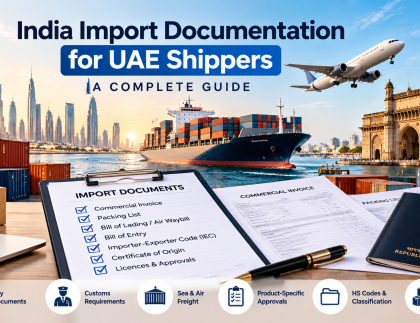
Documents Required to Import Goods from China to UAE
Proper documentation helps customs authorities identify the goods, verify their declared value and process the import declaration.
The documents commonly required for commercial imports include:
1. Commercial Invoice
The commercial invoice contains details about the transaction, including:
- Exporter and importer details.
- Product description.
- Quantity and unit price.
- Total declared value.
- Currency of the transaction.
- Country of origin.
2. Packing List
The packing list provides information about how the goods are packed.
It generally includes:
- Number of packages.
- Package dimensions.
- Gross and net weight.
- Product descriptions.
- Marks and package numbers.
3. Certificate of Origin
A Certificate of Origin identifies the country of origin. Customs may require it to clear shipments and establish the origin of imported products.
4. Bill of Lading or Air Waybill
A Bill of Lading is issued for sea freight shipments, while an Air Waybill is used for air cargo transportation.
These documents include key transportation and shipment information.
5. Import Permits and Product Certificates
Certain products require additional approvals or certificates from relevant authorities before import.
The exact documentation depends on the product category, shipment method and applicable customs procedure.
Businesses should ensure that the invoice, packing list, transport documents and customs declaration contain consistent information. For example, double-check that product descriptions, quantities, weights, and values match exactly across all documents. Cross-check key details by comparing the invoice and packing list to the information on the Bill of Lading or Air Waybill and the customs declaration. This helps prevent customs delays due to discrepancies in product details or declared values.
What Products Can Businesses Import from China to UAE?
China supplies a wide variety of products to UAE businesses across several industries.
Some commonly sourced commercial product categories include:
Electronics and Electrical Products
- Electronic components.
- Electrical accessories.
- Computer accessories.
- Lighting equipment.
- Commercial electrical products.
Machinery and Industrial Equipment
- Manufacturing machinery.
- Industrial tools.
- Spare parts.
- Workshop equipment.
- Construction machinery.
Furniture and Interior Products
- Office furniture.
- Home furniture.
- Commercial interior products.
- Decorative materials.
- Storage solutions.
Construction and Building Materials
- Hardware products.
- Sanitary fittings.
- Lighting fixtures.
- Flooring materials.
- Selected building accessories.
Textiles and Garments
- Bags and accessories.
- Commercial textile products.
Household and Consumer Goods
- Kitchen accessories.
- Home storage products.
- Furniture accessories.
- General merchandise.
- Retail products.
Check the importability of each product before shipment. Product-specific restrictions, standards, labelling requirements and approvals may apply.
Shipping Machinery and Industrial Equipment from China to UAE
Importing machinery and industrial equipment requires careful planning because shipments may involve heavy, oversized or sensitive cargo.
Before arranging transportation, businesses should confirm:
- Equipment dimensions and gross weight.
- Packaging and loading requirements.
- Whether special handling equipment is needed.
- Suitable container or transport arrangements.
- Product-specific import approvals.
- Customs classification and documentation.
Some machinery may require specialised containers, flat racks or other suitable transport arrangements depending on its dimensions and weight.
Shipping Electronics and Commercial Goods from China to UAE
Electronics and commercial products are among the categories businesses commonly source from Chinese manufacturers.
However, importing electronic goods requires attention to product specifications, packaging, transportation requirements and applicable UAE conformity regulations.
Before shipping, importers should verify:
- Product descriptions and technical specifications.
- Applicable product standards and conformity requirements.
- Packaging and protection requirements.
- Battery and dangerous-goods transportation restrictions, where relevant.
- HS code and customs classification.
- Required certificates, registrations or import permits.
UAE Compliance Requirements for Electronic Products
Certain electrical and electronic products may require conformity assessment, product registration or approvals before they can be imported, marketed or sold in the UAE.
The Ministry of Industry and Advanced Technology (MOIAT) administers conformity certification for products covered by applicable UAE technical regulations.
Telecommunications and wireless devices, such as mobile phones, Wi-Fi equipment and certain wireless products, may also require type approval from the Telecommunications and Digital Government Regulatory Authority (TDRA).
Requirements depend on the product category, technical specifications and applicable regulations. Importers should confirm the current requirements with the relevant authorities before arranging shipment.
Documents and Certificates to Check Before Shipping
Depending on the product and applicable compliance requirements, importers may need to arrange or obtain:
- Product Technical Datasheet: Provides product specifications, model details and technical information.
- Test Reports: May be required to demonstrate compliance with applicable electrical safety, electromagnetic compatibility or radio standards.
- Manufacturer’s Declaration of Conformity: May be required under specific conformity assessment procedures.
- UAE Certificate of Conformity: Required for products covered by applicable UAE technical regulations.
- TDRA Type Approval: May be required for regulated telecommunications and wireless equipment.
- CE Certificate or Declaration: May be useful as supporting compliance documentation, but CE marking does not automatically replace UAE-specific approvals.
- Safety Data Sheet (SDS): May be required for batteries or other regulated materials, depending on the product and transportation method.
Not every shipment requires all these documents. The exact requirements depend on the product, its intended use and the applicable UAE regulations.
Importers should request relevant technical and compliance documents directly from their Chinese suppliers and consult the appropriate UAE authorities or a qualified customs and conformity specialist before shipment.
Taking these precautions can help reduce customs delays, avoid compliance issues and support smoother commercial imports.
Official UAE Regulatory Resources
- MOIAT — UAE Certificates of Conformity for Regulated Products.
- TDRA — Register and Approve Telecommunication Equipment.
China to UAE Cargo Consolidation for Small Businesses
Businesses sourcing products from multiple suppliers in China may benefit from cargo consolidation.
Instead of transporting each supplier’s shipment separately, eligible goods can be collected and combined into a consolidated shipment.
This can help businesses manage smaller orders and reduce the need to book multiple separate freight movements.
A typical consolidation process includes:
- Collecting goods from different suppliers.
- Receiving and recording cargo information.
- Checking package quantities and documentation.
- Combining eligible cargo into a shipment.
- Arranging international transportation.
- Completing import customs procedures.
- Delivering the cargo to the agreed destination.
Cargo consolidation may be particularly useful for wholesalers, retailers, e-commerce businesses and small importers.
However, businesses should consider consolidation charges, storage time, cargo compatibility and delivery schedules before choosing this option.
How Does the China to UAE Shipping Process Work?
The international shipping process generally includes several stages, from supplier coordination in China to final cargo delivery in the UAE.
Step 1: Request a Shipping Quotation
Provide your logistics provider with the supplier’s location, cargo description, dimensions, weight, quantity and destination.
Specify whether you prefer sea freight, air freight or another transportation option.
Step 2: Confirm the Supplier and Cargo Details
Verify the supplier’s readiness, cargo availability, packaging information and shipping documents.
For multiple suppliers, discuss whether cargo consolidation is possible.
Step 3: Arrange Cargo Collection
Depending on the agreed service, the supplier may collect the cargo from its warehouse and transport it to the selected port, airport or consolidation facility.
Step 4: Complete Export Procedures in China
The shipment must comply with China’s applicable export requirements. We arrange required declarations and documents before departure.
Step 5: International Cargo Transportation
The goods are transported from China to the UAE by the selected freight method.
Step 6: UAE Customs Clearance
On arrival, the relevant customs declaration and supporting documents are submitted. We address applicable duties, taxes and approvals.
Step 7: Cargo Release and Final Delivery
Once the cargo is released, it can be collected from the port or airport and transported to the agreed warehouse, business premises or delivery address.
The actual sequence and responsibilities may vary depending on the shipment type, Incoterms and service arrangement.
How to Choose the Right Freight Forwarder from China to UAE
Selecting a reliable freight forwarding partner can help businesses coordinate international shipments and reduce avoidable delays.
Before choosing a logistics provider, consider the following:
- Experience in International Shipping
Choose a provider with experience handling your cargo type and shipping route.
- Range of Freight Services
Check whether the provider can arrange sea freight, air freight, cargo consolidation and other relevant logistics services.
- Customs Clearance Support
Confirm whether the provider can coordinate UAE customs clearance and advise on documentation and product-specific requirements.
- Transparent Quotations
Request a precise breakdown of freight charges, handling fees, customs-related costs and destination delivery charges.
- Shipment Tracking and Communication
Choose a provider that offers regular shipment updates and clear communication throughout the transportation process.
- Cargo Handling and Support
Check whether the provider can coordinate special packaging, cargo handling and suitable transport arrangements for your goods.
A good logistics partner should understand your shipment requirements and help you select an appropriate transportation solution.
When evaluating potential logistics providers, consider asking the following key questions to make an informed choice:
– What experience do you have with shipments similar to ours in terms of cargo type and shipping route?
– Can you provide references from other clients who have imported goods from China to the UAE?
– What types of insurance coverage do you offer for cargo during transit, and what are the claim procedures in case of loss or damage?
– How do you handle customs clearance, and are you familiar with UAE customs regulations and product-specific requirements?
– What is your process for managing delays, disruptions, or changes to the shipping schedule?
– Will you provide a dedicated contact for shipment updates and communication throughout the process?
These questions can help you assess the reliability and suitability of your logistics partner before confirming your shipping arrangements.
Why Choose DDU Express for China to UAE Shipping?
International shipping requires coordination between suppliers, freight providers, customs representatives and local delivery services.
DDU Express helps businesses arrange cargo transportation and logistics services for their international shipping requirements.
Whether you are importing commercial goods, machinery, electronics or general cargo, our team can help you understand the available shipping options and coordinate the following steps.
Focused on business shipping needs, we aim to make international cargo transportation more organised and straightforward.
Our shipping support includes:
- International cargo transportation.
- Sea freight and air freight arrangements.
- Commercial cargo shipping.
- Door-to-door shipping coordination.
- Cargo consolidation arrangements.
- Shipping documentation support.
- Customs clearance coordination.
- Delivery planning.
Contact DDU Express with your cargo details to discuss suitable shipping options from China to the UAE.
Frequently Asked Questions About Shipping from China to UAE
What is the best way to ship goods from China to UAE?
The best shipping method depends on cargo volume, weight, urgency and budget. Sea freight is generally suitable for larger commercial shipments, while air freight suits urgent or higher-value cargo. Express shipping may suit small packages and samples.
How long does shipping from China to UAE take?
Shipping from China to the UAE takes 2 to 5 days via express courier, 3 to 10 days via air freight, and 12 to 35 days via sea freight, depending on your selected method and delivery terms. Ocean port-to-port transit averages 12 to 18 days from Southern Chinese ports (Shenzhen, Guangzhou) and 18 to 25 days from Eastern hubs (Shanghai, Ningbo) to Jebel Ali or Khalifa Port, while full door-to-door sea shipping takes 25 to 35 days to account for factory pickup and UAE customs clearance. Standard air freight takes 3 to 6 days airport-to-airport (or 6 to 10 days door-to-door), and express courier services deliver small parcels and samples in 2 to 5 business days.
How much does it cost to ship from China to UAE?
The cost depends on cargo weight, volume, transportation method, origin, destination and additional handling or clearance charges. A detailed quotation requires accurate shipment information.
Can I ship goods from multiple suppliers in China to UAE?
Yes. Cargo consolidation can combine eligible goods from multiple suppliers into one shipment. This can be useful for businesses purchasing products from different manufacturers.
What documents are required to import goods from China to UAE?
Common documents include a commercial invoice, packing list, Certificate of Origin and Bill of Lading or Air Waybill. Certain products may require additional permits, certificates or consents.
What is the customs duty for importing goods from China to the UAE?
Many imported goods are subject to a standard customs duty of 5% of the CIF value. However, the actual rate depends on the product’s HS code, applicable exemptions and tariff rules.
Is VAT applicable to goods imported from China?
The UAE’s standard VAT rate is 5%. The applicable import VAT treatment depends on the import transaction and the importer’s VAT registration status.
Can I ship machinery from China to UAE?
Yes, you can ship machinery and industrial equipment using suitable freight arrangements. Check dimensions, weight, packaging, customs classification and product-specific approvals before shipping.
What is DDP shipping from China to UAE?
DDP means Delivered Duty Paid. Under this Incoterms rule, the seller is responsible for transportation, import clearance, duties and taxes up to the agreed destination, subject to the agreed terms.
Can DDU Express arrange door-to-door shipping from China to UAE?
Contact DDU Express with your supplier location, cargo details and UAE delivery address to confirm available door-to-door shipping arrangements and service coverage.
Get a Shipping Quote from China to UAE
Planning to import commercial goods from China to the United Arab Emirates?
Whether you need sea freight for a large shipment, air freight for urgent cargo or a suitable transportation solution for multiple supplier orders, DDU Express can help you explore your shipping requirements.
Share your cargo details, supplier location, shipment weight and dimensions, and destination in the UAE.
Our team can review your requirements and help identify a suitable shipping arrangement.
Contact DDU Express today to discuss your China-to-UAE cargo shipping needs.
Get a Shipping Quote | Contact Our Logistics Team

Weiworld is an experienced logistics and shipping professional with more than 20 years of industry experience, with extensive knowledge of international shipping, freight forwarding, cargo movement, and logistics operations.
Over the course of his career, he has developed deep practical expertise in Middle East logistics and operations, including shipping processes, international cargo transportation, customs-related procedures, and supply chain coordination.
At DDU Express, Weiworld shares practical insights and industry knowledge to help businesses better understand international shipping, freight forwarding, DDP services, cargo transportation, and logistics solutions across the Middle East and global markets.
His extensive industry experience provides valuable perspective for businesses looking to simplify international shipping and make informed decisions when moving cargo between countries.