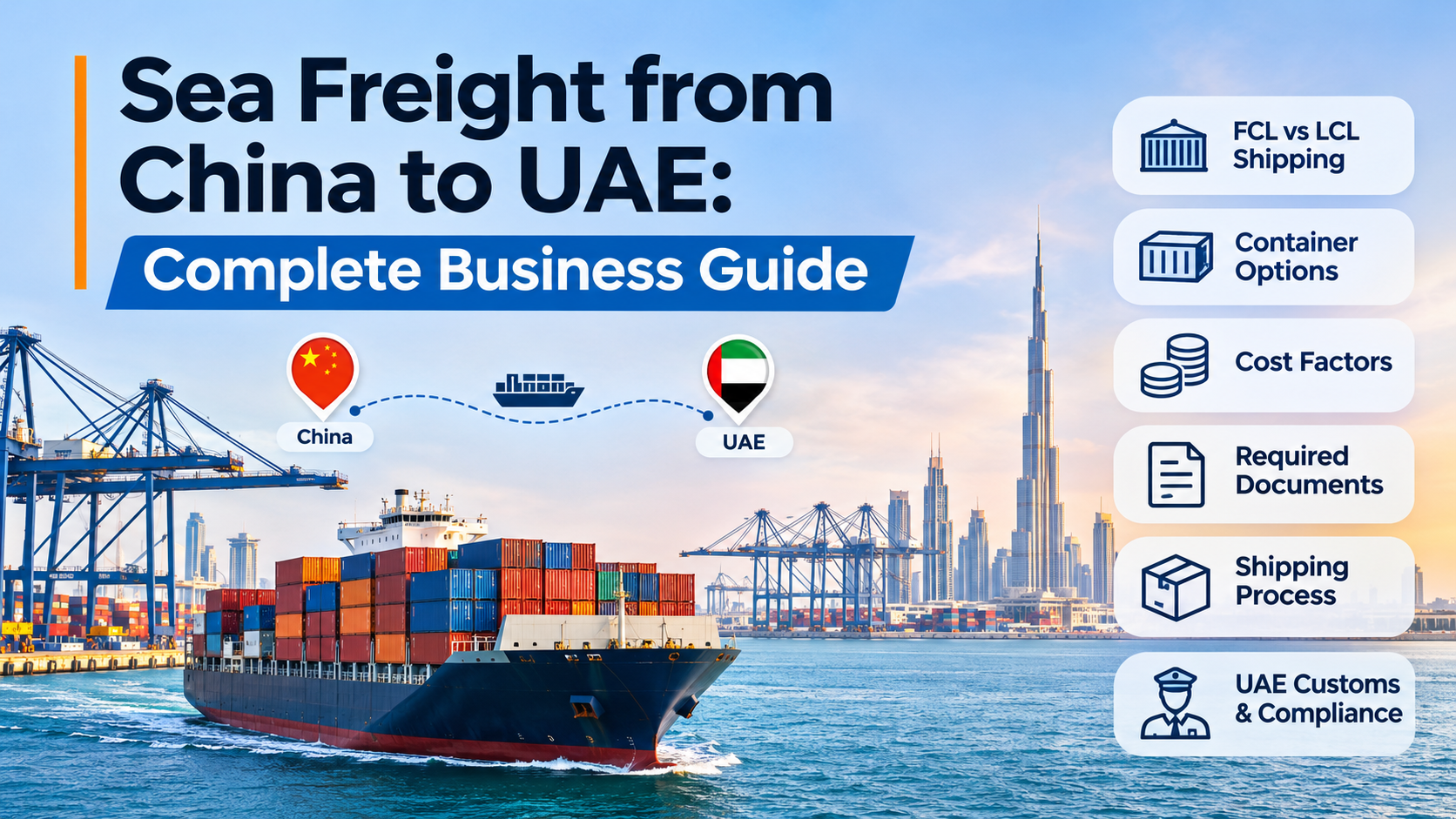
Sea freight is an important transportation option for businesses importing commercial goods from China to the United Arab Emirates. It is commonly considered for bulk orders, machinery, furniture, construction materials, industrial equipment and other products that require larger cargo capacity.
China has an extensive network of international seaports connecting manufacturers and exporters with destinations across the Middle East. For UAE importers, selecting the right shipping arrangement involves more than choosing a vessel or container. Businesses must consider cargo volume, supplier location, container availability, port routing, customs requirements and final delivery arrangements.
Whether you are a wholesaler, retailer, distributor, manufacturer or small business owner, understanding the sea freight process can help you plan shipments and manage logistics expenses.
This guide explains how sea freight from China to the UAE works, the differences between Full Container Load (FCL) and Less than Container Load (LCL), container options, shipping cost factors, documentation, customs clearance and practical considerations for commercial importers.
For a broader overview of all transportation methods, read our complete guide to shipping from China to the UAE. For Dubai-specific shipping arrangements, see our guide to shipping from China to Dubai: costs, transit times and process.
1. What Is Sea Freight from China to UAE?
Sea freight is the transportation of goods by cargo vessels from Chinese seaports to ports serving the UAE.
It is commonly used by businesses that import large quantities of products or cargo that is too expensive or impractical to transport by air.
Typical goods transported by sea freight include:
- Machinery and industrial equipment.
- Furniture and interior products.
- Construction materials.
- Electronics and electrical equipment.
- Textiles and garments.
- Automotive components.
- Household and retail products.
- Commercial and wholesale merchandise.
Sea freight can accommodate different shipment sizes through shared-container arrangements or dedicated containers.
The most suitable option depends on cargo volume, weight, dimensions, handling requirements, delivery schedule and overall logistics cost.
2. FCL vs LCL: Which Sea Freight Option Is Better?
Businesses importing from China generally choose between Full Container Load (FCL) and Less than Container Load (LCL).
Understanding the difference helps importers choose the right arrangement for their cargo.
Full Container Load (FCL) Shipping
FCL means booking an entire shipping container for your shipment.
The container is allocated to one shipment, even if the cargo does not fill its available space.
FCL is commonly suitable for:
- Large commercial orders.
- Bulk product imports.
- Heavy machinery and industrial equipment.
- Furniture and construction materials.
- Regular shipments from Chinese manufacturers.
- Cargo requiring dedicated container space.
Advantages of FCL shipping
- Exclusive use of the container.
- Greater control over loading arrangements.
- Less consolidation and deconsolidation handling.
- Suitable for larger cargo volumes.
- Easier coordination for full-container shipments.
However, importers should consider the complete container cost, including origin handling, ocean freight, destination charges and container-related fees.
Less than Container Load (LCL) Shipping
LCL allows businesses to share container space with cargo belonging to other importers.
Instead of booking an entire container, the importer pays for the space their shipment occupies under the applicable consolidation pricing rules.
LCL is commonly suitable for:
- Small commercial shipments.
- Businesses testing new products.
- Importers purchasing from multiple suppliers.
- Smaller wholesale orders.
- Businesses that do not require a full container.
Advantages of LCL shipping
- No need to book an entire container.
- Suitable for smaller cargo volumes.
- Useful for businesses with limited inventory requirements.
- Can support shipments collected from multiple suppliers.
However, LCL usually involves additional handling stages.
Cargo must be received and consolidated at the origin warehouse before loading. At the destination, the container is unpacked and individual shipments are separated before delivery.
This can increase handling requirements and overall transit time.
FCL vs LCL Comparison
Comparison | FCL | LCL |
Container space | Dedicated container | Shared container |
Best suited for | Larger shipments | Smaller shipments |
Pricing basis | Container-based quotation | Volume or applicable chargeable basis |
Cargo handling | Generally fewer consolidation stages | Consolidation and deconsolidation |
Delivery planning | Dedicated container movement | Requires separation of individual shipments |
Main consideration | Complete container cost | Per-shipment handling and destination charges |
Which option should you choose?
FCL may be more economical when your cargo occupies a substantial portion of a container or when dedicated container handling is important.
LCL can be more suitable for smaller shipments where booking an entire container would be unnecessary.
Always compare the total landed cost of both options before deciding. The cheapest freight rate per unit does not necessarily mean the lowest overall shipping cost.
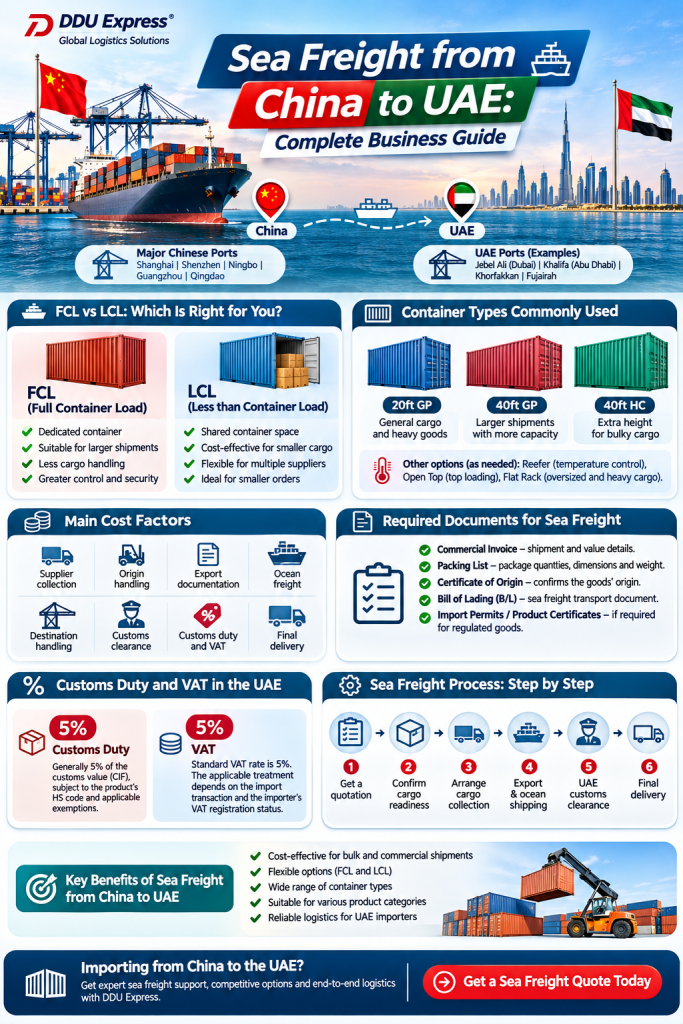
3. What Container Types Are Used for Sea Freight?
Different container types are available depending on cargo dimensions, weight, packaging and handling requirements.
20-Foot General Purpose Container
A 20-foot container is commonly used for commercial cargo, machinery, packaged goods and heavy products.
It can be suitable when cargo weight is relatively high compared with its volume.
40-Foot General Purpose Container
A 40-foot container provides more internal cargo space than a 20-foot container.
It may be suitable for larger shipments of furniture, textiles, consumer products and general merchandise.
40-Foot High Cube Container
A 40-foot High Cube container offers additional internal height compared with a standard 40-foot container.
It can be useful for bulky or relatively lightweight cargo that requires more vertical space.
Specialised Containers
Certain cargo requires specialised equipment or transportation arrangements.
Examples include:
Reefer Containers
Refrigerated containers maintain controlled temperatures for temperature-sensitive goods.
Open Top Containers
These containers have an open roof arrangement and may be suitable for cargo that requires top loading.
Flat Rack Containers
Flat racks can accommodate certain oversized or heavy cargo that cannot fit inside standard container dimensions.
Specialised container availability, cargo acceptance and handling arrangements should be confirmed with the shipping provider before booking.
4. How Much Does Sea Freight from China to UAE Cost?
Sea freight costs depend on the shipment’s origin, destination, cargo volume, container type, carrier availability and applicable charges.
No fixed rate applies to every China-to-UAE shipment.
The final quotation may include several cost components.
Main Sea Freight Cost Components
Cost component | Description |
Supplier collection | Transportation from the factory or warehouse to the origin facility |
Origin handling | Cargo receiving, handling and processing in China |
Export documentation | Required export paperwork and procedures |
Container loading | Stuffing and related handling where applicable |
Ocean freight | Transportation by sea from the origin port |
Destination handling | Port or terminal handling charges in the UAE |
Delivery order | Documentation and release-related charges |
Customs clearance | Import declaration and clearance services |
Customs duty and VAT | Applicable UAE import taxes |
Final delivery | Transportation to the agreed destination |
Not every quotation includes all these services. Importers should request a complete breakdown before confirming a shipment.
Factors That Affect Sea Freight Prices
- Shipment Volume
The cargo volume is an important factor when comparing FCL and LCL.
LCL shipments are generally priced according to volume or the applicable weight and measurement rules, while FCL quotations are usually based on container type and route.
- Departure Port in China
The supplier’s location and distance from the departure port affect domestic transportation and cargo collection costs.
For example, the logistics requirements for cargo collected near Shenzhen may differ from those for goods collected near Shanghai or Qingdao.
- Destination Port in the UAE
The port of discharge affects ocean freight, destination handling, customs arrangements and local transportation.
The final route should be confirmed against the shipping line’s current service and booking.
- Container Type
Standard, high-cube and specialised containers have different availability and pricing arrangements.
- Cargo Characteristics
Oversized, heavy, hazardous or temperature-sensitive cargo may require special equipment, documentation or handling.
- Market Conditions
Freight rates can change due to vessel availability, seasonal demand, fuel-related charges, port congestion and changes to shipping routes.
How to Get an Accurate Sea Freight Quotation
Businesses should provide the following details when requesting a quotation:
- Supplier or factory location in China.
- Cargo description.
- Number of packages.
- Total gross weight.
- Total cargo volume in CBM.
- Individual package dimensions.
- Preferred FCL or LCL arrangement.
- Destination city or delivery address in the UAE.
- Required shipping timeframe.
- Applicable product or handling requirements.
Providing accurate shipment information helps logistics providers compare available options and prepare a more reliable quotation.
Important note: Sea freight rates and destination charges fluctuate. Any online price should be treated as an indicative estimate unless supported by a current, shipment-specific quotation. Customs duty, VAT, insurance and local delivery may be additional charges depending on the agreed arrangement.
Common extra charges can include documentation fees, port handling charges, terminal handling charges, customs clearance fees, storage charges, delivery charges, container demurrage or detention, and charges for special equipment or additional services. Importers should ask for a full breakdown of all possible charges to compare options and budget for the total shipment cost properly.
5. How Is Cargo Volume Calculated for Sea Freight?
Cargo volume is commonly expressed in cubic metres (CBM).
It is particularly important for LCL shipments because the volume occupied by the cargo influences the freight quotation.
The basic formula is:
CBM = Length × Width × Height (in metres)
For example, suppose a shipment contains 10 cartons with the following dimensions:
- Length: 0.60 metres.
- Width: 0.40 metres.
- Height: 0.50 metres.
Volume of one carton:
0.60 × 0.40 × 0.50 = 0.12 CBM
Total volume:
0.12 × 10 = 1.20 CBM
This gives the total external package volume, assuming the cartons are measured correctly.
For pallets or irregularly shaped cargo, use the final packed dimensions rather than the product dimensions alone.
Importers should provide accurate measurements because incorrect dimensions can result in revised freight charges.
6. Major Chinese Ports for Sea Freight to UAE
China has several major commercial ports that support international container transportation.
The most suitable departure port depends on the supplier’s location, cargo readiness, available shipping services and overall logistics cost.
Shanghai Port
Shanghai is a major international container port serving exporters and manufacturers across eastern China.
It is an important option for businesses sourcing products from Shanghai and nearby industrial regions.
Shenzhen Port
Shenzhen is a significant shipping gateway for southern China.
It serves businesses sourcing electronics, consumer products, machinery and other manufactured goods from nearby industrial areas.
Ningbo-Zhoushan Port
Ningbo-Zhoushan is an important international port serving manufacturing and industrial regions in eastern China.
Guangzhou Port
Guangzhou supports international cargo movements for businesses across Guangdong and surrounding areas.
Qingdao Port
Qingdao is an important commercial shipping gateway serving northern China and nearby manufacturing regions.
Choosing the Right Departure Port
The closest port is not automatically the cheapest option.
Businesses should compare:
- Distance from the supplier to the port.
- Factory collection and trucking charges.
- Available vessel schedules.
- Ocean freight quotation.
- Cargo handling requirements.
- Total transportation cost to the UAE.
A suitable route should balance collection cost, shipping availability and the final delivery requirements.
7. Which UAE Ports Are Used for Sea Freight from China?
The UAE has several commercial seaports supporting international cargo transportation and distribution.
The appropriate destination depends on the shipping line, service availability, cargo type and final delivery location.
Jebel Ali Port, Dubai
Jebel Ali is a major commercial port and an important destination for international container cargo serving Dubai.
It supports cargo handling, international trade and distribution through Dubai’s logistics network.
Khalifa Port, Abu Dhabi
Khalifa Port supports commercial container and general cargo operations in Abu Dhabi.
It can be considered for shipments destined for Abu Dhabi and surrounding areas, depending on the available service.
Khorfakkan Port, Sharjah Emirate
Khorfakkan is an important port on the UAE’s eastern coast and serves international maritime cargo movements.
Its location and available shipping arrangements may make it relevant for certain cargo routes.
Fujairah Port
Fujairah is another important maritime gateway on the UAE’s eastern coast, supporting commercial shipping and logistics activities.
Important routing consideration: The actual port of discharge can change according to carrier services, operational conditions and regional port arrangements. Some shipments may use an alternative UAE port with onward road transportation to their final destination. Importers should confirm the port of discharge, inland movement arrangements and applicable charges before booking.
8. How Does the Sea Freight Shipping Process from China to UAE Work?
A commercial sea freight shipment involves several stages.
Step 1: Request a Shipping Quotation
Provide the supplier location, cargo description, shipment dimensions, weight, volume and UAE destination.
Confirm whether you need FCL or LCL shipping.
Step 2: Confirm Cargo Readiness
Check with the supplier to ensure the goods are ready for collection.
Confirm packaging, cargo quantities, final dimensions and any special handling requirements.
Step 3: Arrange Cargo Collection or Delivery to the Origin Warehouse
Depending on the agreed arrangement, cargo may be collected from the factory or delivered to the designated warehouse or port facility.
For LCL shipments, goods are generally received at a consolidation warehouse.
For FCL shipments, the container may be positioned for loading at the supplier’s facility or another agreed location.
Step 4: Complete Export Documentation in China
The required commercial and export documents are prepared.
The shipment must complete the applicable export customs procedures before departure.
Step 5: Container Loading and Vessel Departure
For FCL, cargo is loaded into the allocated container and prepared for transportation.
For LCL, eligible shipments are consolidated with other cargo before container loading.
Once the required procedures are completed, the container is loaded onto the vessel according to the confirmed shipping schedule.
Step 6: International Sea Transportation
The cargo travels from the selected Chinese departure port to the confirmed UAE destination port.
The actual transit period depends on the route, shipping line, vessel schedule and any transshipment.
Step 7: Arrival and UAE Customs Clearance
After arrival, the relevant customs declaration and supporting documents must be submitted.
Applicable customs duties, taxes, inspections and regulatory requirements must be completed before cargo release.
Step 8: Cargo Collection and Final Delivery
Once the cargo is released, arrangements can be made for container collection, deconsolidation where applicable and delivery to the agreed destination.
For FCL shipments, the empty container must also be returned within the agreed period to avoid applicable detention charges.
The exact responsibilities at each stage depend on the agreed shipping service and Incoterms.
Incoterms (International Commercial Terms) are standard trade terms that define the roles of buyers and sellers during international shipments. Some of the most commonly used Incoterms for sea freight include:
FOB (Free On Board): The seller is responsible for delivering the goods to the port of shipment and loading them onto the vessel. After this point, the buyer assumes responsibility for the shipment, including sea freight, insurance, and destination charges.
CIF (Cost, Insurance and Freight): The seller covers the cost of delivering the goods to the port of destination, including sea freight and insurance. However, the buyer is responsible for unloading, customs clearance, and local delivery in the destination country.
DAP (Delivered At Place): The seller is responsible for all costs and risks to deliver the goods to a specified address in the destination country, excluding import customs duties and taxes, which are the buyer’s responsibility.
Choosing the right Incoterm helps avoid misunderstandings about who pays for transportation, who handles documentation, and when risks transfer from the seller to the buyer.
For China-to-UAE sea freight, the most commonly used Incoterms are FOB (Free On Board), CIF (Cost, Insurance and Freight), and DAP (Delivered At Place).
When selecting an Incoterm, importers should consider their experience level, how much control they want over the shipping process, and the services the supplier provides. FOB is popular because it gives the buyer control over the main freight and choice of forwarder, while CIF is convenient for those who prefer the supplier to handle main transport and insurance. DAP provides the highest level of convenience for importers, as the seller manages almost all shipping steps up to final delivery, but costs may be higher. Always clarify who is responsible for export clearance, insurance, and local delivery before confirming your shipping arrangement.
9. What Documents Are Required for Sea Freight from China to UAE?
Preparing accurate documentation helps reduce customs queries and shipment delays.
Common documents for commercial sea freight include:
Commercial Invoice
The commercial invoice provides transaction details, including:
- Seller and buyer information.
- Product description.
- Unit price and total value.
- Country of origin.
Packing List
The packing list describes the shipment’s packaging and cargo details, including:
- Number of packages.
- Package dimensions.
- Gross and net weight.
- Product quantities.
- Package markings and numbers.
Certificate of Origin
The Certificate of Origin identifies where the goods originate. It may be required as part of the applicable import documentation.
Bill of Lading
The Bill of Lading is an important sea freight transport document containing shipment and transportation information.
It may be issued as an original document or under an applicable electronic or release arrangement.
Importers should confirm the release requirements with their shipping provider before the vessel arrives.
Import Permits and Product Certificates
Certain products require additional approvals or certificates from relevant UAE authorities.
This may apply to regulated products such as food, pharmaceuticals, medical products, telecommunications equipment, electronics and other controlled goods.
The exact requirements depend on the product category and applicable UAE regulations.
Other Documents Where Applicable
Depending on the cargo and transport arrangement, additional documents may include:
- Insurance certificate.
- Dangerous Goods Declaration.
- Material Safety Data Sheet (SDS).
- Product conformity documents.
- Special handling instructions.
- Other product-specific permits.
Dubai Customs lists the invoice, packing list, Certificate of Origin and permits from relevant restricted-goods authorities among the documents required for its customs declaration service.
Importers should confirm the requirements for their specific shipment before cargo departure. In the UAE, documents such as invoices, certificates of origin, and other official paperwork may require attestation by the relevant authorities or a UAE Embassy in China. It is also important to ensure that all documents are in English or Arabic, as customs may request certified translations for documents issued in other languages. Double-checking attestation and translation requirements before shipping can help avoid customs clearance delays.
10. UAE Customs Duty and VAT on Sea Freight Imports
Goods imported into the UAE must comply with applicable customs and tax regulations.
Customs Duty
Many goods imported into the UAE mainland are subject to a standard customs duty of 5% of the customs value, commonly calculated using the CIF (Cost, Insurance and Freight) value.
However, the actual customs duty depends on the HS code, tariff classification, exemptions and applicable customs regulations.
Certain products may be subject to different rates or restrictions.
VAT
The standard VAT rate in the UAE is 5%.
The applicable VAT treatment depends on the import transaction and the importer’s VAT registration status.
VAT-registered businesses may be eligible to account for import VAT through the applicable reverse charge mechanism, subject to the relevant conditions.
Businesses should confirm the applicable duty and VAT treatment before calculating the total landed cost.
11. Common Sea Freight Challenges and How to Avoid Them
Sea freight involves several stages, and operational issues can affect shipping schedules and costs.
Incorrect Cargo Measurements
Incorrect dimensions or weights can result in revised freight quotations and additional charges.
How to avoid it: Obtain final packed dimensions and verified cargo weights before requesting a quotation.
Incomplete Shipping Documents
Missing or inconsistent information across invoices, packing lists and transport documents can cause customs queries.
How to avoid it: Review all documents before cargo departure and ensure shipment details are consistent.
Incorrect HS Code Classification
Incorrect classification can affect customs duty and product-specific import requirements.
How to avoid it: Confirm the appropriate HS code with a qualified customs professional before shipping. You can further reduce classification errors by consulting the UAE Federal Customs Authority or Dubai Customs for guidance, using official online tariff search tools, or referencing the GCC Common Customs Tariff. Many customs authorities provide online databases or helplines to help importers verify HS codes. If needed, request written confirmation or advance rulings from UAE customs to ensure the correct classification before shipping.
Port Congestion and Schedule Changes
Vessel schedules and port operations may be affected by congestion, operational disruptions and changes in shipping routes.
How to avoid it: Confirm the latest vessel schedule and allow reasonable time for possible delays.
Unexpected Destination Charges
Importers who compare only ocean freight rates may overlook destination handling, documentation, storage and delivery charges.
How to avoid it: Request a complete quotation showing the included and excluded charges.
Demurrage and Detention
Demurrage and detention charges may apply when containers remain at the terminal or outside the terminal beyond the permitted free time under the applicable terms.
How to avoid it: Confirm the free-time allowance, prepare documents in advance and arrange timely container collection and empty-container return.
Cargo Damage During Transportation
Improper packaging, loading or handling can result in cargo damage.
How to avoid it: Use suitable packaging, confirm loading arrangements and consider appropriate cargo insurance. While cargo insurance is not mandatory for sea freight shipments to the UAE, it is strongly recommended as part of risk management. Typically, cargo insurance covers loss or damage to goods due to accidents, theft, or unforeseen events during transit.
Main types of cargo insurance include:
– All Risk Insurance: This is the most comprehensive coverage, protecting against a wide range of physical loss or damage from external causes during transit. However, it may exclude certain specific risks, so importers should review the terms carefully.
– Total Loss Insurance: This type of policy covers only the total loss of the entire shipment, either through a major incident or if the goods are destroyed or lost.
– Free from Particular Average (FPA): This coverage applies mainly to particular types of disasters such as sinking, collision, fire, or overturning of the vessel but does not cover partial losses unless these result from one of the specified major events.
Importers should review each policy type and consult with their insurance provider to select appropriate coverage for their goods and shipping arrangements.
12. How Can Businesses Reduce Sea Freight Costs from China to UAE?
Businesses can manage shipping expenses through careful planning and better coordination with suppliers and logistics providers.
Consider the following practices:
Compare FCL and LCL
Evaluate both options based on the complete shipment cost rather than comparing only the headline freight rate.
Consolidate Multiple Supplier Orders
If goods are purchased from different Chinese suppliers, consider combining eligible cargo at an origin warehouse.
Optimise Packaging
Efficient packaging can help reduce unnecessary cargo volume and make better use of container space.
Plan Shipments in Advance
Booking and supplier coordination can help businesses avoid last-minute transportation requirements.
Confirm Cargo Details Early
Accurate weight, volume and product information help reduce quotation revisions and unexpected charges.
Review Destination Charges
Compare the full origin-to-destination cost, including handling, customs clearance, storage and final delivery.
Choose Suitable Container Equipment
Select the container type based on cargo dimensions, weight and handling requirements, rather than paying for unnecessary specialised equipment.
13. How to Choose a Sea Freight Forwarder for China-to-UAE Shipments
Choosing a suitable logistics provider is important for coordinating international cargo transportation.
Before selecting a freight forwarder, consider:
Experience with China-to-UAE Shipping
Check whether the provider has experience handling your cargo type and the required trade route.
FCL and LCL Arrangements
Confirm whether the provider can coordinate both full-container and shared-container shipments, depending on your requirements.
Transparent Quotations
Request a clear breakdown of origin charges, ocean freight, destination charges, customs clearance and final delivery.
Documentation Support
Check whether the provider can assist with shipping documentation and coordinate applicable customs requirements.
Cargo Tracking and Communication
Ask how shipment updates are provided and who your point of contact will be.
Destination Delivery Coordination
Confirm whether the provider can arrange container collection, cargo deconsolidation where applicable and final delivery.
A suitable freight partner should help you understand the available options, responsibilities and costs before you confirm a shipment.
To select a reliable forwarder, verify that the company is properly licensed, such as holding a valid freight forwarder or NVOCC license, if applicable. Ask for business references from other customers who have used their shipping services on China-to-UAE routes. Look for memberships in recognized industry associations like FIATA, WCA, or the International Federation of Freight Forwarders, as these can signal higher professional standards. You can also research online reviews and check whether the forwarder has a proven operational track record. Taking these steps can help you reduce risks and avoid communication problems or unforeseen issues with your shipment.
14. Why Choose DDU Express for Sea Freight from China to UAE?
Businesses importing commercial cargo from China need logistics arrangements that suit their shipment size, delivery requirements and budget.
DDU Express helps businesses explore international cargo transportation and suitable sea freight arrangements for their import requirements. What sets our service apart is our commitment to faster response times, tailored logistics solutions, and in-depth local expertise in the UAE market. Our dedicated team provides personalized support at every stage, ensuring smooth communication and proactive problem-solving to help you navigate customs, regulatory requirements, and local delivery challenges.
Whether you are shipping bulk commercial products, machinery, furniture, construction materials or smaller consolidated cargo, our team can help you understand the available shipping options.
Our logistics support includes:
- International sea freight arrangements.
- FCL and LCL shipping coordination.
- Commercial cargo transportation.
- Cargo consolidation arrangements.
- Shipping documentation support.
- Customs clearance coordination.
- Door-to-door shipping coordination.
- Final delivery planning.
Contact DDU Express with your supplier location, cargo volume, dimensions and destination to discuss suitable sea freight arrangements from China to the UAE. Once you reach out, our team will review your requirements and provide a free initial consultation. We will walk you through the quotation process, answer any questions you may have, and share a detailed shipping proposal, including a timeline and cost breakdown so that you can make an informed decision about your shipment.
Frequently Asked Questions About Sea Freight from China to UAE
What is the cheapest way to ship goods from China to UAE?
Sea freight is generally a cost-effective option for larger commercial shipments. LCL may suit smaller cargo volumes, while FCL may offer better overall value for larger shipments.
What is the difference between FCL and LCL shipping?
FCL means booking an entire container for one shipment, while LCL allows multiple importers to share container space. The best option depends on cargo volume, cost and handling requirements.
How long does sea freight from China to UAE take?
Transit time depends on the departure port, destination port, shipping line and whether the service involves transshipment. As a general guide, average sea freight transit times from major Chinese ports to UAE ports typically range from 18 to 28 days. LCL shipments may require additional time for consolidation at origin and deconsolidation at destination, which can add several days to the total delivery time.
For example, a typical door-to-door shipment from Shanghai to Dubai might take 20 to 25 days if using FCL, including customs clearance and local delivery within Dubai after the vessel arrives. For LCL shipments, door-to-door delivery may take around 25 to 32 days in total, allowing for extra time required for consolidation at origin, deconsolidation at destination, customs procedures and final delivery arrangements. Transit times can vary, so request a current route-specific estimate before booking.
Which Chinese ports are used for sea freight to UAE?
Major Chinese ports include Shanghai, Shenzhen, Ningbo-Zhoushan, Guangzhou and Qingdao. The suitable departure port depends on the supplier’s location and available shipping services.
Which UAE ports receive sea freight from China?
Jebel Ali, Khalifa Port, Khorfakkan and Fujairah are among the UAE’s commercial maritime gateways. The actual destination port depends on the carrier’s service and cargo requirements.
What container sizes are commonly used for sea freight?
Common container options include 20-foot, 40-foot and 40-foot High Cube containers. Specialised options such as reefer, open top and flat rack containers may be available for specific cargo requirements.
How is LCL sea freight calculated?
LCL charges are generally based on cargo volume in cubic metres (CBM) or applicable weight and measurement rules. The final quotation may also include origin handling, destination handling and other charges.
What documents are required for sea freight from China to UAE?
Common documents include a commercial invoice, packing list, Certificate of Origin and Bill of Lading. Additional permits or certificates may be required for regulated products.
Is customs duty applicable to sea freight imports into the UAE?
Many goods imported into the UAE mainland are subject to a standard 5% customs duty, but actual rates depend on HS code classification, exemptions and applicable regulations.
Can I consolidate cargo from multiple Chinese suppliers?
Yes. Eligible goods from multiple suppliers may be collected at a consolidation warehouse and combined into an LCL shipment, depending on the service arrangement.
Can I ship machinery and heavy equipment by sea?
Yes. Suitable containers or specialised cargo arrangements may be used, depending on the equipment’s weight, dimensions, packaging and handling requirements.
Can I arrange door-to-door sea freight from China to UAE?
Door-to-door arrangements may include supplier collection, export clearance, international transportation, import customs clearance and final delivery. Confirm the services, costs and importer responsibilities before booking.
How can I get a sea freight quotation from China to UAE?
Provide your supplier location, cargo description, package dimensions, gross weight, total CBM, preferred shipping method and UAE delivery address. These details help a logistics provider prepare a shipment-specific quotation.
Get a Sea Freight Quote from China to UAE
Planning to import commercial goods from China to the UAE?
Whether you need a dedicated container for bulk cargo or an LCL arrangement for smaller shipments, DDU Express can help you explore suitable sea freight and logistics options.
To request a quotation, share the following information:
- Supplier or factory location in China.
- Product description.
- Number of packages.
- Total gross weight.
- Cargo dimensions and total CBM.
- Preferred FCL or LCL arrangement.
- Destination city or delivery address in the UAE.

Weiworld is an experienced logistics and shipping professional with more than 20 years of industry experience, with extensive knowledge of international shipping, freight forwarding, cargo movement, and logistics operations.
Over the course of his career, he has developed deep practical expertise in Middle East logistics and operations, including shipping processes, international cargo transportation, customs-related procedures, and supply chain coordination.
At DDU Express, Weiworld shares practical insights and industry knowledge to help businesses better understand international shipping, freight forwarding, DDP services, cargo transportation, and logistics solutions across the Middle East and global markets.
His extensive industry experience provides valuable perspective for businesses looking to simplify international shipping and make informed decisions when moving cargo between countries.