Dubai is one of the Middle East’s leading commercial and logistics destinations. Businesses across the emirate import products from China to support retail operations, wholesale distribution, construction, manufacturing and e-commerce.
Chinese suppliers provide a broad range of products, including electronics, machinery, furniture, textiles and commercial goods. Shipping these items to Dubai requires more than booking international freight; importers must also manage supplier collection, shipping schedules, customs clearance, destination charges and final delivery.
Selecting the appropriate transportation method and understanding the import process help businesses control logistics costs and prevent delays.
This guide outlines the shipping process from China to Dubai, covering freight options, estimated transit times, cost factors, Jebel Ali Port, Dubai customs procedures and delivery arrangements.
For a broader overview of importing goods into different UAE destinations, see our complete guide to shipping from China to UAE.
1. How Does Shipping from China to Dubai Work?
Shipping commercial goods from China to Dubai involves several stages, starting with cargo collection at the supplier’s location and ending with delivery to the final destination.
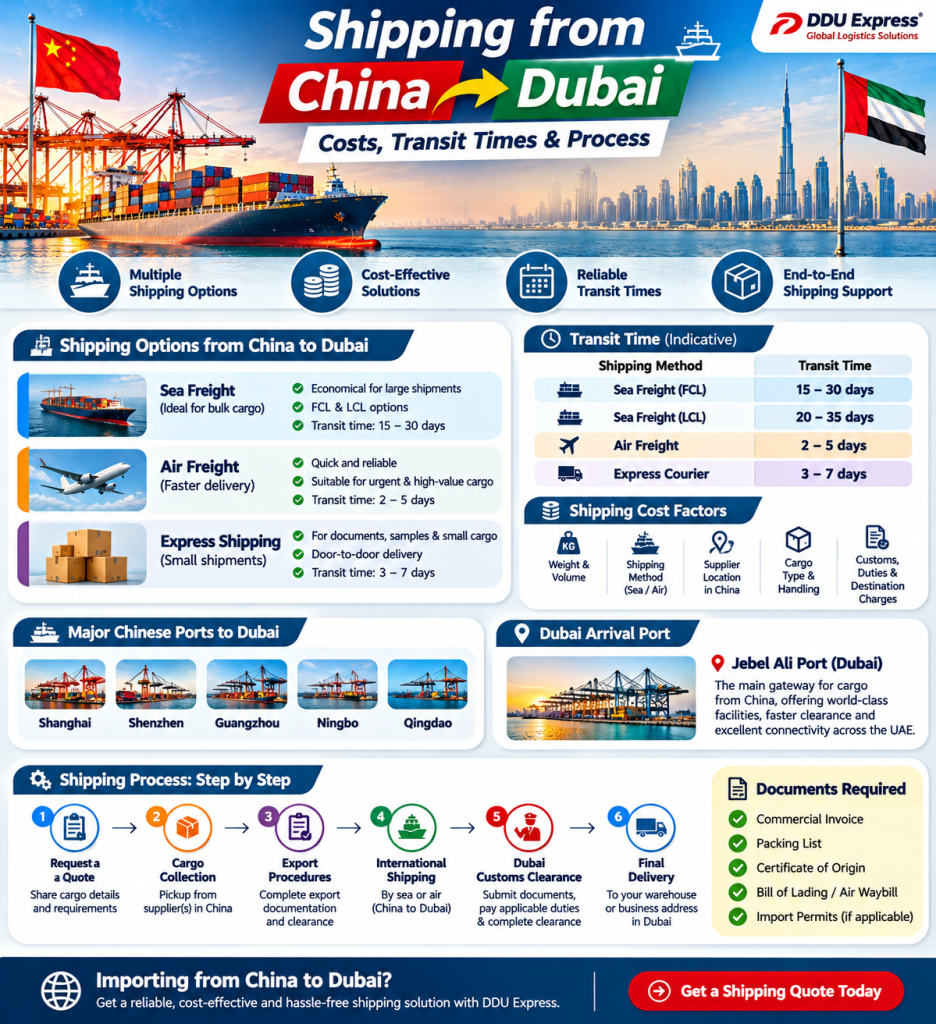
A typical shipment follows this process:
- Request a shipping quotation: Provide the supplier location, product description, cargo weight, dimensions and Dubai delivery address.
- Confirm cargo readiness: Check that the supplier has completed production, packaging and shipment preparation.
- Arrange cargo collection: Collect goods from the factory or warehouse, depending on the agreed service.
- Complete export procedures: Arrange the required export documentation and customs formalities in China.
- Arrange international transportation: Cargo travels to Dubai by sea freight, air freight or express courier.
- Complete Dubai customs clearance: Handle the import declaration, supporting documents, duties and other requirements.
- Arrange final delivery: After customs release, cargo is transported to the agreed warehouse or business address.
The specific process and responsibilities depend on the shipping method, agreed Incoterms and logistics service.
2. What Are the Shipping Options from China to Dubai?
Businesses can choose sea freight, air freight or express courier services. The best option depends on cargo size, weight, delivery urgency and budget.
Sea Freight from China to Dubai
Sea freight is commonly considered for large commercial shipments, bulk orders, machinery, furniture and construction materials.
Jebel Ali Port is a major destination for commercial container cargo arriving in Dubai.
Businesses typically select between two sea freight options.
Full Container Load (FCL)
FCL means booking an entire shipping container for a shipment.
It may be suitable for:
- Large commercial orders.
- Bulk product imports.
- Heavy machinery and industrial equipment.
- Furniture and construction materials.
- Businesses importing goods regularly.
Less than Container Load (LCL)
LCL allows businesses to share container space with cargo from other importers.
It can be useful for:
- Smaller commercial shipments.
- Businesses testing new products.
- Importers purchasing from multiple suppliers.
- Companies that do not need an entire container.
LCL shipments involve consolidation at origin and separation at destination, which can increase overall shipping time.
Air Freight from China to Dubai
Air freight is suitable when fast transportation is required.
Businesses commonly consider it for:
- Electronics and electronic components.
- Product samples.
- Spare parts.
- High-value commercial products.
- Urgent stock replenishment.
Air freight charges generally depend on chargeable weight, which considers both actual weight and volumetric weight.
While air freight typically costs more per kilogram than sea freight, it is useful when products are needed quickly.
Express Courier Shipping
Express courier services suit documents, samples and smaller packages.
They typically provide shipment tracking and convenient collection and delivery services.
However, courier services may be expensive for large commercial shipments. Businesses should compare courier quotations with standard air freight before selecting a service.
3. How Much Does Shipping from China to Dubai Cost?
The cost of shipping from China to Dubai depends on several factors, including the supplier’s location, cargo weight, package dimensions, transportation method and destination requirements.
No single rate applies to every shipment.
Main Shipping Cost Components
Cost component | What it covers |
Supplier collection | Collecting cargo from the factory or warehouse in China |
Origin handling | Cargo receiving, processing and handling |
Export documentation | Required export paperwork and procedures |
International freight | Sea, air or courier transportation |
Destination handling | Port or airport handling charges in Dubai |
Customs clearance | Import declaration and clearance services |
Customs duty and VAT | Applicable UAE import taxes |
Final delivery | Transportation to the agreed warehouse or business address |
What Factors Affect Shipping Prices?
- Cargo Weight and Volume
A shipment’s dimensions and weight directly influence transportation charges. Air freight generally uses chargeable weight, while LCL sea freight is commonly calculated using cargo volume or applicable weight rules.
- Supplier Location in China
The distance from the supplier’s warehouse to the departure port or airport affects collection and domestic transportation costs.
For example, a supplier located near Shenzhen may have different collection and routing costs from one based in Shanghai or Qingdao.
- Shipping Method
Sea freight is typically used for larger shipments, air freight for urgent cargo and express courier services for smaller packages.
- Cargo Type
Fragile, oversized, hazardous or regulated products may require extra packaging, handling or documentation.
- Dubai Destination Charges
Importers should factor in destination handling, delivery order charges, customs processing, storage and local transportation when calculating total landed cost.
What Information Is Needed for a Shipping Quote?
To receive an accurate quotation, provide your logistics provider with:
- Supplier location in China.
- Product description.
- Total cargo weight.
- Package dimensions.
- Number of packages.
- Preferred shipping method.
- Delivery address in Dubai.
- Required delivery timeframe.
Ask for a charge breakdown and clarify which services are included or excluded.
Important note: Freight rates and destination charges vary with market conditions, carrier availability, shipment details and seasonal demand. As a general guideline, sea freight for a 20-foot container (FCL) from China to Dubai may typically range from USD 1,000 to USD 2,000, while LCL shipments can range from USD 80 to USD 150 per cubic meter, depending on the route and specifics. Air freight for standard commercial cargo may range from USD 3 to USD 7 per kilogram, while small express courier shipments can range from USD 8 to USD 15 per kilogram. These indicative prices are estimates and not guaranteed quotations.
Sample Shipment Scenarios:
– Example 1: Shipping 2 pallets (500 kg, total 2.5 cubic meters) by LCL sea freight from Shanghai to Dubai
– LCL freight cost: 2.5 cbm x USD 120 = USD 300 (based on mid-range rate)
– Origin, destination, and local delivery charges: USD 180 (estimate)
– Total estimated shipping cost: USD 480
– Example 2: Shipping 2 pallets (500 kg) by air freight from Shanghai to Dubai
– Air freight cost: 500 kg x USD 5 = USD 2,500 (based on average rate)
– Handling and delivery charges: USD 250 (estimate)
– Total estimated shipping cost: USD 2,750
These are sample calculations for reference only. Actual costs will depend on your shipment’s specific size, route, and timing. For an accurate, shipment-specific quote, contact DDU Express with your cargo details.
4. How Long Does Shipping from China to Dubai Take?
Transit times depend on the departure location, carrier schedule, transportation method, consolidation requirements, customs clearance and final delivery arrangements.
The following are indicative planning ranges, not guaranteed delivery commitments.
Shipping method | Indicative transit time |
Sea freight FCL | Around 15–30 days, port to port |
Sea freight LCL | Around 20–35 days, port to port |
Air freight | Around 2–5 days, airport to airport |
Express courier | Around 3–7 days, door to door |
Actual delivery periods may be longer depending on transshipment, cargo handling, customs inspections, seasonal congestion and local delivery arrangements.
What Affects Sea Freight Transit Time?
Sea freight schedules from Shenzhen, Guangzhou, Shanghai, Ningbo and other Chinese ports can differ.
Direct services and transshipment services may also have different schedules.
LCL shipments may require additional time for cargo consolidation before departure and deconsolidation after arrival.
What Affects Air Freight Transit Time?
Air freight is faster than sea freight, but airport-to-airport transit time does not reflect total delivery time.
Consider supplier collection, export handling, arrival processing, customs clearance and final transportation.
Confirm with your logistics provider whether the quoted transit time covers only international transportation or the full door-to-door process.
5. Which Chinese Ports Are Used for Shipping to Dubai?
The departure port is typically chosen based on supplier location, cargo availability and available shipping services.
Some major Chinese ports used for international cargo transportation include:
Chinese port | General location and relevance |
Shanghai Port | Major international port serving eastern China |
Shenzhen Port | Important gateway for southern China |
Ningbo-Zhoushan Port | Serves industrial and manufacturing areas in eastern China |
Guangzhou Port | Serves businesses across Guangdong and nearby regions |
Qingdao Port | Important shipping gateway for northern China |
For example, suppliers based in Shenzhen or Dongguan may consider Shenzhen as a departure gateway, while businesses sourcing products from Shanghai or Ningbo may consider the corresponding eastern China ports.
The most suitable route depends on the supplier’s location, cargo collection cost, shipping schedules and total logistics quotation.
6. Why Is Jebel Ali Port Important for Shipping to Dubai?
Jebel Ali Port is one of the UAE’s major commercial shipping gateways and an important destination for international container cargo.
It supports cargo handling, international trade and distribution through Dubai’s logistics network.
Businesses importing commercial products from China frequently use Jebel Ali for sea freight shipments destined for Dubai.
What Happens When Cargo Arrives at Jebel Ali?
After a shipment reaches the port, several procedures may need to be completed before the goods can be delivered.
These generally include:
- Arrival notification and shipment documentation.
- Completion of the applicable customs declaration.
- Submission of required supporting documents and permits.
- Payment of applicable customs duties and charges.
- Completion of any required inspection.
- Customs release and port-related formalities.
- Cargo collection and transportation to the final destination.
Procedures vary depending on the shipment, import arrangement and applicable customs requirements.
Delivery After Customs Release
Once cargo is released, arrange local transportation to the agreed warehouse or business address in Dubai.
Importers should coordinate with the receiving location in advance and confirm:
- Delivery address and contact details.
- Warehouse receiving arrangements.
- Vehicle and unloading requirements.
- Delivery appointment, if applicable.
- Any additional handling requirements.
Planning these details before cargo arrival helps avoid unnecessary waiting time and extra charges.
7. How Does Dubai Customs Clearance Work?
Customs clearance is a key step when importing commercial goods from China to Dubai. Import shipments must be declared to Dubai Customs according to applicable procedures. The importer or an authorised customs representative must submit the required declaration and supporting documents.
The general process involves:
- Preparing the commercial invoice and packing list.
- Providing the Bill of Lading or Air Waybill.
- Submitting the applicable customs declaration.
- Providing additional permits or certificates where required.
- Paying applicable customs duties and charges.
- Completing any required inspection.
- Obtaining customs release.
Dubai Customs offers electronic declaration services for import, export, transit and other customs procedures.
Customs Duty on Goods Imported into Dubai
Many goods imported into the UAE mainland are subject to a standard customs duty of 5% of the customs value, commonly calculated using the CIF (Cost, Insurance and Freight) value.
However, the actual duty depends on the product’s HS code, applicable exemptions and customs tariff classification.
Certain products may have different duty rates or special import requirements.
VAT on Imported Goods
The standard VAT rate in the UAE is 5%.
The applicable import VAT treatment depends on the import transaction and the importer’s VAT registration status.
VAT-registered businesses may be eligible to account for import VAT through the applicable reverse charge mechanism, subject to the relevant conditions.
Importers should confirm the applicable customs and VAT treatment before calculating their final landed cost.
8. What Documents Are Required for Shipping from China to Dubai?
Accurate shipping documents help customs authorities identify the goods, verify declared values and process import declarations.
Common documents for commercial shipments include:
Commercial Invoice
Contains seller and buyer information, product descriptions, quantities, unit prices, total values, currency and country of origin.
Packing List
Provides package quantities, dimensions, gross and net weights and packing details.
Certificate of Origin
Identifies the country where the goods originate. It may be required for customs clearance.
Bill of Lading
Used as a transport document for sea freight shipments.
Air Waybill
Used as a transport document for air cargo shipments.
Import Permits and Product Certificates
Certain regulated products may require additional approvals or certificates from the relevant UAE authorities. Common examples include electronics, telecommunications equipment, food and beverages, cosmetics and personal care products, pharmaceuticals, medical devices, and products containing batteries or wireless technology. Importers of these categories should check the specific import requirements and obtain any necessary permits before shipping.
Importers should ensure that product descriptions, quantities, weights and declared values are consistent across the invoice, packing list and transport documents.
For a broader explanation of import documentation, refer to our complete guide to shipping from China to UAE.
9. How Does Door-to-Door Shipping from China to Dubai Work?
Door-to-door shipping is a logistics arrangement in which cargo is collected from a supplier in China and transported to an agreed delivery address in Dubai.
Depending on the agreed service, it may include:
- Collection from the supplier’s warehouse.
- Cargo handling and preparation.
- Export clearance in China.
- International transportation by sea or air.
- UAE import customs clearance.
- Final delivery to the agreed address.
This arrangement can be convenient for businesses that prefer to coordinate their transportation through one logistics provider.
However, importers should carefully check the quotation before confirming a shipment. When reviewing a shipping quote, pay attention to these key checkpoints:
– Which services are included (such as supplier collection, export clearance, international freight, customs clearance, import duty, VAT, and final delivery)
– Which services are excluded or may be billed separately (like insurance, special handling, or storage)
– Any surcharges or additional fees (such as fuel surcharges, congestion charges, or peak season fees)
– The validity period of the quoted prices
– Currency of the quote and payment terms
– Responsibilities for customs formalities and who acts as importer of record
Verifying these details in advance helps avoid misunderstandings and unexpected costs.
Clarify whether the quoted amount includes:
- Supplier collection.
- International freight.
- Customs clearance.
- Import duty and VAT.
- Destination port or airport charges.
- Insurance.
- Final delivery.
Also confirm who will act as the importer of record and who is responsible for completing the import customs formalities. The importer of record is the individual or company legally responsible for ensuring the shipment complies with local laws and regulations, filing the necessary documentation with customs authorities, and paying any required duties and taxes. Clearly identifying the importer of record is important because it defines who has the legal and financial responsibility for the goods once they arrive in Dubai.
To avoid misunderstandings and potential delays, clarify each party’s responsibilities in writing before shipping. For example, your shipping contract, purchase agreement, or logistics service agreement can include a clause such as: “The [Importer/Consignee] shall act as the importer of record and is responsible for all import customs formalities, duties, and taxes in Dubai.” You may also use a checklist at the time of booking that includes: Who acts as importer of record, who submits customs paperwork, and who pays duties and taxes. Confirming and documenting these details in advance helps prevent disputes at the time of customs clearance.
Understanding Incoterms for China-to-Dubai Shipments
Incoterms define the responsibilities, costs and risks allocated between sellers and buyers in international trade.
Common terms include:
- FOB (Free On Board): The seller’s responsibilities generally extend to placing the goods on board the nominated vessel at the agreed port of shipment.
- CIF (Cost, Insurance and Freight): The seller arranges and pays for the cost, insurance and freight to the named destination port, subject to the applicable Incoterms rules.
- DDP (Delivered Duty Paid): The seller takes responsibility for delivery to the agreed destination, including import clearance and applicable duties and taxes, subject to the agreed terms and practical import arrangements.
Importers should understand the agreed Incoterm before arranging transportation because it affects who pays for each stage and who carries the relevant risks.
10. How Can Businesses Reduce Shipping Costs from China to Dubai?
Businesses importing products regularly can manage logistics expenses through better shipment planning and cost comparison.
Consider these practical steps:
Consolidate Shipments
If you purchase products from multiple suppliers, consider combining eligible cargo into one shipment. This may reduce the need for several separate freight movements.
Compare FCL and LCL
Do not automatically assume LCL is cheaper. Compare the complete costs of shared container space and full container shipping for your actual cargo volume.
Plan Shipments in Advance
Planning can help businesses avoid unnecessary urgent transportation charges.
Optimise Packaging
Review package dimensions and avoid unnecessary space, especially when shipping by air freight.
Compare Complete Quotations
Check origin charges, international freight, destination handling, customs clearance and local delivery charges.
Confirm Cargo Details
Accurate cargo weight, dimensions and product descriptions help reduce unexpected charges and documentation corrections.
11. Common Challenges When Shipping from China to Dubai
International cargo transportation can involve operational and documentation challenges.
Some common issues include:
Incorrect Shipping Documents
Inconsistent product descriptions, declared values, or package quantities can trigger customs queries.
Incorrect HS Code Classification
Incorrect classification can affect customs duty calculations and applicable import requirements.
Unexpected Destination Charges
Comparing only the international freight rate may cause you to overlook port handling, storage, delivery order and local transportation costs.
Product Compliance Issues
Certain products require additional approvals, permits or conformity certificates before import.
Shipping Delays
Port congestion, transshipment, weather conditions and customs inspections may affect delivery schedules.
Unplanned Local Delivery Arrangements
A shipment may experience additional waiting time if the receiving warehouse, unloading arrangements or delivery details are not ready.
Businesses can reduce these risks by preparing shipment information in advance, checking applicable requirements and confirming all charges and responsibilities with their logistics provider.
Risk Checklist: How to Avoid Common Shipping Pitfalls
– Double-check all shipping documents for consistency in product descriptions, values, and quantities.
– Confirm the correct HS code classification for your products to avoid customs issues.
– Verify that all required permits and certificates for regulated goods are obtained before shipping.
– Review and clarify all freight, handling, and local charges to prevent unexpected costs.
– Coordinate in advance with the receiving warehouse or delivery address to ensure readiness for the shipment.
– Monitor shipment progress and stay in contact with your logistics provider to quickly address any arising issues.
12. Why Choose DDU Express for Shipping from China to Dubai?
Businesses importing from China need a logistics partner who can coordinate international transportation, shipment documentation and destination arrangements.
DDU Express helps businesses explore suitable freight and logistics arrangements for commercial cargo.
Whether you are importing electronics, machinery, furniture, construction materials or general merchandise, our team can help you understand the available transportation options.
Our logistics support includes:
- International cargo transportation.
- Sea freight and air freight arrangements.
- Commercial cargo shipping.
- Door-to-door shipping coordination.
- Cargo consolidation arrangements.
- Shipping documentation support.
- Customs clearance coordination.
- Final delivery planning.
Contact DDU Express with your supplier location, cargo details and delivery requirements to discuss suitable shipping arrangements from China to Dubai. Our clients benefit from unique advantages such as dedicated account managers, expert guidance throughout the shipping process, and fast-track customs clearance support to help ensure your shipments move efficiently. We also provide real-time shipment tracking and responsive customer service for peace of mind. You can reach our logistics team by email, phone or through our online contact form. Visit our website for contact details and to submit your enquiry.
Frequently Asked Questions About Shipping from China to Dubai
How long does shipping from China to Dubai take?
Sea freight generally takes around 15–30 days port to port for FCL shipments and around 20–35 days for LCL shipments. Air freight typically takes 2–5 days, airport to airport. Actual delivery time depends on handling, customs clearance and final transportation.
How much does shipping from China to Dubai cost?
The cost depends on cargo weight, volume, transportation method, supplier location and destination charges. A shipment-specific quotation is needed to calculate the actual cost.
Which port is used for shipping from China to Dubai?
Jebel Ali Port is a major destination for commercial sea freight arriving in Dubai.
Which Chinese port is best for shipping to Dubai?
Shenzhen, Guangzhou, Shanghai, Ningbo and Qingdao are among the major departure options. The most suitable port depends on the supplier’s location, shipping schedule and total transportation cost.
What is the cheapest way to ship goods from China to Dubai?
Sea freight is generally a cost-effective option for larger commercial shipments. LCL may suit smaller cargo volumes, while FCL may be more economical for larger shipments.
What is the customs duty for importing goods from China to Dubai?
Many goods imported into the UAE mainland are subject to 5% customs duty based on their customs value. Actual rates depend on product classification, exemptions and applicable customs regulations.
Is VAT applicable when importing goods from China to Dubai?
The UAE standard VAT rate is 5%. Import VAT treatment depends on the import transaction and the importer’s tax registration status.
Can I ship goods from multiple suppliers in China to Dubai?
Yes. Eligible cargo from multiple suppliers can be collected and consolidated into a shared shipment, depending on the logistics provider’s arrangements.
Can I arrange door-to-door shipping from China to Dubai?
Door-to-door shipping can include supplier collection, international freight, customs clearance and final delivery. Confirm the services and charges included in the quotation before booking.
What documents are needed to ship goods from China to Dubai?
Common documents include a commercial invoice, packing list, Certificate of Origin and Bill of Lading or Air Waybill. Certain products may require additional permits or certificates.
Can small businesses import goods from China to Dubai?
Yes. Small businesses can consider LCL sea freight, air freight or express courier services depending on shipment size, urgency and budget.
Can DDU Express help with shipping from China to Dubai?
Contact DDU Express with your supplier location, product details, cargo dimensions and delivery address to discuss available shipping and logistics arrangements.
Get a Shipping Quote from China to Dubai
Planning to import products from China to Dubai?
Whether you need sea freight for bulk cargo, air freight for urgent shipments or a suitable arrangement for products from multiple suppliers, DDU Express can help you explore your logistics requirements.
To request a quotation, share the following information with our team:
- Supplier location in China.
- Product description.
- Total cargo weight and dimensions.
- Number of packages.
- Preferred shipping method.
- Delivery location in Dubai.
- Required delivery timeframe.
Our team can review your shipment details and explain the available shipping options.
Contact DDU Express today to discuss your China-to-Dubai shipping requirements and request a cargo shipping quotation.

Weiworld is an experienced logistics and shipping professional with more than 20 years of industry experience, with extensive knowledge of international shipping, freight forwarding, cargo movement, and logistics operations.
Over the course of his career, he has developed deep practical expertise in Middle East logistics and operations, including shipping processes, international cargo transportation, customs-related procedures, and supply chain coordination.
At DDU Express, Weiworld shares practical insights and industry knowledge to help businesses better understand international shipping, freight forwarding, DDP services, cargo transportation, and logistics solutions across the Middle East and global markets.
His extensive industry experience provides valuable perspective for businesses looking to simplify international shipping and make informed decisions when moving cargo between countries.