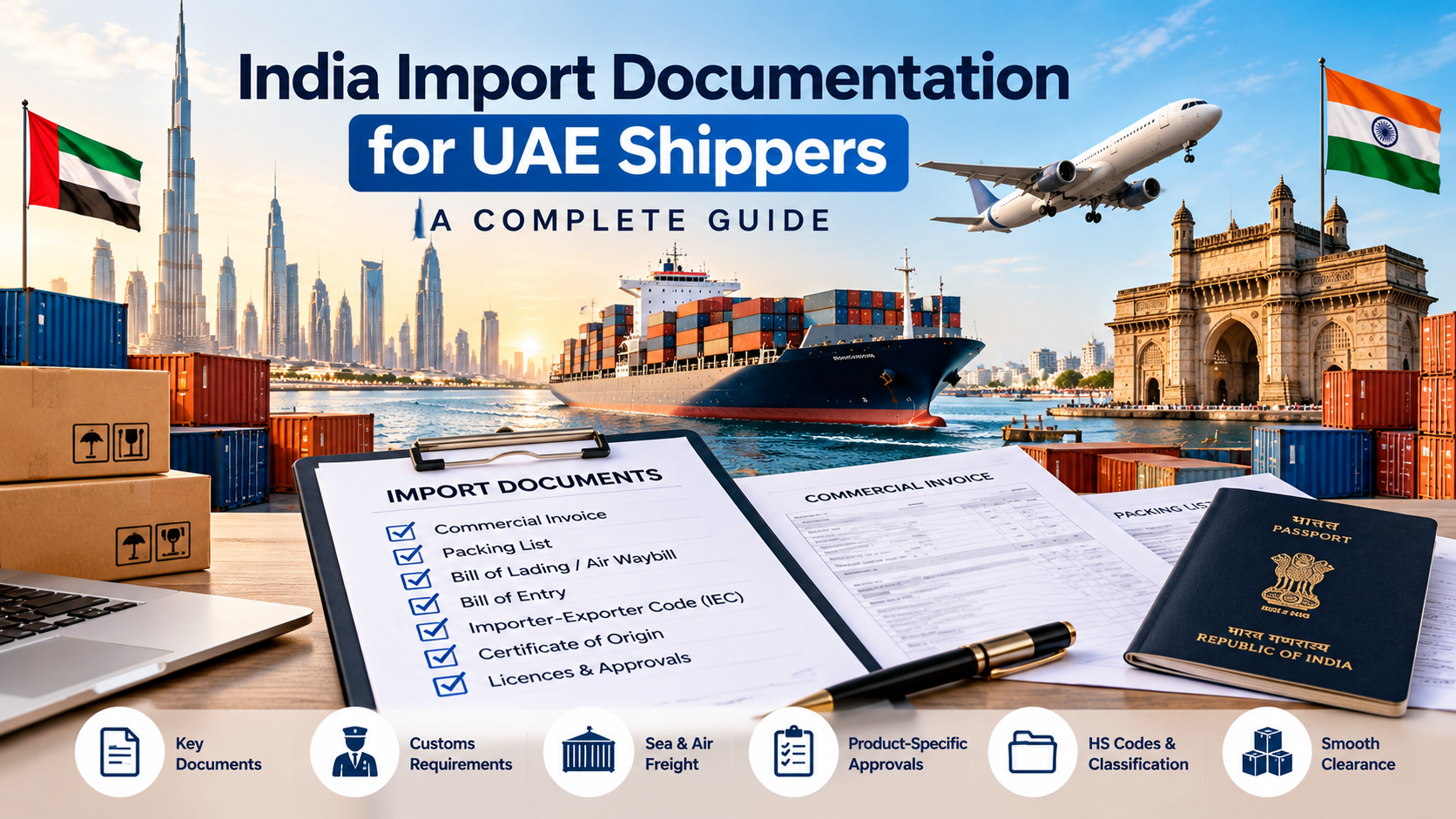
The process of shipping goods from the United Arab Emirates to India goes beyond simply booking a air or sea freight service, since it is necessary for both the Indian importer and the shipping parties to make sure that the required documents are accurate, complete and suitable for the goods being transported.
For exporters, suppliers and businesses based in the UAE, understanding India’s requirements regarding import documentation prior to shipping can help in avoiding unnecessary customs inquiries, delays in clearance and extra storage or handling costs.
The specific documents needed will vary according to the kind of goods, the import transaction, the method of transport and any relevant regulatory requirements; a typical commercial shipment will involve an invoice, a packing list and a transport document, whereas some products may be required to have additional licences, certificates or approvals; furthermore, under India’s customs law the importer is obliged to file a Bill of Entry for the imports that are subject to it.
This article sets out the main documents that shippers based in the UAE should prepare, the arrangements that Indian importers need to make, and the steps involved in getting a shipment ready for clearance.
If you are planning a shipment, you can also read our complete guide to shipping from UAE to India for an overview of freight options and the shipping process.
1. Why Is Import Documentation Important When Shipping to India?
Documentation when importing enables customs authorities to identify the goods, examine the value that has been declared, check the relevant import conditions and decide if the shipment can be released.
The presence of missing or inconsistent documents may result in further questions, inspections, requests for clarification, or delays. Extra charges could occur if the cargo stays at a port, airport or warehouse while the problem is being dealt with.
Correct documentation is particularly important when shipping:
- Commercial goods for resale or distribution
- Machinery and industrial equipment
- Electronics and electrical products
- Raw materials and manufacturing components
- High-value or specialized cargo
- Products subject to licenses or regulatory approvals
The best approach is to confirm the requirements before the cargo leaves the UAE rather than waiting until it reaches India.
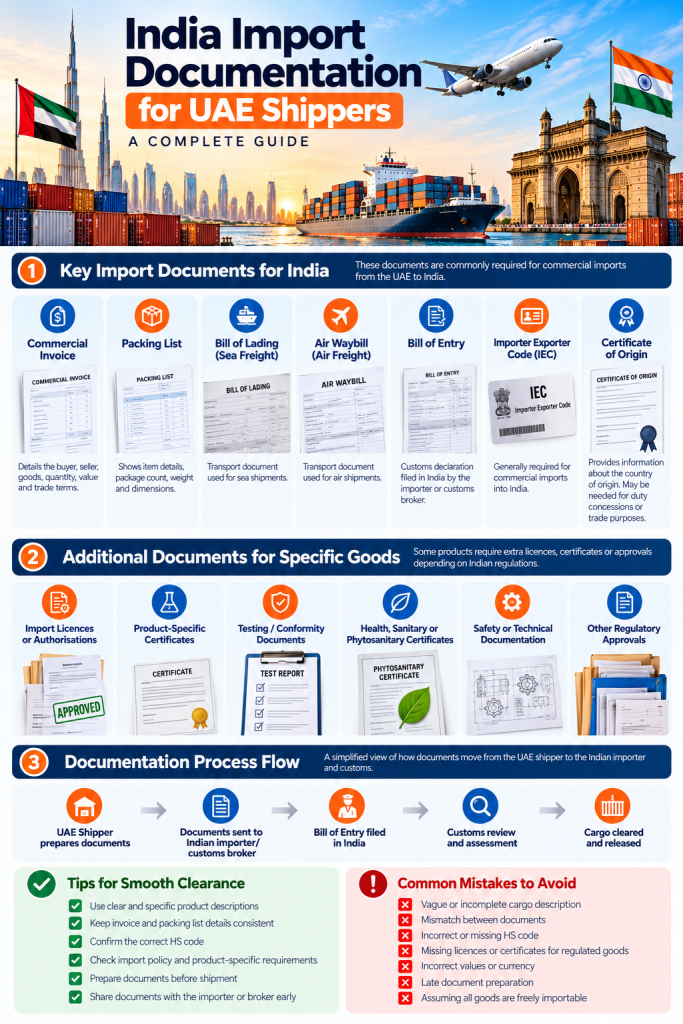
2. Essential Documents for Importing Goods from UAE to India
Documents listed below are often relevant when it comes to commercial imports; however, not every shipment will need each document in that particular form, and specific requirements for the product may apply.
Commercial invoice
The commercial invoice shows the transaction between the seller and the buyer and states the items being shipped together with the declared value of the goods.
A typical invoice includes:
- Exporter’s name and address
- Importer’s name and address
- Invoice number and date
- Description of the goods
- Quantity and unit price
- Total invoice value and currency
- Applicable sale terms
- Country-of-origin information, where relevant
The description of the goods should be clear and particular. For instance, ‘industrial stainless-steel pump’ gives more information than ‘machine parts’.
The invoice must give a correct account of the transaction; it should not contain vague descriptions, inconsistent values, or any information that contradicts the packing list and shipping documents.
Packing list
A packing list states the way in which the shipment was packed and indicates the contents of each package.
It may include:
- Number and type of packages
- Description of the goods
- Quantity in each package
- Net and gross weight
- Package dimensions
- Marks and package numbers
When the cargo is being transported in pallets or containers, accurate counts and measurements of the packages help coordinating the handling and in checking the details of the shipment.
Bill of Lading or Air Waybill
The transport document depends on how the goods travel.
- Bill of Lading (B/L): Generally used for sea freight.
- Air Waybill (AWB): Used for air freight.
The documents include important information about shipments and transport, for example the name of the shipper, the consignee, the cargo and the transport reference. The documents that are required and the requirements associated with them vary according to the carrier and the service.
Ensure the consignee details, cargo description, and shipment information match the other documents.
For transport options, see our guides to Dubai to India sea freight and Dubai to India air freight.
Bill of Entry
The Bill of Entry serves as a main customs declaration when goods are imported into India and is usually submitted electronically by the importer or by the authorized customs broker using the relevant customs system.
The declaration includes information which is used by customs for the purpose of assessment, such as details regarding the goods and their stated value. Documents providing support, for example the invoice and any other relevant records, must be available to verify the declaration.
The Indian Customs Law makes the importer liable for the accuracy and completeness of the declaration and the documents which support it.
This requires UAE shippers to send the Indian buyer or their customs broker the correct documents in good time so that clearance can be prepared.
Importer-Exporter Code (IEC)
The Importer-Exporter Code serves as a vital registration for companies which import and export goods in India, and in most cases a firm will need to have an IEC if it is to carry out commercial imports unless there is an applicable exemption.
The Indian importer should check if it has the required registration and also see whether any applicable exemption or special procedure relates to the shipment.
The UAE exporter must obtain the correct importer information and talk to the consignee before sending the goods.
Certificate of Origin
A Certificate of Origin contains details concerning the origin of the goods and might be required for customs purposes, for the reason of trade policy or for other commercial purposes, according to the shipment.
It is especially relevant in the case where an importer wants to claim preferential tariff treatment under a relevant trade agreement. This treatment is not automatic; the goods have to comply with the applicable origin rules and the necessary certificate of origin must be acceptable in accordance with the relevant procedure.
The country in which the UAE dispatches the goods is not necessarily the country of origin; it is possible for goods made in a different country to be re-exported via the UAE and thus have different origin consequences.
Find out if a Certificate of Origin or some other proof of origin is needed before shipping.
3. Additional Documents for Regulated or Specialized Goods
Certain products require more than the usual commercial and transport documents.
Depending on the product and applicable Indian regulations, additional documentation may include:
- Import licenses or authorizations
- Product-specific certificates
- Testing or conformity documents
- Health, sanitary or phytosanitary certificates
- Safety or technical documentation
- Documents required by the relevant Participating Government Agency
- Other declarations required for restricted or regulated goods
It is not necessary for every product to have these documents; the requirements will vary according to the product’s classification, its intended use, the relevant regulations and the present import policy. The import procedures in India make a distinction between goods that can be imported freely and those that are restricted, banned or subject to particular conditions.
For instance, some food products, chemicals, electronic equipment and industrial goods may have to undergo further inspections before they are cleared.
Before you book the shipment, request the Indian importer or customs broker to check what the requirements are for the specific product and HS code.
4. Understanding HS Codes for UAE–India Shipments
The Harmonized System (HS) code is used for the classification of goods for customs and trade. The way in which goods are classified can influence the duty rate that applies, the import policy and the product-specific compliance requirements.
It is necessary to have a reliable product description if you are to determine the correct classification.
When preparing shipment details, provide:
- The product’s full commercial name
- Its material or composition, where relevant
- Its intended use or function
- Model or part number, if applicable
- Technical specifications for specialized goods
- The proposed HS code, if already established
You should not choose a code merely because it seems to have a lower duty rate; instead, the classification must correctly represent the goods in accordance with the applicable tariff rules.
For machinery, spare parts and industrial equipment, technical descriptions can be especially important. Read our guide on how to ship machinery from UAE to India for more information about planning specialized shipments.
5. Who Is Responsible for Preparing the Documents?
The UAE shipper, the Indian importer, the freight forwarder and the customs broker all share the responsibilities. The specific arrangement will depend on the sales contract, the shipping terms and the services that have been booked.
Party | Typical responsibilities |
UAE exporter or supplier | Prepare accurate commercial invoices, packing details and other export-side documents applicable to the shipment |
Indian importer | Provide correct importer information, confirm import eligibility and meet applicable registration and compliance requirements |
Freight forwarder | Coordinate transportation and advise on shipment information and transport documentation within the agreed service scope |
Indian customs broker | Assist with the Bill of Entry, customs declarations and clearance procedures when authorised |
Relevant issuing or regulatory authority | Issue or verify certificates, licences and approvals where required |
Even though a freight forwarder can help with coordinating the process, this does not mean that all the legal responsibilities are transferred from the importer or exporter.
Before sending the documents, agree on which person will provide each one and which person will carry out each clearance step.
6. Documentation for Sea Freight vs Air Freight
The basic commercial documents are generally the same in both cases, but there is a difference between the transport document and the operational arrangements.
Sea freight documentation
For sea shipments a Bill of Lading or some other appropriate sea transport document should be used. The details of the containers, the number of packages, the weights and the descriptions of the cargo must agree with the commercial records. You should check the document cut-off times and the destination requirements with the forwarder.
Air freight documentation
Most air shipments make use of an Air Waybill and it is important that the details of the package, its weight, the description of the cargo and the consignee’s information are correct. In the case of special cargo it may be necessary to have extra declarations or handling documents.
The method of shipping does not eliminate the necessity of adhering to India’s import regulations; the transport option should be selected taking into account the type of cargo, how urgent it is, the volume involved and the total cost.
For a broader comparison, see shipping from Dubai to India: costs, transit times and process.
7. Common Documentation Mistakes That Cause Delays
Problems may still arise during clearance even if the necessary documents are on hand.
Watch out for these common mistakes:
- Vague cargo descriptions: Use clear descriptions that identify the actual goods.
- Invoice and packing list mismatches: Check quantities, package counts and descriptions across the documents.
- Incorrect consignee information: Verify the importer’s legal name and address before documents are issued.
- Unverified HS codes: Confirm the classification rather than guessing.
- Missing product approvals: Check whether the goods require licenses, are subject to restrictions or need an agency.
- Incorrect values or currencies: Ensure that the invoice accurately records the transaction.
- Late document preparation: Share the paperwork with the importer and broker before the shipment arrives.
- Unclear origin information: Distinguish the country of origin from the country from which the goods are dispatched.
Review documents before dispatch to identify discrepancies while you still have time to correct them.
8. How UAE Shippers Can Prepare for Smooth Customs Clearance
Use this checklist before sending commercial goods to India.
Pre-shipment checklist
- Confirm the exact goods description and intended use.
- Verify the Indian importer’s details and applicable IEC requirements.
- Check the HS code and import policy for the goods.
- Prepare an accurate commercial invoice.
- Prepare a packing list with correct quantities, weights and dimensions.
- Confirm whether a Certificate of Origin is required.
- Check for product-specific licenses, certificates or approvals.
- Confirm whether the shipment will travel by air or sea and prepare the applicable transport details.
- Send the documents to the Indian importer or customs broker for review before dispatch.
- Agree on customs clearance responsibilities and identify charges excluded from the freight quotation.
This checklist is a general planning aid. It does not replace a product-specific review by the importer or customs broker.
9. How DDU Express Can Help with UAE–India Shipping
Preparing documents and coordinating transportation can be challenging when several parties are involved. A freight forwarder can organize shipment information, coordinate the transport process and clarify which documents the booked service requires. Before you confirm a shipment, make sure you provide the cargo description, origin, destination, package dimensions, weight, shipment value and preferred delivery schedule. In the case of goods that are regulated or special, indicate this at the time of issuing the quotation.
You can also explore our guides on how to ship commercial cargo from UAE to India and UAE to India door-to-door cargo shipping to understand the broader shipping process and service considerations.
Frequently Asked Questions
What documents are required to import goods from UAE to India?
Common commercial import documents include a commercial invoice, packing list, Bill of Lading or Air Waybill, and a Bill of Entry filed for customs clearance. Depending on the goods and transaction, the importer may also need an IEC, proof of origin, licenses, certificates or other approvals.
Is an IEC mandatory for every shipment to India?
An IEC is generally required for commercial import activities unless a specific exemption applies. The Indian importer should confirm the applicable requirement for the shipment and its circumstances.
Is a Certificate of Origin always required?
No. The requirement depends on the goods, transaction, applicable customs procedures and whether origin evidence is needed for a particular purpose, such as a preferential tariff claim.
Who files the Bill of Entry in India?
The importer or an authorized customs broker generally files the Bill of Entry through the applicable customs system. The importer remains responsible for ensuring that the declaration and supporting information are accurate.
Can goods be shipped before all import documents are ready?
This depends on the documents involved and the applicable import requirements. Shipping cargo before confirming required licenses, certificates or other approvals can cause delays or complications. Confirm the requirements with the Indian importer or customs broker before dispatch.
Do personal effects require the same documents as commercial cargo?
Not necessarily. Personal belongings and commercial goods can be subject to different procedures and documentation requirements. For more detail, read our related guide on shipping personal effects vs commercial cargo from UAE to India.
Conclusion
India import documentation is an essential part of shipping goods from the UAE. Accurate invoices, packing lists, transport documents and customs declarations help the parties prepare for clearance, while product-specific licenses and certificates may be needed for regulated goods.
UAE shippers should coordinate with the Indian importer and customs broker before dispatch, verify the product classification and applicable import conditions, and ensure that the documents consistently describe the actual shipment.
For more information about transport options, procedures and planning, visit our complete guide to shipping from UAE to India or contact DDU Express to discuss your cargo requirements.

Weiworld is an experienced logistics and shipping professional with more than 20 years of industry experience, with extensive knowledge of international shipping, freight forwarding, cargo movement, and logistics operations.
Over the course of his career, he has developed deep practical expertise in Middle East logistics and operations, including shipping processes, international cargo transportation, customs-related procedures, and supply chain coordination.
At DDU Express, Weiworld shares practical insights and industry knowledge to help businesses better understand international shipping, freight forwarding, DDP services, cargo transportation, and logistics solutions across the Middle East and global markets.
His extensive industry experience provides valuable perspective for businesses looking to simplify international shipping and make informed decisions when moving cargo between countries.