When a shipment needs to reach India quickly, air freight from Dubai to India can be a feasible alternative to sea freight.
Air cargo is particularly useful for urgent commercial shipments, smaller consignments, high-value goods, spare parts, and products where delivery time matters more than transportation cost.
However, air freight is not automatically the right choice for every shipment. Businesses should consider cargo weight, dimensions, urgency, value, destination, customs requirements, and total logistics cost before choosing air transportation.
This guide explains how Dubai to India air freight works, which cargo types are suitable, how costs are calculated, what documents may be required, and when businesses should consider air cargo instead of sea freight.
If you are comparing different shipping methods, documentation, customs requirements and delivery options, our complete guide to shipping from UAE to India provides a broader overview for businesses.
What Is Dubai to India Air Freight?
Dubai to India air freight is the transportation of cargo by aircraft from Dubai or another UAE origin to an airport in India, followed by customs clearance and final delivery.
Unlike passenger baggage, commercial air cargo is handled through dedicated cargo networks and follows specific documentation, security, and handling procedures.
Air freight can be used for:
- Commercial goods
- Urgent inventory
- Spare parts
- Samples
- Electronics
- High-value products
- E-commerce products
- Documents and business materials
- Medical equipment, where permitted
- Time-sensitive shipments
The suitability of air freight depends on the actual cargo and applicable regulations.
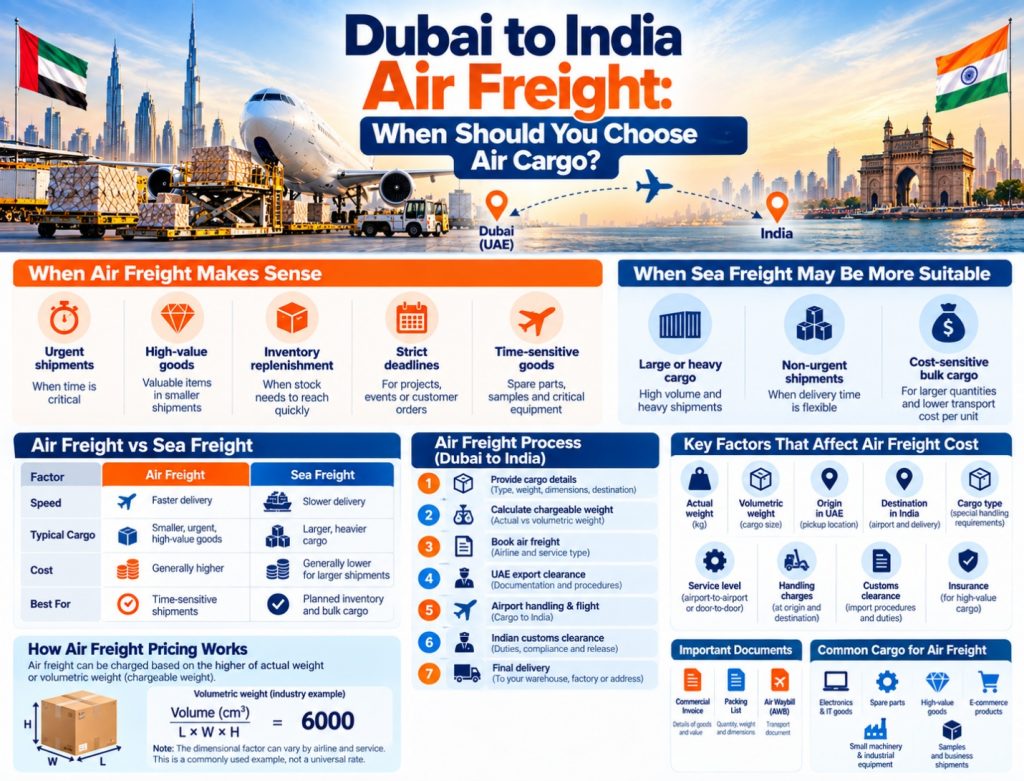
When Should You Choose Air Freight from Dubai to India?
Air freight makes the most sense when time has a significant business value.
- When the shipment is urgent
If waiting for a sea shipment could interrupt operations, delay production or leave inventory unavailable, air freight may be worth considering.
For example, a manufacturer waiting for a critical spare part may prefer air cargo because the cost of a production delay could be higher than the additional transportation cost.
- When the shipment is relatively small
Smaller commercial shipments may not justify booking a full container by sea.
Air freight can provide a practical option when the cargo needs to move quickly without waiting to accumulate a larger shipment.
- When the cargo has a high value-to-weight ratio
Electronics, specialised components, samples and other high-value products can sometimes be better suited to air transportation because the shipment value is high compared with its physical size.
- When inventory needs to be replenished quickly
Enterprises can use air freight for urgent stock replenishment when existing inventory is running low.
- When the cargo has a strict delivery deadline
Product launches, trade exhibitions, project requirements and urgent customer orders may require faster transportation.
- When reducing transit time is more important than freight cost
Air freight generally costs more than sea freight, but businesses sometimes choose it because the time saved has greater commercial value.
When Should You Avoid Air Freight?
Air freight isn’t necessarily the best option for every shipment.
Sea freight may be more appropriate when:
- Cargo volume is large
- Goods are heavy
- Delivery is not urgent.
- The shipment can be planned in advance
- Transportation cost is a major consideration.
- The cargo requires containerised transportation
- You are moving large quantities of inventory.
For example, shipping several pallets of non-urgent inventory may make more sense by sea than by air.
Base the decision on the overall business requirement, not simply the fastest available transportation method.
Air Freight vs Sea Freight from Dubai to India
Factor | Air Freight | Sea Freight |
Speed | Faster | Slower |
Cost per unit | Generally higher | Generally lower for larger shipments |
Suitable cargo | Small, urgent, high-value | Large, heavy, non-urgent |
Shipment size | Smaller shipments can be practical | Better suited to larger volumes |
Inventory replenishment | Useful for urgent stock | Useful for planned replenishment |
FCL/LCL | Not applicable | FCL and LCL available |
Best for | Time-sensitive cargo | Cost-conscious larger shipments |
There is no universal winner. The appropriate method depends on cargo, budget and delivery requirements.
How Does Dubai to India Air Freight Work?
A typical air cargo shipment includes several stages.
Step 1: Provide cargo details
The freight forwarder normally needs:
- Cargo description
- Number of packages
- Dimensions
- Gross weight
- Cargo value
- Pickup location
- Indian destination
- Preferred delivery date
Accurate information helps determine the appropriate air freight arrangement.
For a broader overview of shipping costs, transit times, routes and the overall process, see our guide to shipping from Dubai to India.
Step 2: Check cargo eligibility
Not every product can be shipped by air in the same way.
Some goods could have restrictions relating to:
- Batteries
- Chemicals
- Dangerous goods
- Pharmaceuticals
- Medical equipment
- Cosmetics
- Food products
- Liquids
- Certain electronics
Special processing or extra documentation may be required depending on the cargo.
Step 3: Check the chargeable weight
Air freight pricing can depend on both the actual weight and the volumetric weight.
For lightweight but bulky cargo, the space the shipment occupies can matter more than its actual weight.
A commonly used calculation is:
Volumetric weight = Length × Width × Height ÷ applicable dimensional factor
The applicable factor can vary by carrier and service, so the freight forwarder should confirm the chargeable weight used for the quotation.
Step 4: Select the air freight service
Depending on the shipment, businesses may have options involving:
- Airport-to-airport
- Door-to-airport
- Airport-to-door
- Door-to-door
The exact service depends on the carrier, destination and logistics provider.
Step 5: Arrange pickup in Dubai
Cargo can be collected from locations such as:
- Warehouse
- Office
- Factory
- Distribution centre
- Supplier location
Pickup arrangements depend on cargo size, loading requirements, and location.
Step 6: Complete UAE export procedures
Before departure, the shipment must comply with applicable UAE export requirements.
The freight forwarder can coordinate the appropriate documentation and export procedures based on the shipment.
Step 7: Air transportation
The cargo is handed over to the applicable air cargo network and transported to the destination airport in India.
The actual routing and schedule depend on the carrier, destination and available flight connections.
Step 8: Indian customs clearance
After arrival, the shipment must complete the applicable Indian import procedures.
Customs may consider:
- Product description
- HS classification
- Declared value
- Importer details
- Country of origin
- Applicable duties
- Required approvals
Incorrect or incomplete documentation can delay clearance.
Step 9: Final delivery
After customs clearance, the shipment can be delivered to:
- Warehouse
- Factory
- Office
- Retail location
- Fulfilment centre
- Customer address
For businesses looking for an end-to-end solution, door-to-door air freight can combine pickup, air transportation, customs coordination and final delivery.
Businesses moving commercial goods from the UAE should also consider the complete shipment process, from cargo preparation and documentation to freight selection and customs clearance. Our guide on how to ship commercial cargo from UAE to India explains these steps in detail.
For a broader overview of the shipping process, costs, transit times and available options, see our guide to shipping from Dubai to India.
For businesses looking to arrange an air cargo shipment, explore our air freight services for shipping solutions from Dubai to international destinations.
How Much Does Air Freight from Dubai to India Cost?
There is no single fixed price for air freight from Dubai to India.
The quotation can depend on:
Actual weight
The cargo’s actual weight affects the freight calculation.
Volumetric weight
Large but lightweight shipments can be charged based on the space they occupy.
Chargeable weight
The carrier may use whichever applicable calculation produces the chargeable weight under its pricing rules.
Origin
Pickup location within Dubai or elsewhere in the UAE can affect the total cost.
Destination
Delivery to different Indian airports and final destinations can affect transportation costs.
Cargo type
Special handling, restricted cargo or temperature-sensitive products may require additional services.
Service level
Door-to-door service can cost more than airport-to-airport transportation because it includes additional logistics services.
Customs and destination charges
Customs clearance, handling, and final delivery can add to the overall landed cost.
Why Air Freight Can Be More Expensive Than Sea Freight
Air freight uses limited aircraft cargo capacity and is designed around faster transportation.
Sea freight can move much larger quantities of cargo on vessels, making it more practical for many high-volume shipments.
However, comparing only the freight rate can be misleading.
Businesses should consider:
Transportation cost + customs + handling + delivery + inventory cost + cost of delay
For urgent cargo, faster delivery may justify the higher freight cost.
How Long Does Dubai to India Air Freight Take?
Air freight is generally much faster than sea freight, but no single delivery time applies to every shipment.
The entire timeline can depend on:
- Origin pickup
- Export documentation
- Cargo acceptance
- Flight schedule
- Direct or connecting routing
- Destination airport
- Customs clearance
- Final delivery
Therefore, businesses should distinguish between air transit time and total door-to-door delivery time.
A shipment may spend time on pickup, export processing, airport handling and customs in addition to the actual flight.
What Documents Are Required for Air Freight?
The exact documents depend on the cargo and transaction.
Common documents can include:
- Commercial invoice
- Packing list
- Air Waybill
- Certificate of Origin, where applicable
- Import documentation
- Product-specific certificates
- Insurance documents, where applicable
Some products may require additional licences, approvals or regulatory documentation.
The information across the invoice, packing list and physical cargo should be consistent.
Air Waybill: What Is It?
An Air Waybill (AWB) is a transport document used for air cargo shipments.
It contains important shipment information such as:
- Shipper
- Consignee
- Origin
- Destination
- Cargo details
- Weight
- Shipment reference
- Carrier information
The AWB is different from a Bill of Lading used for sea freight.
What Cargo Is Suitable for Air Freight?
Air freight can be particularly useful for:
Electronics
Small, valuable electronic products can be suitable when rapid transportation is important.
Spare parts
Critical spare parts can be moved quickly when waiting for sea transportation could affect operations.
Samples
Businesses sending product samples to customers or partners may use air cargo because of the smaller shipment size and need for faster delivery.
E-commerce inventory
Air freight can help replenish stock when inventory levels are low.
High-value goods
Some high-value products can benefit from shorter transit times, though you should assess applicable security and insurance requirements.
Time-sensitive commercial goods
Products with strict delivery deadlines may be suitable for air transport.
Shipping Machinery by Air from Dubai to India
Machinery can sometimes be shipped by air, but suitability depends heavily on its size and weight.
Air freight may make sense for:
- Smaller machinery
- Components
- Spare parts
- Control equipment
- Urgent replacement units
Large industrial machinery is usually harder to move by air because of aircraft capacity, dimensions, and handling requirements.
For oversized or heavy machinery, sea freight or specialised transportation may be more appropriate.
Air Freight for E-Commerce Businesses
E-commerce companies may use air freight when inventory needs to reach India quickly.
For example:
A Dubai-based seller may have a product that is selling faster than expected. Instead of waiting for the next planned sea shipment, the business could use air freight to replenish a smaller stock quantity.
Air freight can therefore work alongside sea freight rather than replacing it completely.
A business might use:
Sea freight → planned bulk inventory
Air freight → urgent inventory replenishment
This approach may help businesses balance transportation cost and inventory availability.
Common Mistakes When Choosing Air Freight
Choosing air freight only because it is faster
Speed helps, but businesses should first decide whether the shipment truly needs urgent delivery.
Ignoring volumetric weight
A large lightweight shipment may cost more than expected because of its volume.
Comparing only the airline freight rate
Handling, customs, pickup and delivery can affect the total cost.
Not checking cargo restrictions
Certain products may require special documentation plus handling.
Providing incorrect dimensions
Incorrect dimensions can result in revised freight calculations.
Waiting until the last minute
Urgent shipments can cost more when capacity is limited, or routing options are fewer.
How to Reduce Dubai to India Air Freight Costs
Provide accurate dimensions
Correct measurements help avoid quotation changes.
Consolidate smaller shipments
Where practical, combining compatible shipments can reduce unnecessary transportation costs.
Compare air and sea
If the shipment isn’t genuinely urgent, sea freight may be a more economical alternative.
Plan inventory
Avoid relying on expensive emergency shipments whenever possible.
Optimize packaging
Reduce unnecessary volume while maintaining adequate cargo protection.
Compare complete landed costs.
Don’t compare only the headline air freight rate.
When Air Freight Makes Business Sense
A simple way to evaluate the decision is to ask:
Is the cargo urgent?
If yes, air freight may be worth considering.
Is the shipment relatively small?
If yes, air freight can be practical.
Is the cargo valuable or time-sensitive?
If yes, faster transport may add more business value.
Would a delay affect production or sales?
If yes, the additional cost of air transportation may be justified.
Is the shipment large and non-urgent?
If yes, compare sea freight before choosing air cargo.
Dubai to India Air Freight: Simple Decision Guide
Urgent?
→ Yes
→ Consider Air Freight
Small shipment?
→ Yes
→ Compare Air Freight
Critical spare part?
→ Yes
→ Air Freight may be appropriate
Large shipment?
→ Yes
→ Compare Sea Freight
Non-urgent inventory?
→ Yes
→ Sea Freight may be more economical
Strict delivery deadline?
→ Yes
→ Air Freight may be worth considering
The final decision should consider the cargo, delivery requirements, and complete logistics cost.
Why Choose DDU Express for Dubai to India Air Freight?
DDU Express provides freight forwarding and logistics solutions for businesses shipping internationally.
Depending on shipment requirements, services can include:
- Air freight
- Freight forwarding
- Customs clearance
- Door-to-door logistics
- Warehousing
- E-commerce logistics
- Project cargo
- Sea freight
For businesses shipping from Dubai to India, the appropriate transportation method depends on cargo type, weight, dimensions, urgency, destination and required service.
Planning an air shipment from Dubai to India? Share your cargo details and destination with DDU Express to discuss the available freight options.
Frequently Asked Questions
When should I choose air freight from Dubai to India?
Air freight is generally worth considering when the shipment is urgent, relatively small, high-value, time-sensitive or required for fast inventory replenishment.
Is air freight from Dubai to India more expensive than sea freight?
Air freight generally costs more than sea freight, especially for larger shipments. However, the faster delivery can make it suitable for urgent cargo.
How is Dubai to India air freight charged?
Air freight pricing can depend on chargeable weight, which may include actual and volumetric weight, as well as the origin, destination, cargo type, and service requirements.
How long does air freight from Dubai to India take?
Total delivery time depends on flight routing, cargo handling, export procedures, customs clearance, and final delivery. Flight time is only one part of the overall process.
Can I ship machinery by air from Dubai to India?
Yes, smaller machinery, components and urgent spare parts may be suitable for air freight. Large or heavy machinery may require sea freight or specialised transportation.
Can I ship e-commerce inventory by air?
Yes. Air freight can help with urgent inventory replenishment or smaller shipments when waiting for sea freight isn’t practical.
What documents are required for air freight?
Common documents can include a commercial invoice, packing list and Air Waybill, along with applicable import documents and product-specific certificates.
Can DDU Express arrange door-to-door air freight?
Depending on the shipment requirements, a door-to-door solution can include pickup, air transportation, customs coordination and final delivery.
Conclusion
Air freight from Dubai to India is primarily about time.
For urgent shipments, critical spare parts, smaller consignments and time-sensitive inventory, the faster transportation offered by air cargo can provide important business value.
For large, heavy or non-urgent shipments, sea freight may be more appropriate.
Before choosing air cargo, compare:
- Cargo weight
- Volumetric weight
- Shipment value
- Delivery deadline
- Air freight cost
- Customs and handling
- Final delivery requirements
- Cost of delaying the shipment
The right choice is not simply the fastest or cheapest option. It is the transportation method that fits the shipment and the business requirement.

Weiworld is an experienced logistics and shipping professional with more than 20 years of industry experience, with extensive knowledge of international shipping, freight forwarding, cargo movement, and logistics operations.
Over the course of his career, he has developed deep practical expertise in Middle East logistics and operations, including shipping processes, international cargo transportation, customs-related procedures, and supply chain coordination.
At DDU Express, Weiworld shares practical insights and industry knowledge to help businesses better understand international shipping, freight forwarding, DDP services, cargo transportation, and logistics solutions across the Middle East and global markets.
His extensive industry experience provides valuable perspective for businesses looking to simplify international shipping and make informed decisions when moving cargo between countries.