
The process of shipping machinery from the UAE to India involves greater planning than that needed for ordinary commercial cargo because industrial equipment can be heavy, oversized, high-value or difficult to handle. Therefore, planning should be carried out before the shipment leaves the UAE with regard to the method of shipping, packing, the documentation, customs classification and the arrangements for transportation.
For a broader overview of shipping options, documentation, costs and logistics, read our complete guide to shipping from UAE to India.
Machinery can be sent from Dubai, Abu Dhabi, Sharjah or any other location in the UAE to ports and destinations in India. The type of freight business uses—whether FCL by sea, LCL, breakbulk, RoRo or air freight—will depend on the size, weight, value and urgency of the machine.
The process also includes carrying out the export formalities in the UAE and completing import customs clearance in India. When it comes to imports into India, the DGFT lists the Bill of Lading or Airway Bill, the commercial invoice together with the packing list, and the Bill of Entry as essential import documents; at the same time some particular goods may need extra documentation or must comply with specific regulations. (DGFT)
The guide outlines the steps involved in arranging the shipment of machinery from the UAE to India, the documents usually needed, how to select the appropriate shipping method, and the factors that can influence the final cost.
What Types of Machinery Can Be Shipped from UAE to India?
Businesses may ship different types of machinery and industrial equipment from the UAE, including:
- Construction machinery
- CNC machines
- Industrial manufacturing equipment
- Excavators
- Loaders
- Forklifts
- Cranes and lifting equipment
- Generators
- Compressors
- Agricultural machinery
- Food-processing machinery
- Packaging machinery
- Printing machinery
- Workshop equipment
- Mining equipment
- Pumps and industrial systems
- Production-line equipment
- Replacement machinery and equipment
The method of shipping will vary according to the item’s dimensions, its gross weight, its centre of gravity, the need to dismantle it and its destination.
In some cases, a standard container will not be appropriate for very large machinery; the goods might then have to use special equipment or an alternative method of transport.
Step-by-Step: How to Ship Machinery from UAE to India
1. Gather full details of the machinery
Before asking for a freight quotation, make sure that the machine details are accurate.
Typically, the freight forwarder will need:
- Machine name
- Manufacturer
- Model number
- Quantity
- Dimensions
- Gross weight
- Net weight
- Country of origin
- Approximate value
- Whether the machine is new or used
- Photos of the machinery
- Technical specifications
- Packing details
- Pickup location in the UAE
- Delivery location in India
It is especially important to consider the dimensions when it comes to oversized machinery.
A difference of just a few centimetres can cause the machinery to either fail to fit in a container or mean that it has to be handled in a special way.
Information to provide for a machinery shipping quote
Information | Why it matters |
Length | Determines loading and container suitability |
Width | Helps identify container/equipment requirements |
Height | Important for container and road transport |
Weight | Determines handling and transportation requirements |
Value | Used for documentation, insurance and customs |
Machinery type | Helps determine classification and handling |
New/used | Can affect import requirements |
Pickup location | Determines UAE transport cost |
Indian destination | Determines port and inland delivery requirements |
2. Verify the HS Code and the Import Requirements
A very important step is to determine the right HS/ITC(HS) classification for the machinery.
The classification can affect:
- Customs duty
- Import policy
- Required documentation
- Product-specific regulations
- Applicable exemptions or concessions
- Customs assessment
You should not choose an HS code merely because it seems similar to the description of the machinery; instead, you must take into account the equipment’s real technical function and characteristics.
The DGFT says that, in general, imports into India will need an IEC unless they are specifically exempted, and in its regulations concerning import documentation it specifies the Bill of Lading or Airway Bill, the commercial invoice together with the packing list, and the Bill of Entry as mandatory documents, adding that further requirements may apply in the case of certain products. (DGFT)
3. Find out if the machinery is new or used.
It is especially important when shipping industrial equipment from the UAE.
The import requirements for used machinery can differ from those for new machinery.
The Foreign Trade Policy of India includes specific provisions relating to second-hand goods. For instance, the policy sets out different categories of second-hand capital goods, some of which are subject to restrictions or extra conditions. On the other hand, other second-hand capital goods may be imported freely. (DGFT)
The importer should, before shipping used machinery, check what the current policy is with regard to the specific machine and its HS classification.
For used machinery, prepare details such as:
- Year of manufacture
- Manufacturer
- Model
- Serial number
- Original purchase value
- Current declared value
- Machine condition
- Remaining useful life, where relevant
- Photos
- Technical specifications
- Previous ownership details where applicable
This will help to cut down on questions when going through customs inspection.
4. Select the appropriate shipping method
There is no one shipping method that is suitable for all machines.
The main options are:
Sea Freight
Sea freight is usually the primary choice when it comes to large, heavy or non-urgent machinery.
It can be suitable for:
- Industrial machinery
- Construction equipment
- Factory equipment
- Heavy equipment
- Multiple machines
- Large shipments
Depending on the cargo, the machinery may be shipped using:
- FCL containers
- Open-top containers
- Flat-rack containers
- Breakbulk
- RoRo, where available and suitable
For a detailed explanation of container options, shipment planning and sea freight considerations, see our guide to Dubai to India sea freight.
Air Freight
Air freight may be considered for:
- Smaller machinery
- High-value equipment
- Urgent replacement equipment
- Critical production components
- Time-sensitive machinery
Because of the higher transportation costs, air freight becomes less suitable for many large machines.
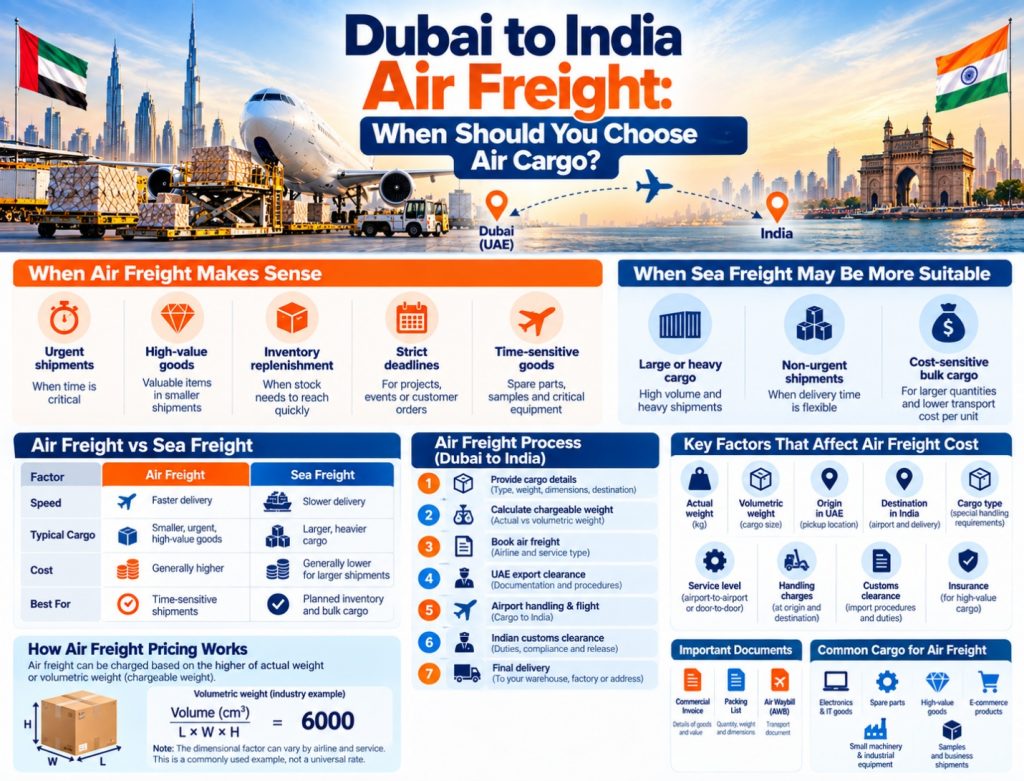
If your machinery or replacement components require faster transportation, explore our guide on Dubai to India air freight to understand when air cargo may be suitable.
Sea vs Air for Machinery
Factor | Sea Freight | Air Freight |
Heavy machinery | Usually suitable | Often impractical |
Oversized machinery | Special equipment may be available | Usually unsuitable |
Large equipment | Suitable | Limited |
Urgency | Lower | Higher |
Cost for heavy cargo | Generally more economical | Generally higher |
Small high-value equipment | Possible | Often suitable |
Factory equipment | Common option | Limited |
If you want to read more about sea freight from Dubai to India, you can refer to the article on Dubai to India Sea Freight.
5. Decide if the Machinery Needs to be Taken Apart
It is not possible to transport some machines efficiently while they are in their assembled state.
Dismantling can reduce:
- Overall dimensions
- Shipping difficulty
- Handling requirements
- Transportation restrictions
- Equipment requirements
Take care when carrying out the dismantling.
Before shipment, determine:
- Which components can be removed?
- Whether specialist technicians are required
- How components will be labeled
- How parts will be protected
- Whether reassembly instructions are available
- Whether loose components need separate packing
For complex industrial machinery, photographs and component lists can be useful during both loading and installation.
6. Get the machinery ready for transport.
Make sure that the machinery is properly secured before it is transported internationally.
Depending on the machine, preparation may include:
- Cleaning the equipment
- Draining fluids where appropriate
- Disconnecting batteries
- Removing vulnerable components
- Protecting electrical parts
- Securing moving parts
- Applying suitable corrosion protection
- Blocking and bracing
- Using proper lifting points
- Protecting exposed surfaces
The precise method of preparation will vary according to the equipment and the way in which the goods are shipped.
Incorrect loading or insufficient securing of heavy machinery can lead to damage to the cargo and to further handling problems.
7. Choose the Correct Container or Cargo Equipment
Container selection is particularly important for machinery.
Standard container
Suitable when the machinery fits within normal container dimensions and weight limitations.
Open-top container
Useful when the machinery is too tall for normal top loading.
Flat-rack container
Consider for cargo that is too wide or otherwise unsuitable for a standard container.
Breakbulk
Large machinery that cannot be containerized may require breakbulk transportation.
RoRo
In some cases machinery which is self-propelled or has wheels might be suitable for use in RoRo transport provided that the necessary service and route are available.
Finalise the choice of equipment by referring to the real dimensions, weight, method of loading and the route of the machine.
8. Make arrangements for the pickup in the UAE and for export handling.
When the shipping plan has been confirmed, the machinery must be transported from its present location in the UAE to the relevant port or cargo facility.
This may involve:
- Factory pickup
- Heavy-haul transportation
- Loading
- Securing
- Port handling
- Export documentation
- Customs procedures
- Vessel loading
In the case of machinery that is oversized, the inland transport stage can take on an important role in the entire logistics plan.
9. Prepare the necessary documents
Machinery shipments commonly involve documents such as:
- Commercial invoice
- Packing list
- Bill of Lading or Air Waybill
- Importer Exporter Code (IEC)
- Purchase order or sales contract, where applicable
- Machinery specifications
- HS/ITC(HS) classification details
- Certificate of Origin, where applicable
- Insurance documents
- Technical documents
- Additional certificates or approvals where applicable
The present general import requirements set out by the DGFT require the Bill of Lading/Airway Bill, the commercial invoice-cum-packing list and the Bill of Entry as essential import documents, although it also states that further documents may be necessary in respect of certain goods or regulatory requirements. (DGFT)
For more information about documentation, customs procedures and arranging business shipments, read our guide on how to ship commercial cargo from UAE to India.
10. Export the Machinery from the UAE
The UAE-side logistics process may include:
- Export documentation
- Customs declaration
- Cargo inspection where required
- Port handling
- Container loading
- Vessel booking
- Export clearance
Your freight forwarder can coordinate the different parties involved in the shipment.
11. International transport to India
After export clearance, the machinery is transported to the selected Indian port or airport.
Sea freight is generally regarded as the method of choice for large industrial machinery since it is capable of carrying heavy and oversized cargo.
The shipment may arrive at ports such as:
- Nhava Sheva / JNPT
- Mundra
- Chennai
- Cochin
- Kolkata
- Other suitable Indian ports
The most appropriate port depends on the shipping service and final delivery location.
12. Indian Customs Clearance
Once the machinery reaches India, customs clearance needs to be completed before the cargo can be released.
The process can involve:
- Bill of Entry filing
- Document verification
- HS classification
- Customs valuation
- Duty assessment
- Examination, where required
- Payment of applicable duties and taxes
- Customs release
The exact duty and compliance requirements depend on the machinery, classification, value, origin and applicable regulations.
That is why it is best to check the HS code and the import requirements before the machinery is shipped rather than delaying this until the cargo has arrived.
13. Arrange Final Delivery to the Indian Destination
Once it has passed customs, the machinery can be sent to its final destination.
For example:
Dubai → Indian Port → Customs Clearance → Heavy-Haul Transport → Factory
When you get a door-to-door service, the logistics provider will coordinate all the various stages involved in it.
This can be particularly useful for machinery because the final movement from the port to the factory may require:
- Low-bed trailers
- Hydraulic trailers
- Crane arrangements
- Route planning
- Special handling
- Local permits, where applicable
Businesses arranging shipments from Dubai can also refer to our detailed guide to shipping from Dubai to India for an overview of the shipping process, transit times and cost considerations.
What is the cost of shipping machinery from the UAE to India?
There is not a single fixed price when it comes to shipping machinery.
The final cost can depend on:
1. Machinery weight
Heavy machinery needs suitable transportation and handling equipment.
2. Dimensions
Oversized cargo can require special containers or transportation arrangements.
3. Shipping method
Sea, air, RoRo and breakbulk options have different pricing structures.
4. Origin in UAE
Pickup from Dubai, Abu Dhabi, Sharjah or another location can change inland transportation costs.
5. Indian destination
The distance between the arrival port and the final factory can significantly affect total logistics costs.
6. Port handling
Heavy or oversized equipment may require additional loading, unloading and handling arrangements.
7. Customs and duties
Applicable customs duties and taxes depend on the machinery and its classification.
8. Packing and securing
Special packing, crating, blocking and securing can add to the shipment cost.
9. Insurance
High-value machinery may require cargo insurance.
10. Heavy-haul transportation
Delivering oversized machinery may require specialized trailers and handling equipment.
How long does it take to send machinery from the UAE to India?
Transit time depends on the shipping method, origin, destination, carrier schedule, customs clearance and final delivery requirements.
A machinery shipment can involve several stages:
Pickup → UAE export clearance → Port handling → International transportation → Indian customs → Port release → Inland transportation
Therefore, businesses should avoid planning production schedules based only on the vessel’s port-to-port transit time.
For time-critical machinery, allow additional time for:
- Export documentation
- Cargo preparation
- Port handling
- Customs clearance
- Equipment availability
- Inland transportation
Shipping Used Machinery from UAE to India
Although used machinery may be appealing to businesses that want to obtain equipment at a lower purchase price, it is necessary to check the import requirements before shipping it.
The key information should include:
- Machine age
- Manufacturer
- Model
- Serial number
- Year of manufacture
- Condition
- Original value
- Current value
- Technical specifications
- Intended use
India’s Foreign Trade Policy has specific provisions for second-hand goods, and treatment can vary depending on the equipment category. (DGFT)
Do not assume that every used machine has the same import requirements. Verify the applicable policy and product-specific conditions before booking the shipment.
How to Ship Oversized Machinery from Dubai to India
Oversized machinery requires additional planning because the cargo may not fit inside a standard container.
Before booking, check:
- Overall dimensions
- Weight
- Lifting points
- Center of gravity
- Loading method
- Port equipment
- Container suitability
- Road restrictions
- Trailer requirements
- Final delivery route
For very large machines, a freight forwarder may need to coordinate the shipping line, port, heavy-haul transporter, crane operator and customs broker as part of one logistics plan.
Common Mistakes When Shipping Machinery
1. Giving incorrect dimensions
Incorrect dimensions can result in booking the wrong container or equipment.
2. Selecting the HS code at the last minute
Classification should be reviewed before shipment.
3. Not checking used machinery requirements
Second-hand equipment may have specific import conditions.
4. Ignoring final-mile transportation
A machine arriving at an Indian port does not mean it has reached the factory.
5. Poor cargo securing
Heavy equipment must be properly secured for transportation.
6. Not checking lifting requirements
Some machinery requires cranes or specialized lifting equipment.
7. Focusing only on ocean freight
Total landed logistics costs include pickup, port handling, customs and final delivery.
8. Not planning documentation in advance
Documentation problems can delay customs clearance.
How to Reduce Machinery Shipping Costs
Businesses can often control logistics costs through better planning.
Provide accurate cargo details.
Accurate dimensions and weight help the forwarder choose suitable equipment.
Compare FCL and specialized options.
Depending on the machine, a standard container, flat rack, open top, or other method may cost more or less.
Plan shipments.
Last-minute bookings can reduce available options.
Consolidate compatible equipment
Multiple machines may sometimes be shipped together when dimensions and handling requirements allow.
Prepare documentation early
Avoiding documentation errors can reduce delays and additional charges.
Plan final delivery before departure.
Consider the cost of moving heavy machinery from the Indian port to the factory before the shipment leaves the UAE.
Machinery Shipping from Dubai to India: Simple Process
The overall process can be summarised as:
- Machinery assessment
↓
- Dimensions & weight confirmation
↓
- HS code & import requirement check
↓
- Shipping method selection
↓
- Packing/dismantling/securing
↓
- UAE pickup
↓
- UAE export clearance
↓
- Sea or air transportation
↓
- Indian customs clearance
↓
- Port release
↓
- Heavy-haul / inland transportation
↓
- Delivery to factory
What is the advantage of using a freight forwarder for shipping machinery?
The shipment of machinery usually requires more coordination than that of ordinary cargo.
A freight forwarder can coordinate:
- UAE pickup
- Export clearance
- Container booking
- Special equipment
- Port handling
- International transportation
- Indian customs coordination
- Inland transportation
- Door-to-door delivery
- Cargo documentation
Coordinating the various stages of the shipment of large machinery can be simplified by using a single logistics provider.
Shipping Machinery from UAE to India with DDU Express
DDU Express is able to provide businesses with help regarding the logistics needed for sending machinery from the UAE to India.
Depending on the shipment, services can include:
- Machinery pickup in UAE
- Sea freight
- Air freight
- FCL shipping
- Special cargo handling
- Export documentation
- Customs clearance
- Door-to-door transportation
- Heavy equipment logistics
- Final delivery coordination
When you intend to ship machinery from Dubai, Abu Dhabi or another area in the UAE to India, you should give the machine’s dimensions, weight, value, the pickup location and the delivery location in India when asking for a quotation.
Get a machinery shipping quote from DDU Express and discuss the most suitable transportation option for your equipment.
Frequently Asked Questions
Can I ship heavy machinery from UAE to India?
Yes, machinery can be transported from the UAE to India, but the appropriate shipping method depends on its size, weight, type and import requirements.
What is the best way to ship machinery from Dubai to India?
For many large or heavy machines, sea freight is a practical option. Depending on the equipment’s dimensions and characteristics, you may need to consider FCL, flat rack, open-top, RoRo or breakbulk options.
Can I ship used machinery from UAE to India?
You can import used machinery in certain circumstances, but the applicable Indian import policy depends on the specific equipment and classification. India’s Foreign Trade Policy contains specific provisions for second-hand goods. (DGFT)
What documents are required to import machinery into India?
Common import documentation includes the Bill of Lading or Air Waybill, commercial invoice/packing list and Bill of Entry. Additional documents may apply depending on the machinery and applicable regulations. (DGFT)
Do I need an IEC to import machinery into India?
An IEC is generally required for import/export activities unless a specific exemption applies. (DGFT)
Can oversized machinery be shipped in a normal container?
Not always. If the machinery exceeds standard container dimensions or weight limits, you may need specialized equipment or alternative shipping methods.
Can DDU Express arrange door-to-door machinery delivery?
Yes. DDU Express can arrange door-to-door machinery delivery for eligible shipments, coordinating transportation from the pickup location in the UAE through international shipping, customs clearance, and onward delivery to the final destination in India. The service and requirements may vary depending on the machinery type, dimensions, weight, origin, and destination.
How much does it cost to ship machinery from UAE to India?
The cost depends on machinery dimensions, weight, value, shipping method, origin, destination, handling requirements, customs and inland transportation. A shipment-specific quotation is required for an accurate price.
Conclusion
Shipping machinery from UAE to India requires more planning than ordinary cargo because equipment can be heavy, oversized, valuable or technically complex.
The main steps involve evaluating the machinery, checking its dimensions and weight, verifying the HS code and the requirements for import, choosing the right method of shipping, preparing the necessary documentation, arranging the UAE export procedures, obtaining clearance from Indian customs and planning the final delivery to the destination.
For large equipment, the most important planning should happen before the machinery leaves the UAE. Accurate cargo information and early coordination can help avoid unnecessary handling problems, delays and additional costs.

Weiworld is an experienced logistics and shipping professional with more than 20 years of industry experience, with extensive knowledge of international shipping, freight forwarding, cargo movement, and logistics operations.
Over the course of his career, he has developed deep practical expertise in Middle East logistics and operations, including shipping processes, international cargo transportation, customs-related procedures, and supply chain coordination.
At DDU Express, Weiworld shares practical insights and industry knowledge to help businesses better understand international shipping, freight forwarding, DDP services, cargo transportation, and logistics solutions across the Middle East and global markets.
His extensive industry experience provides valuable perspective for businesses looking to simplify international shipping and make informed decisions when moving cargo between countries.