Choosing the right freight forwarding company in the UAE can have a major impact on your international shipping operations. A reliable logistics partner can help coordinate transportation, documentation, customs procedures, cargo handling and final delivery, while the wrong choice can lead to delays, unexpected costs and communication problems.
The UAE is an important logistics and trading hub connecting businesses with markets across the Middle East, Asia, Europe and Africa. With Dubai serving as a major commercial and transportation center, businesses have access to a wide range of freight forwarding and logistics providers.
But how do you choose the right one?
In this guide, we explain the key factors businesses should consider when selecting a freight forwarding company in UAE, including services, transportation options, customs support, GCC connectivity, cargo expertise and customer service.
What Does a Freight Forwarding Company Do?
A freight forwarder helps businesses coordinate the movement of goods from one location to another.
Depending on the shipment, a freight forwarding company may coordinate:
- Sea freight
- Air freight
- Land transportation
- FCL and LCL shipping
- Customs clearance
- Cargo documentation
- Warehousing
- Transshipment
- Project cargo
- Door-to-door delivery
- Cargo insurance arrangements
- GCC transportation
The freight forwarder may work with shipping lines, airlines, transport companies, customs specialists, warehouses and other logistics providers to coordinate the shipment.
For businesses importing or exporting through the UAE, having one logistics partner coordinate multiple stages can make the shipping process easier to manage.
Why Is Choosing the Right Freight Forwarder Important in UAE?
International shipments involve multiple stages and parties. A delay at one stage can affect the rest of the supply chain.
For example:
Supplier → Pickup → International Freight → UAE Port/Airport → Customs → Transportation → Warehouse → Final Delivery
A suitable freight forwarding company can help coordinate these stages and provide communication throughout the shipment.
The right logistics partner can be particularly important when handling:
- Regular commercial shipments
- Time-sensitive cargo
- High-value goods
- Heavy machinery
- Oversized cargo
- Project cargo
- E-commerce shipments
- GCC-bound cargo
- Import and export shipments
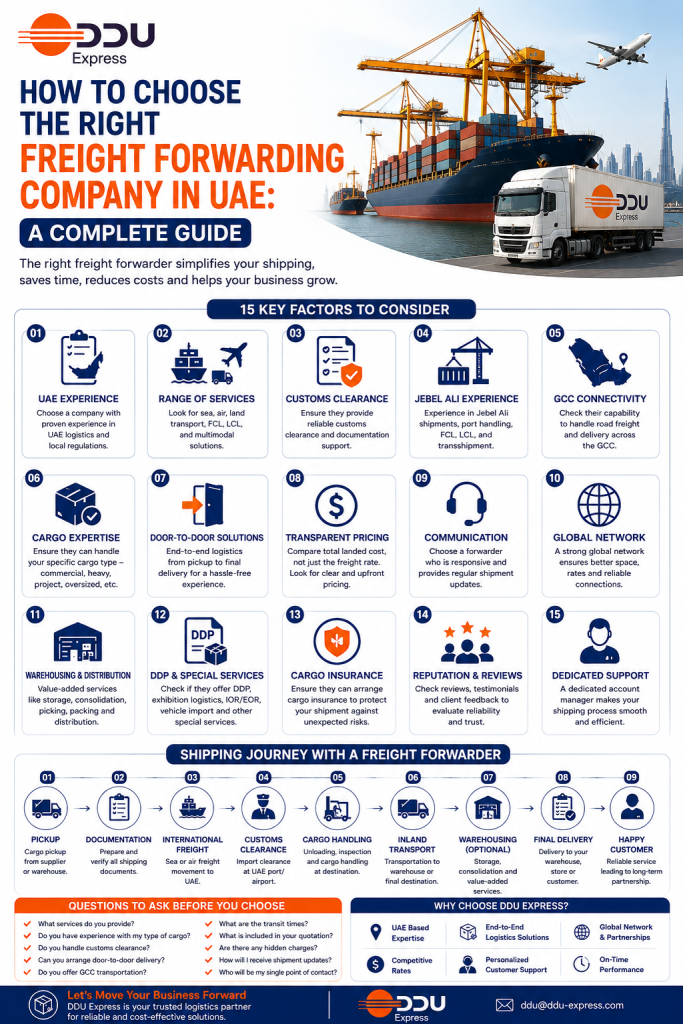
Check the Freight Forwarder’s UAE Experience
One of the first things to consider is the company’s experience with logistics in the UAE.
A freight forwarder familiar with the UAE market should understand the practical requirements associated with shipping through locations such as Dubai and other UAE logistics hubs.
Ask potential providers about their experience with:
- UAE imports
- UAE exports
- Dubai logistics
- Jebel Ali shipments
- Air cargo
- Sea freight
- Customs clearance
- GCC transportation
- Transshipment
- Local delivery
A company with relevant UAE experience may be better positioned to coordinate shipments according to local requirements.
Look at the Range of Freight Services
Your business may not always use the same transportation method.
One shipment may require sea freight, while another may need air freight. A large project shipment may require specialized transportation and handling.
For this reason, it can be useful to choose a freight forwarding company that offers multiple logistics options.
Suitable for many larger commercial shipments and cargo that does not require the speed of air transportation.
Useful for time-sensitive, urgent or relatively smaller shipments where transit speed is a priority.
Important for domestic UAE delivery and shipments moving between the UAE and GCC countries.
Multimodal Transportation
Combines different transportation modes to create a logistics solution based on the shipment’s origin, destination and requirements.
A provider with multiple transportation options can give your business greater flexibility as shipping requirements change.
- Check Their Customs Clearance Capability
Customs clearance is an important part of importing and exporting goods.
Incorrect documentation, classification issues or missing requirements can result in delays and additional costs.
When evaluating a freight forwarder, ask:
- Do you provide customs clearance support?
- Do you handle import and export shipments?
- Can you coordinate customs documentation?
- Can you support transit or transshipment shipments?
- Do you handle the type of cargo we regularly ship?
The exact customs requirements depend on factors such as cargo type, origin, destination and applicable regulations.
A freight forwarding partner should be able to explain what information and documentation are required for your shipment.
Consider Their Jebel Ali Experience
For businesses using sea freight through Dubai, experience with Jebel Ali can be an important consideration.
Jebel Ali is a major maritime gateway serving Dubai and the UAE’s international trade network.
If your business regularly imports or exports containerized cargo, ask the freight forwarder about its experience coordinating:
- FCL shipments
- LCL shipments
- Containerized cargo
- Project cargo
- Breakbulk cargo
- Transshipment
- Port-related logistics
- Inland transportation
A provider that understands the complete journey can help coordinate cargo from the port to the final destination.
For more information, see our guide:
Jebel Ali Freight Forwarding: A Guide to Shipping Cargo Through Dubai
Check GCC Transportation Capabilities
If your business distributes products beyond the UAE, your freight forwarder should ideally be able to support regional transportation.
The UAE can act as a logistics gateway to GCC markets including:
- Saudi Arabia
- Oman
- Qatar
- Bahrain
- Kuwait
Ask the logistics provider whether they can coordinate road freight or multimodal transportation from the UAE to your required destination.
For businesses that regularly ship to multiple GCC markets, having one logistics partner coordinate international freight and regional transportation can simplify supply chain management.
Make Sure They Can Handle Your Type of Cargo
Not all cargo can be handled in the same way.
Before choosing a freight forwarding company, confirm that it has experience with your particular cargo type.
General Commercial Cargo
Products and goods transported through standard shipping methods.
Machinery & Equipment
Industrial machinery and equipment may require additional handling and transportation planning.
Heavy Cargo
Heavy shipments may require specialized equipment and transportation arrangements.
Oversized Cargo
Large cargo can require route planning and special handling.
Complex industrial and infrastructure shipments often require coordination across multiple logistics stages.
Online businesses may require recurring international shipments, warehousing, customs and delivery services.
Choose a freight forwarder based on the actual requirements of your cargo, rather than simply choosing the cheapest quotation.
Ask About Door-to-Door Logistics
Some businesses only need transportation between ports.
Others want a complete logistics solution from the supplier to the final destination.
A door-to-door shipment could look like:
Supplier → Pickup → Sea/Air Freight → UAE → Customs → Local Transport → Warehouse → Final Delivery
If you want an end-to-end solution, ask whether the freight forwarder can coordinate all these stages.
This can reduce the need to communicate with several separate logistics providers.
Compare Transit Times — Not Just Prices
Price is important, but it should not be the only factor.
When comparing freight quotations, look at:
- Freight cost
- Transit time
- Origin charges
- Destination charges
- Customs-related costs
- Local transportation
- Handling charges
- Documentation charges
- Insurance
- Delivery charges
- Potential additional fees
A quotation with the lowest initial price may not necessarily be the lowest overall logistics cost.
Ask the freight forwarder to clearly explain what is included and excluded from the quotation.
Evaluate Communication and Shipment Updates
Good communication is an important part of logistics.
Before choosing a provider, consider how they communicate with customers.
Ask:
- Who will manage my shipment?
- How will shipment updates be provided?
- How quickly can I expect responses?
- Who should I contact if there is a delay?
- Will I receive important documentation promptly?
For regular importers and exporters, having a responsive logistics contact can make day-to-day shipping considerably easier.
Check Their International Network
A UAE freight forwarder may coordinate shipments involving multiple countries.
Ask about the company’s international network and whether it can support your regular origins and destinations.
For example, if your business imports from Asia and distributes products through the UAE and GCC, your logistics partner should be able to coordinate the international and regional portions of that supply chain.
Look for experience with the trade routes that are actually important to your business rather than simply choosing a company based on the number of countries it claims to cover.
Consider Warehousing and Distribution Services
If your business stores products in the UAE, it may be useful to work with a logistics provider that can also coordinate warehousing.
Potential requirements include:
- Storage
- Cargo consolidation
- Inventory handling
- Distribution
- Order fulfillment
- Local transportation
- Repacking or other value-added services where available
Having freight forwarding and warehousing capabilities within the same logistics network can simplify supply chain coordination.
Ask About DDP and Door-to-Door Shipping
If you sell products internationally or operate an e-commerce business, you may need more than port-to-port transportation.
DDP, or Delivered Duty Paid, is an international trade arrangement where the seller takes responsibility for transportation and applicable import-related obligations through delivery, subject to the specific shipment and destination requirements.
If you require DDP shipping to the UAE, ask the logistics provider:
- Is DDP available for my destination?
- What costs are included?
- Who manages customs?
- Who is responsible for applicable import requirements?
- Is final delivery included?
Make sure the responsibilities and costs are clearly understood before booking.
Check Specialized Logistics Capabilities
Some businesses have logistics requirements that go beyond conventional freight forwarding.
For example:
Exhibition Logistics
Exhibitions and trade shows often require time-sensitive transportation and delivery.
Transshipment
Cargo may enter the UAE and continue to another international destination.
Some international shipments may require Importer of Record or Exporter of Record arrangements.
Vehicle Import Logistics
Vehicle shipments can involve additional documentation and clearance requirements.
Project Logistics
Large industrial shipments can require specialized planning and coordination.
If your business requires any of these services, make sure the freight forwarder has relevant experience before booking.
Ask About Cargo Insurance
Cargo can be exposed to different risks during transportation.
The appropriate insurance requirements depend on factors such as:
- Cargo value
- Cargo type
- Transportation mode
- Route
- Handling requirements
- Applicable policy terms
Ask your freight forwarding company whether cargo insurance can be arranged or whether they can help you understand the insurance requirements for your shipment.
For high-value, heavy or project cargo, this should be considered during the planning stage rather than after the shipment has already started.
Review the Company’s Reputation
Before selecting a freight forwarding company, research its reputation.
Look for:
- Customer reviews
- Business history
- Industry experience
- Service range
- Professional communication
- Relevant certifications or memberships
- Case studies
- Customer references where available
Don’t rely on a single review or rating.
Instead, look for consistent evidence that the company provides the services you need.
Ask for a Detailed Freight Quotation
Once you have shortlisted potential freight forwarders, provide the same shipment information to each company.
Include:
Origin:
Where the cargo is being collected.
Destination:
UAE, GCC or international destination.
Cargo Type:
What you are shipping.
Weight:
Total shipment weight.
Dimensions:
Package or cargo dimensions.
Quantity:
Number of packages, pallets or containers.
Shipping Mode:
Sea, air, road or multimodal.
Required Delivery Date:
Your preferred timeline.
Providing accurate information helps freight forwarders prepare more meaningful quotations.
Questions to Ask a Freight Forwarding Company in UAE
Before making a decision, ask the following questions:
- What freight services do you provide?
- Do you handle shipments through Dubai and Jebel Ali?
- Do you provide customs clearance support?
- Can you arrange door-to-door delivery?
- Do you handle GCC road transportation?
- Can you manage project or oversized cargo?
- Do you provide warehousing?
- Can you arrange DDP shipping?
- How will I receive shipment updates?
- What charges are included in the quotation?
- Are there any destination or additional charges?
- Can you arrange cargo insurance?
- Who will manage my shipment?
- What information do you need to provide a quotation?
The answers will help you compare providers based on service capability, transparency and reliability, rather than price alone.
Freight Forwarder vs Shipping Company: What’s the Difference?
These terms are sometimes used interchangeably, but they can refer to different roles.
A shipping line or carrier physically transports cargo, particularly by sea.
A freight forwarder coordinates transportation and related logistics services on behalf of the customer. Depending on the service, the forwarder may arrange transportation with carriers and coordinate customs, documentation, warehousing and inland delivery.
For businesses with complex logistics requirements, a freight forwarder can therefore provide a broader coordination role.
Why Dubai Is an Important Logistics Hub
Dubai’s location makes it an important connection point between major international markets.
Businesses can use Dubai for:
- International imports
- International exports
- Re-exports
- Transshipment
- GCC distribution
- E-commerce logistics
- Industrial cargo
- Project logistics
For companies operating in the UAE, choosing a freight forwarder with knowledge of Dubai’s logistics environment can help simplify international and regional supply chain operations.
Why Choose DDU Express?
DDU Express provides freight forwarding and logistics services in UAE, supporting businesses with international and regional cargo movements.
Our solutions include:
- Sea freight
- Air freight
- Land transportation
- Customs clearance
- Project cargo
- Heavy and oversized cargo
- Transshipment
- DDP logistics
- Warehousing
- E-commerce logistics
- Door-to-door delivery
- Exhibition logistics
Based in Dubai, DDU Express helps businesses coordinate cargo moving through the UAE and onward to GCC and international destinations.
Whether you need to import commercial goods into the UAE, export products from Dubai, move machinery or manage a complex project shipment, we can develop a logistics solution based on your cargo and destination.
Final Checklist: Choosing a Freight Forwarder in UAE
Before selecting a logistics partner, make sure you have considered:
✓ UAE logistics experience
✓ Relevant transportation options
✓ Customs clearance capability
✓ Jebel Ali experience where required
✓ GCC transportation
✓ Experience with your cargo type
✓ Door-to-door services
✓ Warehousing options
✓ International network
✓ Clear pricing
✓ Shipment communication
✓ Cargo insurance options
✓ Specialized logistics capabilities
✓ Customer reputation
The best freight forwarding company is not necessarily the one offering the lowest quotation. It is the provider that can reliably coordinate the right transportation, documentation, customs, handling and delivery solution for your specific shipment.
Frequently Asked Questions
How do I choose a freight forwarding company in UAE?
Compare companies based on their UAE experience, transportation services, customs capabilities, cargo expertise, international network, communication, pricing transparency and ability to provide the specific logistics services your business requires.
What services should a UAE freight forwarder provide?
Depending on your requirements, a freight forwarder may provide sea freight, air freight, land transportation, customs clearance, warehousing, project cargo, transshipment, DDP and door-to-door logistics.
Is Dubai a good location for freight forwarding?
Dubai is an important international logistics and trading hub, providing connections between the UAE, GCC and global markets.
What should I include when requesting a freight quotation?
Provide the cargo origin, destination, cargo type, weight, dimensions, quantity, preferred transportation mode and required delivery timeline.
Should I choose the cheapest freight forwarder?
Not necessarily. Compare the complete logistics cost, included services, transit time, communication, customs support and potential additional charges before making a decision.
Can a freight forwarder arrange customs clearance?
Many freight forwarders provide or coordinate customs clearance services. Confirm the exact scope of service for your shipment before booking.
Can freight forwarders handle heavy or oversized cargo?
Some freight forwarders specialize in project cargo, heavy machinery and oversized shipments. If your cargo requires specialized handling, confirm the provider’s relevant experience before booking.
Can a UAE freight forwarder arrange GCC transportation?
Many logistics providers coordinate road and multimodal transportation between the UAE and GCC destinations. Confirm that the provider supports your required route and cargo type.
Conclusion
Choosing the right freight forwarding company in UAE is an important decision for any business involved in international trade.
Look beyond the freight rate and evaluate the complete logistics solution: transportation options, customs coordination, cargo expertise, GCC connectivity, communication, warehousing and final delivery.
For businesses operating in Dubai and across the UAE, a reliable freight forwarding partner can help simplify the movement of goods from international suppliers to UAE destinations and from UAE businesses to customers around the world.
Need help with your next shipment?
DDU Express provides freight forwarding and logistics solutions from Dubai across the UAE, GCC and international markets.

Weiworld is an experienced logistics and shipping professional with more than 20 years of industry experience, with extensive knowledge of international shipping, freight forwarding, cargo movement, and logistics operations.
Over the course of his career, he has developed deep practical expertise in Middle East logistics and operations, including shipping processes, international cargo transportation, customs-related procedures, and supply chain coordination.
At DDU Express, Weiworld shares practical insights and industry knowledge to help businesses better understand international shipping, freight forwarding, DDP services, cargo transportation, and logistics solutions across the Middle East and global markets.
His extensive industry experience provides valuable perspective for businesses looking to simplify international shipping and make informed decisions when moving cargo between countries.