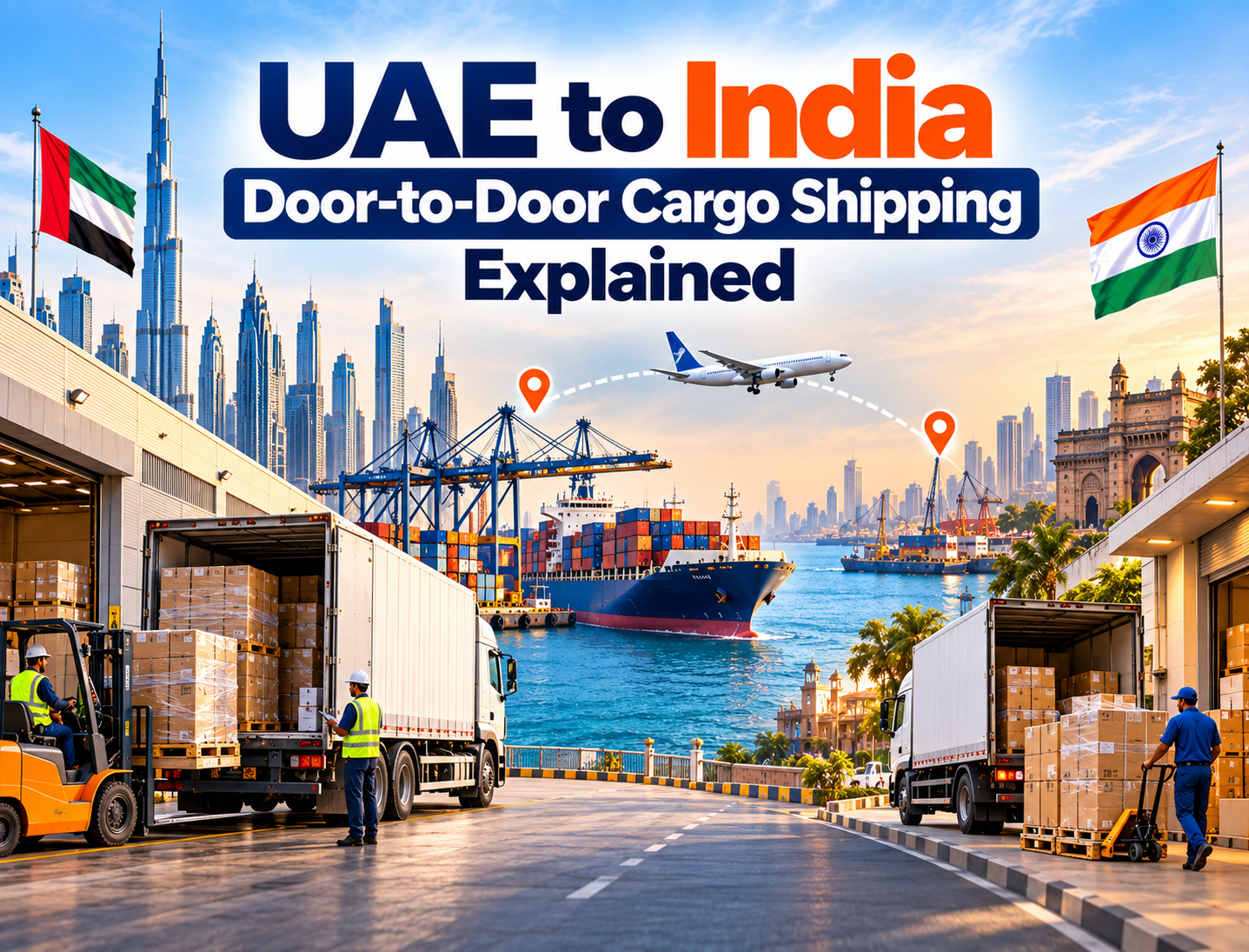
The process of shipping goods from the UAE to India includes a number of stages such as pickup, the preparation of export documents, international transport, clearance at Indian customs, handling at the port, and the final delivery.
By arranging door-to-door cargo shipping, all the stages are brought together as part of a single logistics arrangement, so that cargo can be picked up at a place in the UAE and delivered to a particular address in India.
This can make it easier for businesses to transport commercial goods, machinery, equipment, inventory and other cargo between the two countries.
The specific procedure varies according to the type of cargo, the method of shipping, the origin, the destination, the customs requirements and the delivery arrangements. This article outlines how door-to-door shipping from the UAE to India operates and the considerations that businesses should make before booking a shipment.
For a broader overview of shipping methods, costs, documentation and logistics arrangements, explore our complete guide to shipping from UAE to India.
What Is Door-to-Door Cargo Shipping?
With door-to-door shipping, the logistics company arranges the transport from the pickup place in the UAE to the final delivery address in India.
A typical shipment may follow this route:
UAE Pickup → Export Clearance → Port/Airport → International Freight → Indian Customs → Port/Airport Release → Inland Transport → Final Delivery
Rather than handling each stage on its own, the shipper can get in touch with a freight forwarder to arrange the entire shipment.
For example:
Dubai warehouse → Jebel Ali Port → Indian port → Customs clearance → Indian warehouse
or:
Abu Dhabi supplier → Dubai airport → Indian airport → Customs clearance → Customer address
The specific route to be taken will depend on the type of cargo and the service chosen.
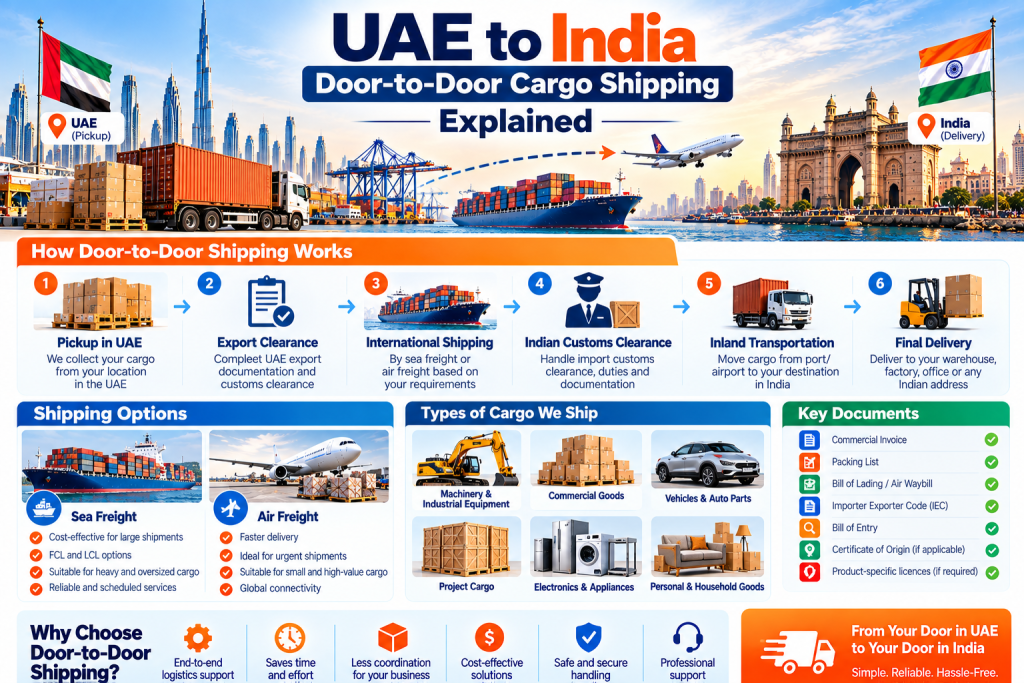
How does door-to-door shipping from the UAE to India work?
It typically consists of a number of stages.
1. Share Your Cargo Details
The freight forwarder should be given accurate details about the shipment.
Important details include:
- Type of cargo
- Number of packages
- Weight
- Dimensions
- Cargo value
- Pickup location
- Delivery location
- New or used goods
- Preferred shipping method
- Required delivery timeframe
With machinery or large cargo, it is especially important to take the dimensions and weight into account.
Package dimensions can also have an effect on the chargeable weight when it comes to air freight.
2. Select sea freight or air freight
The fact that door-to-door service doesn’t necessarily involve just one mode of transportation.
Depending on the shipment, you can use:
Sea Freight
Usually considered for:
- Large shipments
- Commercial cargo
- Heavy equipment
- Machinery
- Bulk goods
- Non-urgent shipments
- FCL and LCL cargo
For businesses transporting larger consignments, machinery or bulk cargo, our detailed guide to Dubai to India sea freight explains the available shipping options and important considerations.
Air Freight
Often considered for:
- Urgent shipments
- Smaller consignments
- High-value goods
- Samples
- Spare parts
- Time-sensitive commercial shipments
When making the choice it is necessary to take into account both the delivery requirements and the total logistics cost.
Sea freight could be used in the case of large consignments where the delivery time can be flexible. If the cargo is urgent or only relatively small in amount, then air freight would be more suitable.
If delivery speed is a priority, read our guide on Dubai to India air freight to understand when air cargo may be suitable for your shipment.
Door-to-Door Sea Freight vs Air Freight
Factor | Door-to-Door Sea Freight | Door-to-Door Air Freight |
Speed | Slower | Faster |
Large cargo | Suitable | Limited |
Heavy machinery | Suitable in many cases | Usually less suitable |
Small shipments | Possible | Often suitable |
Cost per unit | Generally lower for larger shipments | Generally higher |
Urgent cargo | Less suitable | More suitable |
FCL/LCL | Available depending on shipment | Not applicable in the same way |
Final delivery | Included in door-to-door arrangement | Included in door-to-door arrangement |
3. Make the pickup arrangement in the UAE
When the shipment has been booked the carrier will be able to collect the cargo from the specified UAE address.
Pickup could be from:
- Warehouse
- Factory
- Office
- Supplier
- Distribution centre
- Retail location
- Construction site
The vehicle used for picking up the cargo relies on it.
In most cases a standard delivery vehicle will be enough.
When it comes to machinery or heavy equipment, you will probably need specialized transportation.
4. Get the cargo ready for export
You need to pack and get the cargo ready before it is transported.
Depending on the shipment, this can include:
- Cartons
- Pallets
- Wooden crates
- Export packaging
- Shrink wrapping
- Strapping
- Moisture protection
- Cargo securing
Heavy machinery may require additional blocking, bracing and securing.
The packaging must be suitable for the chosen method of transportation and for the characteristics of the cargo.
5. Prepare Export Documents
The documents needed will vary depending on the kind of cargo and the nature of the transaction.
Common documents can include:
- Commercial invoice
- Packing list
- Bill of Lading
- Air Waybill
- Export declaration
- Certificate of Origin, where applicable
- Purchase order or sales documentation
- Product-specific certificates, where required
According to the UAE government’s trade advice, the export process involves booking the shipment, packing and arranging transport, preparing the commercial invoice and packing list, issuing the certificate of origin where it is required, making the export declaration and carrying out the customs procedures. (UAE)
6. Completion of UAE export clearance
Before the shipment leaves the country it must go through the relevant UAE export procedures.
For a sea shipment, this may include:
Cargo pickup → Export documentation → Export declaration → Port handling → Vessel loading
For air freight:
Cargo pickup → Export documentation → Airport handling → Air shipment
The specific procedure will depend on the emirate in the UAE, the type of cargo and the method of shipping.
7. International Transportation
Once the cargo has passed the export clearance, it starts its international journey.
Sea freight
The cargo is carried from a port in the UAE to an appropriate port in India by vessel.
Air freight
The aircraft takes the cargo from an airport in the UAE to an airport in India.
The last Indian gateway will depend on the shipping service and the delivery destination.
8. Indian Customs Clearance
Once the shipment has reached India, it must carry out the relevant import customs procedures.
When importing goods into India, the DGFT regards the Bill of Lading or Airway Bill, the commercial invoice together with the packing list, and the Bill of Entry as essential import documents. At the same time, certain goods may need extra documentation or have to comply with product-specific requirements. (DGFT)
The customs process may involve:
- Filing the Bill of Entry
- Document verification
- HS classification
- Customs valuation
- Duty assessment
- Examination where required
- Payment of applicable duties and taxes
- Customs release
The specific requirements will vary according to the goods in question.
9. Release at a port or an airport
Once the customs clearance has been carried out and all the relevant charges and procedures have been completed, the cargo may be released for further transportation.
In the case of sea freight, the cargo would have to be transported from the Indian port to the inland destination.
With air freight the cargo is taken from the airport cargo facility to its final destination.
10. The final delivery in India
This is the last stage of door-to-door shipping.
The cargo is taken from the port in India or the airport in India to the address where it is to be delivered.
For example:
Jebel Ali → Nhava Sheva → Mumbai warehouse
or:
Dubai → Chennai Airport → Chennai factory
or:
Sharjah → Cochin → Kerala business address
When calculating the total shipping cost you should take final-mile transportation into account.
For more information about the shipping process, costs and transit considerations, see our complete guide to shipping from Dubai to India
What kinds of cargo can be shipped door-to-door from the UAE to India?
Door-to-door logistics is capable of dealing with a variety of types of cargo, provided that the relevant shipping and import requirements are met.
Examples include:
Commercial Goods
- Retail products
- Consumer goods
- Industrial supplies
- Business inventory
- Packaging materials
Machinery
- Industrial machinery
- CNC machines
- Generators
- Construction equipment
- Workshop machinery
E-commerce Shipments
- Online orders
- Product samples
- Small commercial consignments
Personal or Household Goods
We might also carry household or personal goods depending on the type of shipment and the relevant regulations.
Spare Parts
Door-to-door logistics is useful in the situation where replacement parts have to be sent from a supplier in the UAE to a business in India.
What Documents Are Required?
The exact documentation depends on the type of goods, but commonly used documents include:
Document | Purpose |
Commercial Invoice | Declares transaction and cargo value |
Packing List | Provides package and cargo details |
Bill of Lading | Sea transportation document |
Air Waybill | Air transportation document |
Bill of Entry | Indian import customs document |
Certificate of Origin | Establishes origin where applicable |
Export Declaration | UAE export customs process |
Product-specific certificates | Required for certain goods |
DGFT notes that additional documentation may be required for specific products that are subject to restrictions, policy conditions, NOCs or product-specific compliance requirements. (DGFT)
What is the cost of door-to-door shipping from the UAE to India?
There is not a single fixed rate for door-to-door shipping from the UAE to India.
The total cost is going to be influenced by a number of factors.
1.The pickup location in the UAE.
The farther the supplier is from the port or airport, the higher the costs of inland transportation will be.
2. Cargo Weight
For heavier cargo it may be necessary to use larger vehicles or alter the way it is handled.
3. Cargo Volume
With sea freight, the amount of goods to be shipped and the number of containers needed can have a significant effect on the price.
4. Shipping Method
The pricing for sea freight and air freight are different.
5. FCL or LCL
The total cost can be influenced by whether a full container or shared container space is chosen for sea cargo.
6. Destination in India
The cost of delivering to Mumbai, Delhi, Chennai, Kerala or to any other destination will vary depending on the inland transportation required.
7. Cargo Type
Cargo that is fragile, hazardous, oversized, or specialized might need extra handling.
8. Customs and Duties
The import duties and taxes that apply will vary depending on the type of goods, their classification and the relevant regulations.
9. Fees at ports and at airports
The costs associated with handling, the necessary documentation and any other charges payable at the destination can add to the total cost.
10. Final-Mile Delivery
The fact that the distance between the Indian gateway and the final delivery address is taken into account makes it an essential element of door-to-door pricing.
Door-to-Door Shipping vs Port-to-Port Shipping
A major difference is the person or organisation responsible for arranging transportation once the goods have arrived in India.
Port-to-Port
The shipment is carried from the port in the UAE to a port in India.
The importer may then need to arrange:
- Customs clearance
- Port release
- Inland transportation
- Final delivery
Door-to-Door
The logistics arrangement includes the transportation from the pickup point in the UAE to the agreed delivery address in India, on the basis of the agreed service scope.
Port-to-Port | Door-to-Door |
Port to port | Address to address |
More stages arranged separately | More stages coordinated together |
Importer handles onward logistics | Forwarder coordinates onward transportation |
More coordination required | Simplifies logistics management |
Make sure that the exact inclusions are confirmed in the quotation.
Door-to-Door Cargo Shipping for Businesses
Door-to-door logistics can be of assistance to companies which regularly transport goods between the UAE and India.
Examples include:
- UAE distributors supplying Indian customers
- Indian businesses purchasing goods from UAE suppliers
- E-commerce companies
- Manufacturers
- Importers
- Retailers
- Construction companies
- Industrial businesses
- Spare-parts suppliers
A business need not arrange for several transportation companies since it can use a freight forwarder to handle the shipment as one logistics operation.
If you are arranging a business shipment, our detailed guide on how to ship commercial cargo from UAE to India covers cargo preparation, business documentation and import considerations.
Shipping Machinery Door-to-Door
More detailed planning is needed for machinery than for ordinary cargo.
Before booking, provide:
- Machine dimensions
- Gross weight
- Photos
- Machine type
- Value
- New/used status
- Pickup location
- Indian delivery location
The logistics plan may involve:
UAE factory → Heavy-haul pickup → Port → Sea freight → Indian customs → Heavy-haul delivery → Final factory
When it comes to oversized machinery, you should consider the choice of container, the loading equipment, road transport and final-mile access before shipping it.
For a detailed explanation of equipment preparation, container selection, customs documentation and heavy machinery transportation, read our guide on how to ship machinery from UAE to India.
Door-to-Door Shipping for Commercial Cargo
Since the cargo is commercial in nature, it will need a more structured procedure because it involves business documentation and clearance for import into India.
Before shipping, confirm:
- Importer details
- IEC requirements
- HS classification
- Commercial invoice
- Packing list
- Cargo value
- Import restrictions
- Required product-specific approvals
- Final delivery address
It allows the forwarder to decide on the correct logistics route and the necessary documentation.
How long does door-to-door shipping from the UAE to India take?
Every shipment does not have a single delivery time.
The overall timeline can be affected by:
- Pickup location
- Cargo preparation
- Export clearance
- Shipping method
- Vessel or flight schedule
- Port or airport handling
- Indian customs clearance
- Cargo release
- Inland transportation
- Final delivery distance
International transit time makes up only one section of the entire door-to-door journey.
With regard to urgent deliveries, air freight can cut down the time it takes to transport the goods as against sea freight, although the overall time still relies on customs and other handling procedures.
Common Mistakes to Avoid
1. To look at only the freight rate
Just because the freight rate for sea or air transport is low doesn’t mean that the total door-to-door cost is low.
Make sure to verify what is included.
2. Giving wrong cargo dimensions
Wrong measurements may lead to extra transportation or handling costs.
3. Disregarding the customs requirements of India
Before the cargo leaves the UAE, check the import requirements.
4. The use of an incorrect HS code
Verify the classification based on the actual goods.
5. Not confirming destination charges
Ask whether customs clearance, port handling, duties, delivery and other destination charges are included or excluded.
6. Not planning the final delivery
For large cargo, the final road transportation can be a significant part of the logistics plan.
7. Waiting until the cargo is ready to prepare documents
Prepare documentation before shipment wherever possible.
How to Choose a Door-to-Door Freight Forwarder
When comparing logistics providers, look beyond the headline freight price.
Consider whether the provider can coordinate:
- UAE pickup
- Export customs
- Sea freight
- Air freight
- Indian customs clearance
- Port/airport handling
- Inland transportation
- Final delivery
- Cargo documentation
- Special cargo requirements
Also ask for a clear quotation showing what is included and excluded.
For example:
Is Indian customs clearance included?
Are destination charges included?
Are duties and taxes included?
Is final-mile delivery included?
Are port handling charges included?
These questions help avoid unexpected charges later.
UAE to India Door-to-Door Shipping Process at a Glance
- Share cargo details
↓
- Get a door-to-door quotation
↓
- Confirm documents and import requirements
↓
- Arrange UAE pickup
↓
- Complete UAE export procedures
↓
- Ship by sea or air
↓
- Complete Indian customs clearance
↓
- Release cargo
↓
- Arrange inland transportation
↓
- Deliver to final address
Door-to-Door Cargo Shipping with DDU Express
Based on your shipment requirements, DDU Express can arrange cargo movement from the UAE to India.
Depending on the cargo and service selected, logistics support can include:
- UAE cargo pickup
- Sea freight
- Air freight
- FCL and LCL shipping
- Export documentation
- Customs clearance coordination
- Port and airport handling
- Door-to-door transportation
- Commercial cargo
- Machinery and heavy equipment logistics
- Final-mile delivery
When requesting a quotation, provide the cargo type, weight, dimensions, pickup location in the UAE and delivery address in India.
This allows us to assess your shipment requirements before preparing the final logistics plan.
Frequently Asked Questions
What is UAE to India door-to-door shipping?
It is a logistics service where cargo is collected from a specified location in the UAE and transported through the required export, international shipping, Indian customs and inland delivery stages to an agreed address in India.
Is customs clearance included in door-to-door shipping?
It depends on the service and quotation. Always confirm whether UAE export clearance and Indian import customs clearance are included.
Can I ship cargo from Dubai to Kerala door-to-door?
Yes, subject to the cargo and applicable import requirements. We can arrange the shipment from a UAE pickup location through an Indian gateway and onward to the final Kerala address.
Is door-to-door shipping cheaper than arranging everything separately?
Not necessarily. The main advantage is coordinating multiple logistics stages. Compare the total landed logistics cost, not just the international freight rate.
Can machinery be shipped door-to-door?
Yes, machinery can be handled through a door-to-door logistics arrangement, but heavy or oversized equipment may require specialized transportation, loading and delivery planning.
Can I use air freight for door-to-door delivery?
Yes. Air freight can be combined with UAE pickup, export procedures, Indian customs clearance and final-mile delivery.
What documents are required for UAE to India cargo?
Common documents include the commercial invoice, packing list and Bill of Lading or Air Waybill. Indian imports generally require a Bill of Entry, while specific products can require additional documentation or approvals. (DGFT)
How much does UAE to India door-to-door shipping cost?
The price depends on the cargo, weight, volume, origin, destination, shipping method, customs requirements and final-mile transportation. A shipment-specific quotation is needed for an accurate price.
Conclusion
UAE to India door-to-door cargo shipping combines multiple logistics stages into one coordinated shipment — from pickup in the UAE to final delivery in India.
The process can include cargo pickup, export documentation, customs procedures, sea or air transportation, Indian import clearance and inland delivery.
For businesses, the key is to understand the full logistics cost and service scope, not just the international freight rate.
Before booking, provide accurate cargo details and confirm exactly what the quotation includes, particularly customs clearance, destination charges, duties and taxes, port handling and final delivery.

Weiworld is an experienced logistics and shipping professional with more than 20 years of industry experience, with extensive knowledge of international shipping, freight forwarding, cargo movement, and logistics operations.
Over the course of his career, he has developed deep practical expertise in Middle East logistics and operations, including shipping processes, international cargo transportation, customs-related procedures, and supply chain coordination.
At DDU Express, Weiworld shares practical insights and industry knowledge to help businesses better understand international shipping, freight forwarding, DDP services, cargo transportation, and logistics solutions across the Middle East and global markets.
His extensive industry experience provides valuable perspective for businesses looking to simplify international shipping and make informed decisions when moving cargo between countries.