

Requirements for shipping goods from the United Arab Emirates to India vary widely depending on the nature of the items and the reason for the shipment. For example, a person moving from Dubai to India will probably need to have their clothes, furniture, kitchen utensils and other household goods transported. In contrast, a business might need to ship its products, machinery, equipment, spare parts or stock intended for resale.
Even though both consignments go between the same countries, personal effects and commercial cargo do not always require the same documentation, customs or shipping conditions.
It is necessary to understand the difference between personal effects and commercial cargo if you are to arrange a shipment, since this will allow you to choose an appropriate transport method, enable you to prepare the required documentation, allow for an accurate estimation of the costs and help to reduce the risk of delays.
For a broader overview of transport options, documentation and shipping processes, start with our complete guide to shipping from UAE to India.
What Are Personal Effects?
Personal effects are possessions meant for an individual’s personal use, not for commercial sale; they usually include items moved when someone relocates, returns to India, or sends items to family members.
Examples may include:
- Clothes, footwear and personal accessories
- Books and personal documents
- Kitchen utensils and household items
- Furniture and home furnishings
- Personal electronics and appliances
- Toys and other family belongings
- Used household goods associated with a relocation
How a shipment is handled will vary depending on the items involved, their condition, quantity, ownership, intended use and relevant Indian customs regulations. Just because something is for use or intended for personal use does not mean that it is automatically exempt from customs duties or import restrictions.
If you plan to ship valuable electronics, appliances, restricted products or large quantities of the same kind of items, it is advisable to check beforehand whether any additional documents, declarations or approvals are needed.
What Is Commercial Cargo?
Commercial cargo includes goods which are shipped for business purposes and these may be meant for resale, for use in manufacturing, for carrying out a project, for business operations or for distribution.
Typical examples include:
- Products imported for resale
- Wholesale goods and retail inventory
- Industrial machinery and equipment
- Spare parts and engineering components
- Raw materials and manufacturing supplies
- Business electronics and office equipment
- Samples, promotional products and project materials
With commercial shipments it is necessary to give careful attention to the commercial invoice, the packing list, the product classification, the declared value, the country of origin and the relevant import requirements. In some cases, depending on the items and the transaction, you may need additional licenses, certificates or regulatory approvals.
For a detailed explanation of business shipping procedures, read our guide on how to ship commercial cargo from UAE to India.
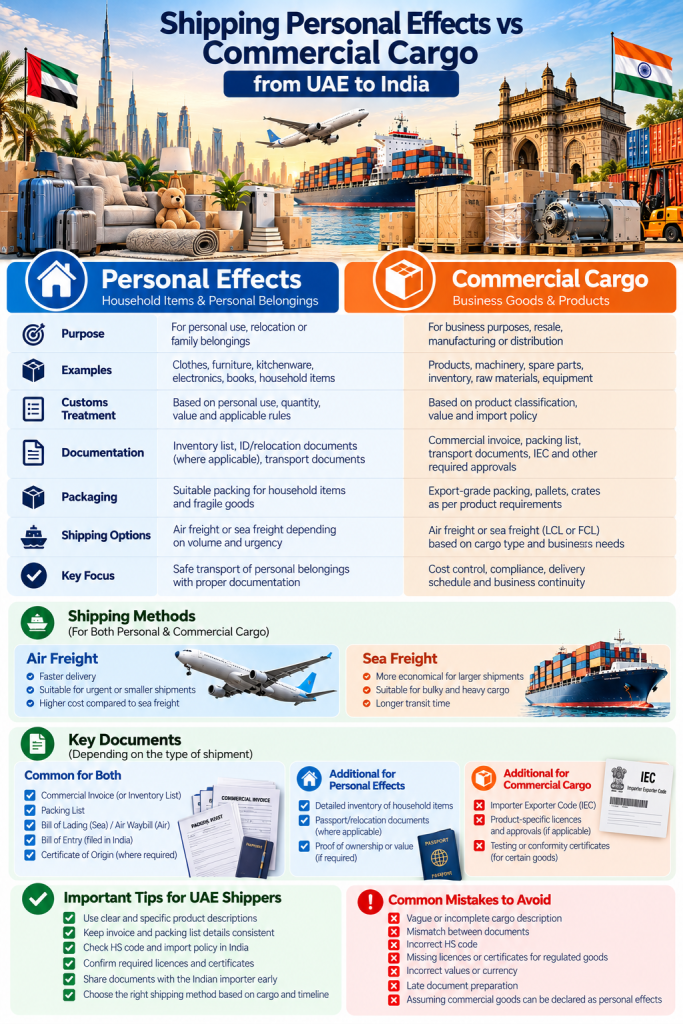
Personal Effects vs Commercial Cargo: Key Differences
The only difference is the purpose of the shipment, but that is just one factor; customs classification, supporting documents, item restrictions and the import procedure can also differ.
Factor | Personal effects | Commercial cargo |
Typical purpose | Personal use, household relocation or family belongings | Resale, business use, manufacturing or distribution |
Common examples | Clothes, furniture, books and household items | Products, machinery, spare parts and inventory |
Documentation | Item inventory, identity or relocation documents where applicable, and transport documents | Commercial invoice, packing list, transport documents and other documents required for the goods |
Customs treatment | Depends on eligibility, item type, value and applicable personal effects or baggage rules | Depends on product classification, value, import policy and applicable duties and regulatory requirements |
Packaging | Based on household items, fragility and shipment volume | Based on product protection, handling, stacking, storage and transport requirements |
Shipping options | Air freight or sea freight, depending on volume, urgency and service availability | Air freight, sea freight, FCL or LCL, depending on cargo and business needs |
Cost considerations | Volume, weight, packing, collection, delivery and customs-related charges | Cargo dimensions, weight, commodity, freight mode, handling, customs-related costs and delivery requirements |
Main planning priority | Protecting belongings and arranging suitable collection and delivery | Cost control, documentation, delivery schedules and business continuity |
Important: This is only a general comparison and not a guarantee regarding customs treatment. Indian customs requirements will vary based on the shipment’s actual circumstances and the items being imported.
1. Documentation Requirements
One of the key distinctions between personal effects and commercial cargo is the presence of documentation, the details in both instances having to give an accurate description of the contents of the shipment.
Documents for personal effects
Depending on the shipment and the applicable procedure, you may need:
- A detailed inventory of the items being shipped
- The sender’s and receiver’s identification details
- A passport, visa, residence or relocation-related document where relevant
- A packing list or other item declaration
- A transport document, such as an air waybill or bill of lading
- Receipts, proof of ownership or value information for selected items, if requested
- Any additional declarations or approvals required for specific goods
The inventory description must be clear and describe each item specifically; for example, rather than using a general term like “miscellaneous goods,” describe the contents as “used kitchen utensils and household cookware.”
It would be wrong to assume that everything you have used is eligible for duty-free import; whether you are entitled to any concessions depends on the relevant rules and your particular situation.
Documents for commercial cargo
Commercial shipments may require a different set of documents, such as:
- Commercial invoice
- Packing list
- Bill of lading or air waybill
- Importer details and applicable customs registration information
- Correct product descriptions and HS codes
- Country-of-origin information or certificate, where required
- Product-specific licenses, certificates or regulatory approvals, where applicable
- Additional documents requested by the customs authorities or relevant agencies
The amount of paperwork needed varies by product, transaction and import process; some categories, such as regulated products, electronics, foodstuffs, chemicals and machinery, require extra inspections.
For a more detailed overview, see customs requirements for shipping goods from UAE to India.
2. Customs Clearance: Why the Difference Matters
Although personal items and commercial goods may follow different customs procedures, do not assume either category will automatically receive clearance or an exemption.
With regard to personal effects, customs will take into account the type of items, whether they are used or new, how many there are, the reason for importing them and the recipient’s eligibility. Items that seem to be intended for resale or which are subject to import restrictions may be subject to further examination.
With commercial cargo, customs clearance usually consists of checking the goods as declared, their value, their classification and compliance with the relevant import requirements. The importer might have to submit supporting documents or get product-specific approvals before the customs authorities release the shipment.
Common issues that can cause delays include:
- Incomplete or inconsistent shipment descriptions
- Differences between the invoice, packing list and actual cargo
- Incorrect or unsuitable product classification
- Missing permits or certificates for regulated goods
- Undeclared items or inaccurate declared values
- Uncertainty about the importer’s eligibility or responsibilities
Check the appropriate customs procedures before sending goods out of the UAE, especially for high-value items, restricted products, machinery, or consignments that include both personal effects and business goods.
3. Choosing Between Air Freight and Sea Freight
Personal belongings and commercial goods have the possibility of being transported by air or sea, and the correct method to use will depend on the volume, weight, urgency, destination and the handling requirements of the shipment.
Air freight
Air freight is suitable for smaller or time-critical deliveries where the need for a quick delivery is important; it can be appropriate for essential personal items, certain electronics or commercial goods that need to be delivered quickly. Charges may be based on actual weight or volumetric weight, so package dimensions matter.
Sea freight
Sea freight suits bulky household goods, furniture, large shipments and commercial cargo that does not need to be delivered urgently. Total cost varies with shipment volume, container arrangement, handling charges and other fees.
For a more detailed comparison of sea shipping options, read Dubai to India sea freight: the complete business guide. If delivery speed is a priority, our guide to Dubai to India air freight explains when air cargo may be suitable.
When should you consider LCL or FCL?
For sea freight, different shipment arrangements may be suitable for commercial cargo and personal effects depending on their size and the services available.
- If your shipment does not require a full container, it will share space with other goods, so take this into account.
- FCL (Full Container Load) means you use a container solely for the shipment in question. This option suits large volumes or cargo that needs its own container.
It is necessary to compare not only the total charges but also the range of services offered, rather than supposing that one shipping method will always be the more economical choice. Various factors, such as costs at the point of origin and at the destination, consolidation, delivery, and customs procedures, can affect the final amount payable.
4. How Do Shipping Costs Differ?
There is no fixed rate when shipping either personal effects or commercial cargo from the UAE to India, the total cost varying according to the particulars of the shipment and the services needed.
Personal effects shipping costs
Costs may include:
- Collection from the sender’s home or storage location
- Packing materials and professional packing, if requested
- Shipment volume and chargeable weight
- Air or sea freight
- Export handling and documentation
- Destination handling and delivery
- Customs duties, taxes or other charges where applicable
- Storage, inspection or special handling, if required
Even if furniture and household items aren’t very heavy, they can still take up a lot of space, so provide accurate measurements to get a reliable shipping quote.
Commercial cargo shipping costs
Commercial shipments can involve the same general freight and handling categories, along with other requirements that depend on the products. These might be:
- Special packing or palletization
- Cargo insurance
- Dangerous-goods handling, where applicable
- Customs documentation and product compliance
- Import duties and taxes
- Port or terminal handling
- Warehousing and inland transportation
- Oversized, heavy or specialized cargo handling
Businesses should consider the total landed cost rather than focusing only on the international freight rate, since a low freight quote may not include all charges related to origin, destination, customs or delivery.
For practical cost-saving advice, read how to reduce UAE–India shipping costs.
5. Packing and Preparing the Shipment
Packing requirements depend on the nature of the goods, their fragility and the transport method.
Packing personal belongings
When preparing household goods:
- Use sturdy cartons that can support the contents’ weight.
- Protect fragile kitchenware, glass items and electronics with appropriate cushioning.
- Keep an inventory of the packed items.
- Label cartons clearly by contents and handling needs.
- Separate items that may require special declarations or approvals.
- Verify the relevant requirements before packing any items that may be prohibited or restricted.
For furniture and appliances, confirm whether dismantling, protective wrapping or specialized handling is needed. Photographing valuable belongings before packing can also help you maintain a record of their condition.
Packing commercial cargo
Goods sold in a commercial context may need packaging designed for repeated handling, stacking, storage and transportation. The type of shipment may cause companies to require cartons, pallets, protective inserts, moisture protection or export-grade packing.
Machinery and industrial equipment may require additional preparation to prevent movement, impact damage or moisture exposure. For specialized shipments, consult our guide on how to ship machinery from UAE to India.
The packaging must be enough to protect the goods without adding any extra volume or weight. It is possible for excessive packaging to raise freight costs, in particular when the charges are calculated according to volumetric weight or shipment size.
6. Can You Ship Personal Effects and Commercial Cargo Together?
A shipment can include both personal possessions and business-related items. For instance, a person moving to India might take with them tools, office equipment or products associated with a business.
You can’t declare or clear all items as personal effects if personal possessions are mixed with business-related goods.
Before arranging such a shipment:
- Prepare a separate list of personal belongings and business goods.
- Identify new items, used items and products intended for resale.
- Record quantities, values and descriptions accurately.
- Check whether different declarations, documents or customs procedures apply.
- Ask the freight forwarder how to pack, document and present the items for clearance.
Depending on the contents and the relevant rules, it may be more suitable to use separate packing lists, invoices, declarations or even separate shipments.
Do not refer to commercial stock as personal property to obtain a reduced shipping rate or different customs treatment. Incorrect declarations could lead to inspections, delays, extra charges or penalties.
7. Door-to-Door Shipping for Personal Effects and Commercial Cargo
Door-to-door delivery can make the procedure easier by arranging for the collection at the point of origin and the delivery at the destination. The service may include one or more of the following: pickup, packing, export handling, international transportation, customs coordination and final delivery.
For individuals, the arrangement can decrease the amount of effort required when moving their household goods to different locations.
It can assist businesses in organizing the pickup of cargo, the transport schedules and its delivery to an office, a warehouse, a project site or some other agreed destination.
It does not follow that door-to-door shipping covers all the costs, nor does it include the customs duties or the clearance responsibilities. One should carefully go through the quotation to find out which services are included and which charges might have to be paid separately.
Read UAE to India door-to-door cargo shipping explained for more information about the service and its considerations.
8. Common Mistakes to Avoid
Whether you are shipping household belongings or business goods, a few common mistakes can complicate the process.
- Providing an incomplete inventory: Insufficient or vague descriptions may lead to questions during documentation review or inspection.
- Assuming used goods are duty-free: Customs treatment depends on the applicable rules and the shipment’s circumstances.
- Choosing a shipping method based solely on price: Other factors such as transit time, handling requirements, destination charges and the scope of services should also be considered.
- Underestimating shipment volume: Large items such as household furniture and bulky packaging can significantly increase shipping costs.
- Using inaccurate values or descriptions: Declarations should reflect the actual contents and relevant transaction details.
- Ignoring product-specific requirements: Waiting until the last minute: Delayed preparation may restrict available shipping options and reduce the time available to address documentation requirements.Not confirming delivery arrangements: Verify access restrictions, unloading requirements and whether the destination is a residence, warehouse or commercial facility.
Businesses shipping larger consignments should also verify that the selected freight service matches the cargo’s handling and delivery requirements.
9. How to Get an Accurate UAE–India Shipping Quote
It would be advisable to give a full amount of details regarding the shipment before booking if you want to get an accurate shipping quote.
Information to provide | Personal effects | Commercial cargo |
Origin and destination | Collection and delivery addresses or locations | Pickup location and final delivery address |
Cargo description | Household belongings and furniture | Product names, materials and intended use |
Quantity | Number of cartons and large items | Number of packages, pallets or units |
Dimensions and weight | Approximate carton and furniture measurements | Package dimensions, gross weight and total volume |
Value | Reasonable value details where required | Commercial value and invoice details |
Shipping preference | Air, sea or assistance choosing | Air, sea, LCL or FCL preference |
Special requirements | Fragile goods, appliances or packing needs | Handling, palletisation, compliance or delivery needs |
Timing | Preferred collection and arrival window | Required delivery date or business schedule |
Request that the freight forwarder give an explanation regarding the expected transit time, the documents required, the services included, the exclusions, and any charges that might occur at the destination.
If you are shipping for business purposes, our guide to shipping commercial cargo from UAE to India provides additional guidance on planning the shipment.
Frequently Asked Questions
What is the main difference between personal effects and commercial cargo?
Personal effects are usually items that are meant for an individual’s personal use, for example clothes, furniture and household items. Commercial cargo refers to goods which are shipped for business purposes, such as for resale, manufacturing, distribution or business operations. The customs treatment that applies will depend on the goods and the circumstances.
Can I send used household items from Dubai to India?
Used household goods can be sent from Dubai to India provided that the relevant import regulations are observed. It will depend on the specific circumstances and the applicable rules whether any customs concession is available. Make sure you have a accurate list of the items and verify the requirements before sending them.
Do personal effects require a commercial invoice?
Personal effects shipments aren’t subject to the same documentation process as commercial shipments, and you might be required to provide an inventory, transport documents and other declarations. You should ask your freight forwarder what documents apply to your particular shipment.
Is commercial cargo more expensive to ship than personal effects?
It doesn’t have to be so. The cost will vary according to the size, weight, dimensions, type of goods, method of shipping, the handling needed and the destination charges. Shipments made on a commercial basis may require extra documentation or compliance, just as bulky household items can also be costly to move.
Can I ship personal belongings by sea from UAE to India?
Sea freight is suitable for large quantities of household goods, furniture and other possessions since it does not require immediate delivery. The question of whether it is suitable and what its cost will be depends on the volume of the shipment, the handling requirements, the destination and the services available.
Are customs duties applicable to personal effects imported into India?
The duties and various charges will vary depending on the type of goods, the relevant customs rules in effect, and the person’s eligibility for any applicable concession; merely using the items or having them in used condition does not ensure that an exemption will apply. It is important to check the current requirements before shipping.
Can a business send machinery from the UAE to India?
Yes, you can ship machinery when you meet the applicable import conditions and documentation requirements. Depending on the equipment, you may need additional technical documents, approvals, packing or specialized handling. See our guide to shipping machinery from UAE to India.
Does door-to-door shipping include customs duties?
Not automatically. Door-to-door services can include different combinations of collection, transportation, customs coordination and final delivery. Check the quotation to confirm whether customs clearance, duties, taxes and destination charges are included or billed separately.
Conclusion
Shipping personal effects and commercial cargo from the UAE to India requires consideration of factors beyond the choice between air and sea freight. The purpose of the shipment, the nature of the goods, documentation, customs requirements, as well as packing and delivery arrangements, all play a significant role in the planning process.
For individuals, the priority is to prepare an accurate inventory, protect household belongings and confirm the requirements for importing personal items into India. For businesses, careful product classification, commercial documentation, compliance and total landed-cost planning are essential.
By accurately identifying the nature of the shipment and confirming all requirements prior to dispatch, it is possible to make informed decisions, minimise avoidable delays and select a shipping arrangement that best meets your needs.
For more guidance, explore our complete guide to shipping from UAE to India or contact DDU Express to discuss your shipment requirements.

Weiworld is an experienced logistics and shipping professional with more than 20 years of industry experience, with extensive knowledge of international shipping, freight forwarding, cargo movement, and logistics operations.
Over the course of his career, he has developed deep practical expertise in Middle East logistics and operations, including shipping processes, international cargo transportation, customs-related procedures, and supply chain coordination.
At DDU Express, Weiworld shares practical insights and industry knowledge to help businesses better understand international shipping, freight forwarding, DDP services, cargo transportation, and logistics solutions across the Middle East and global markets.
His extensive industry experience provides valuable perspective for businesses looking to simplify international shipping and make informed decisions when moving cargo between countries.