Importing goods from China to the UAE involves multiple moving parts—coordinating international freight, preparing export paperwork, clearing UAE customs, paying import duties and VAT, and arranging final delivery. For growing businesses, managing every stage independently can quickly become time-consuming and complex. DDP (Delivered Duty Paid) shipping streamlines cross-border trade by placing responsibility for transportation, import clearance, duties, and taxes on the seller, giving importers a more predictable supply chain.
However, DDP is not simply standard door-to-door delivery with all fees rolled into one price. Not every Chinese supplier is legally set up to handle UAE customs clearance or act as an Importer of Record. Before agreeing to DDP terms, importers need to understand how the process works, what a quotation truly covers, how UAE duties and VAT apply, and how to verify a seller’s local clearance capability.
This guide covers everything you need to know about DDP shipping from China to the UAE—including step-by-step workflows, cost analyses, transit times, Incoterms comparisons, required documentation, and risk management. If you are comparing broader logistics arrangements, explore our complete guide to shipping from China to UAE.
1. What Is DDP Shipping?
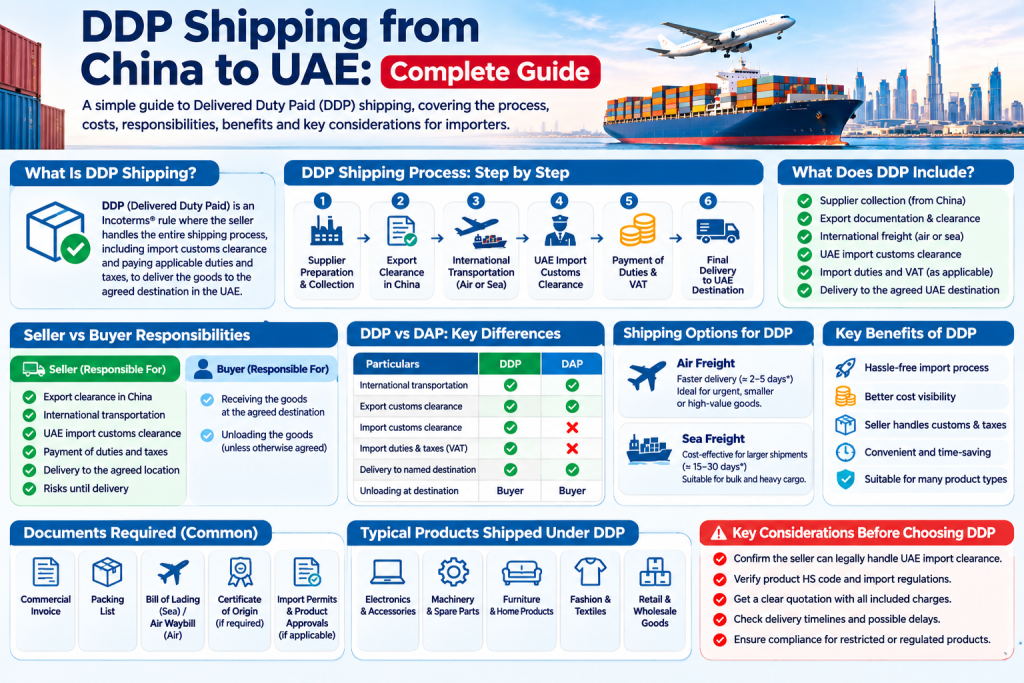
DDP (Delivered Duty Paid) is one of the 11 Incoterms® 2020 rules published by the International Chamber of Commerce (ICC). Under DDP, the seller assumes the maximum level of obligation under Incoterms® 2020: they arrange carriage, complete both export and import customs formalities, pay all applicable duties and taxes, and bear the risk of loss or damage until the goods reach the agreed destination in the UAE.
Under a standard DDP arrangement, the seller is responsible for:
- Preparing and packing the goods for export.
- Completing export customs clearance in China.
- Arranging international air, sea, or multimodal transportation.
- Coordinating import customs clearance in the UAE.
- Paying applicable import customs duties and taxes.
- Delivering the cargo to the agreed destination in the UAE.
- Carrying transit risk until arrival at the named destination.
The buyer receives the shipment at the named destination and is responsible for unloading the goods from the arriving vehicle, unless the sales contract states otherwise.
2. How the DDP Shipping Process Works (7 Steps)
Executing a DDP shipment from China to the UAE requires close coordination between your Chinese supplier, the freight forwarder, customs brokers, and local UAE delivery carriers. While exact workflows vary by cargo type, most shipments follow seven stages:
- Supplier Confirmation and Cargo Details: You confirm product specifications and order quantities with your supplier. The seller or freight forwarder collects essential shipment data—including product descriptions, HS codes, quantities, declared values, carton counts, gross weight, dimensions, pickup address in China, and delivery address in the UAE. Accurate cargo details are critical for transport planning and customs classification.
- Shipping Method Selection: The freight mode is selected based on cargo volume, urgency, product sensitivity, and budget:
- Sea freight: Best for larger, heavier, or less urgent commercial shipments. Learn more about transit options in our sea freight from China to UAE
- Air freight: Best for urgent, smaller, or higher-value cargo. Review rates and transit considerations for air freight from China to UAE.
- Express courier: Best for documents and eligible smaller parcels.
- Cargo Collection in China: The shipment is picked up from the supplier’s factory or warehouse—typically across major export hubs such as Shenzhen, Guangzhou, Yiwu, Ningbo, or Shanghai—and checked for package count, weight, dimensions, and export suitability.
- Export Customs Clearance in China: The seller or forwarder prepares export paperwork—such as the commercial invoice, packing list, and export declaration—and clears the cargo through Chinese export customs.
- International Transportation: The cargo moves from China to the UAE via the agreed air, sea, or courier route. Transit speed depends on vessel or flight schedules, routing, and carrier capacity.
- UAE Import Customs Clearance: Upon arrival at a UAE entry point—such as Jebel Ali Port, Dubai International Airport (DXB), or Al Maktoum International Airport (DWC)—the seller or their authorized local representative submits the import declaration, supporting documents, product approvals, and duty/VAT payments to UAE customs authorities (such as Dubai Customs). Customs may request further information or inspect the cargo before release.
- Final Delivery in the UAE: Once customs releases the cargo, local transport delivers it to the named UAE address ready for unloading. Unless otherwise agreed, unloading is the buyer’s responsibility.
3. What Is Included in a DDP Shipment?
A comprehensive DDP agreement covers the core logistics and customs obligations required to bring cargo cleared for import to your UAE destination.
Supplier pickup in China | Seller |
Export documentation & China customs clearance | Seller |
Origin port/airport handling | Seller |
International freight | Seller |
UAE destination handling | Seller |
UAE import customs clearance | Seller |
Applicable UAE import customs duty | Seller |
Applicable UAE import VAT/taxes | Seller |
Delivery to named UAE destination | Seller |
Unloading at destination | Buyer (unless agreed otherwise) |
Are All Charges Always Included in a DDP Quote?
Not necessarily. Under Incoterms® 2020, DDP does not obligate the seller to purchase cargo insurance or unload the goods at the destination. Before confirming an order, review the written quotation and sales contract to confirm whether the following items are included or excluded:
- Pickup from the supplier’s factory or warehouse
- Export packaging or repacking
- Cargo insurance
- Customs inspection fees or special product permits
- Storage, demurrage, or detention charges caused by delays
- Delivery to a specific warehouse, retail store, or business address
- Unloading, inside delivery, or installation
4. DDP Shipping Costs from China to UAE
Unlike standard freight quotes, a DDP quotation bundles international transportation with UAE import clearance, customs duty, and VAT. Six primary factors determine your total landed cost:
- Cargo Weight and Volume: Air freight is priced on chargeable weight—the greater of actual gross weight or volumetric weight. Sea freight depends on whether you ship FCL (Full Container Load) or LCL (Less than Container Load).
- Shipping Method: Air freight costs more per kilogram than sea freight but significantly shortens lead times. Sea freight is generally more economical for bulky or heavy commercial orders with flexible timelines.
- Product Category and HS Code: Your product’s Harmonized System (HS) code determines the applicable customs duty rate, exemptions, and regulatory compliance requirements.
- UAE Customs Duty and VAT: Duty and VAT add directly to the landed cost and are calculated based on customs valuation (typically CIF value), HS classification, and tax rules.
- Final Delivery Location: Delivery distance within the UAE, cargo size, and special handling needs affect last-mile transport rates. Businesses focused specifically on Dubai deliveries can review local hub considerations in our guide to shipping from China to Dubai.
- Permits and Compliance Approvals: Regulated items requiring conformity assessments, inspections, or special handling increase overall shipping costs.
Illustrative DDP Cost Structure Example
Actual freight and clearance fees vary widely by cargo dimensions, weight, route, and HS code. The table below illustrates how cost components are structured on a hypothetical commercial shipment to Dubai with a declared CIF customs value of USD 10,000 (for illustration only):
Origin Pickup & Export Clearance | Quoted by seller/forwarder based on China location & cargo size | Included in DDP freight quote |
International Freight (Air or Sea) | Based on chargeable weight (air) or CBM/container (sea) | Varies by mode, season, and route |
UAE Destination Handling & Clearance | Port/airport fees, broker filing, and documentation | Included in DDP quote |
UAE Import Customs Duty (5% Standard) | Typically 5% of CIF customs value (varies by HS code) | ~$500 (5% × $10,000) |
UAE Import VAT (5% Standard) | Standard 5% VAT applied per UAE tax valuation rules | ~$525 (5% × [$10,000 + $500 duty]) |
Final Delivery to Named Address | Local UAE trucking to your warehouse/office | Included in DDP quote |
Pro Tip: Never compare DDP quotes on total price alone. Always check that competing quotes use the same product description, declared customs value, HS code, delivery destination, tax treatment, and service inclusions.
5. Estimated Transit Times: Air vs. Sea Freight
Transit time depends heavily on the shipping mode selected mode plus the time needed for pickup, export clearance, UAE customs handling, and local delivery. The figures below are indicative transit ranges rather than guaranteed door-to-door schedules:
~2–5 days (airport-to-airport) | |
~15–30 days (port-to-port) | |
Express Courier | ~3–7 days (door-to-door, depending on service) |
Full end-to-end DDP delivery takes longer than port-to-port or airport-to-airport transit because it includes origin collection, customs clearance at both ends, and final delivery.
Factors That Can Impact Your Delivery Window:
- Supplier manufacturing timelines and cargo readiness
- Pickup scheduling in China
- Airline or ocean vessel space availability
- Peak-season congestion and holidays
- Export customs procedures and UAE customs inspections
- Product-specific regulatory approvals
- Final delivery address within the UAE
Always request an end-to-end estimated delivery window rather than relying solely on international transit times.
6. DDP vs. DAP: Key Differences
Both DDP and DAP (Delivered at Place) require the seller to transport goods to a named destination in the UAE. The critical difference is who handles import customs clearance and pays duties and taxes.
Export customs clearance (China) | Seller | Seller |
International transportation | Seller | Seller |
Import customs clearance (UAE) | Seller | Buyer |
Import customs duty | Seller | Buyer |
Import taxes (VAT) | Seller | Buyer |
Delivery to named UAE destination | Seller | Seller |
Unloading at destination | Buyer (unless agreed) | Buyer (unless agreed) |
- Choose DDP when you want the seller to manage import clearance, duties, and taxes end-to-end—and you have confirmed they can legally fulfill UAE import requirements.
- Choose DAP when you want the seller to arrange freight to the UAE, but you prefer to control UAE customs clearance, Importer of Record filings, and VAT recovery directly through your own customs broker.
7. DDP vs. DDU: Why DDU Is Outdated
DDU (Delivered Duty Unpaid) was part of earlier Incoterms editions, but it was officially removed and is not included in Incoterms® 2010 or Incoterms® 2020. Its modern equivalent is DAP (Delivered at Place), where the seller arranges carriage to the destination while the buyer handles import clearance, duties, and taxes.
To prevent legal imprecision in contracts and commercial invoices, businesses should use current Incoterms® 2020 terms (DDP or DAP) rather than legacy DDU terminology.
8. Required Customs and Shipping Documents
Accurate, consistent paperwork prevents customs holds and unexpected storage fees. Standard documents for DDP shipments from China to the UAE include:
- Commercial Invoice: Lists seller and buyer details, full product descriptions, quantities, unit and total values, currency, and country of origin.
- Packing List: Details package counts, dimensions, gross weight, net weight, and item quantities per carton.
- Transport Document: Either a Bill of Lading (B/L) for sea freight or an Air Waybill (AWB) for air freight, detailing shipper, consignee, routing, and cargo specifics.
- Certificate of Origin: Confirms where the goods were manufactured and may be required depending on the product and applicable customs rules.
- Import Permits and Product Approvals: Certain regulated categories require advance clearance or conformity certificates from relevant UAE authorities before import—for example:
- Telecom and wireless devices (often regulated by TDRA)
- Food products and cosmetics (frequently requiring registration or approval via authorities such as Dubai Municipality)
- Electrical and electronic products (which may require MoIAT conformity certificates such as ECAS or EQM)
- Medical devices, pharmaceuticals, chemicals, and restricted goods
Not every shipment requires special permits, but verifying compliance before dispatch is essential.
9. UAE Customs Duty and VAT Under DDP
Under DDP Incoterms®, the seller is responsible for paying applicable import customs duties and taxes. Still, buyers should understand how UAE import charges work to verify that their quote is compliant.
UAE Customs Duty
Most commercial goods imported into the UAE mainland are subject to a standard 5% customs duty calculated on the CIF (Cost, Insurance, and Freight) value. Actual rates vary by HS code, product category, and applicable exemptions.
UAE Import VAT
The standard VAT rate in the UAE is 5%. How import VAT is collected and accounted for depends on the transaction structure, customs valuation, and whether the importer is VAT-registered with the Federal Tax Authority (FTA). VAT-registered businesses are able to generally account for import VAT through their VAT return mechanism, subject to applicable regulatory requirements.
Why Importer of Record Clarity Matters
If your seller is based in China without a UAE commercial entity, they cannot clear customs directly. Never accept a DDP quote that states “all taxes included” without documenting who will act as the Importer of Record in the UAE and how import VAT will be paid and treated. Always confirm this structure with a licensed UAE customs broker or qualified trade advisor before shipping.
10. Products Commonly Shipped Under DDP
DDP works across a wide range of commercial goods, provided the products are legally importable into the UAE, and the seller can fulfill local clearance requirements:
- Electronics and Accessories: Consumer electronics, computer components, and accessories (dependent on regulatory approvals and airline/battery shipping rules).
- Machinery and Spare Parts: Industrial components, replacement parts, and commercial equipment shipped by air or sea.
- Furniture and Home Goods: Furniture, decor, and household products commonly consolidated via sea freight.
- Fashion and Textiles: Apparel, fabrics, footwear, bags, and accessories.
- Retail and Wholesale Inventory: General commercial stock imported for distribution or resale.
Regulated Goods Caution: Items requiring special permits, dangerous goods declarations, or conformity certificates must be pre-verified with UAE Customs or a licensed customs broker. A seller should never promise DDP delivery on restricted or regulated goods without first confirming eligibility.
11. Key Benefits of DDP Shipping for Importers
- Simplified Import Management: The seller coordinates international freight and customs formalities, reducing the buyer’s administrative workload.
- Clearer Landed Cost Visibility: A transparent DDP quotation helps you budget total delivery costs up to the named UAE destination.
- Less Customs Friction: The seller handles UAE import clearance and duty/tax payments, provided they have a compliant local setup.
- Ideal for Small Businesses and First-Time Importers: Companies without an in-house logistics team can import smoothly without managing multiple intermediaries.
- Flexible Freight Modes: Compatible with air freight, sea freight, and multimodal logistics.
- Predictable Receiving: Delivery straight to your agreed UAE business address makes warehouse scheduling easier.
12. Common Risks and How to Avoid Them
While convenient, poorly structured DDP shipments carry real operational risks:
- Unclear Importer of Record: If an overseas seller has no licensed local partner to clear UAE customs, the shipment can stall at the port. Confirm the clearance structure before payment or dispatch.
- Inaccurate Customs Valuation: Under-declaring or misstating cargo value can trigger customs reassessment, fines, or lengthy holds.
- Incorrect HS Classification: Using the wrong HS code leads to incorrect duty calculations, compliance issues, and clearance delays.
- Hidden Charges: Vague quotes may omit destination handling, storage, inspection fees, insurance, or last-mile delivery.
- Missing Product Approvals: Shipping regulated goods without pre-approvals can result in extra costs, inspection delays, or cargo rejection.
- Unrealistic Delivery Guarantees: International freight involves vessel/flight schedules and customs checks—insist on realistic delivery windows rather than unconditional date promises.
Handling Delays and Disputes: Make sure your shipping agreement explicitly outlines who covers unexpected costs from customs inspections, storage, or delays. If a dispute arises, contact your seller or logistics partner immediately, review the contractual terms, and—if unresolved—consult a licensed UAE customs broker or international trade professional to minimize delays and extra charges.
13. How to Choose and Verify a DDP Shipping Partner
Because the seller or logistics partner controls customs clearance and tax compliance under DDP, vetting them up front is essential. Look for a partner with proven China-to-UAE route experience, transparent pricing, product compliance expertise, proactive milestone updates, and clear contract terms covering demurrage, detention, and inspection costs.
Seller & Partner DDP Verification Checklist
Use these questions before confirming a DDP shipment to the UAE:
- UAE DDP Track Record: Have you handled DDP shipments into the UAE before, and can you provide client references?
- Importer of Record & Broker: Who will act as the Importer of Record in the UAE, and can you share the name and contact details of your licensed UAE customs broker or local trade partner?
- Licenses & Authorizations: Can you provide proof of the relevant UAE import licenses or partner authorizations required to clear this cargo?
- Duty & VAT Treatment: Step by step, how will customs clearance, import duty, and UAE VAT be paid, and how will VAT be documented?
- Regulatory Approvals: Will you obtain all necessary product permits or conformity approvals before dispatch?
- Written Inclusions & Exclusions: Does the written quote explicitly itemize what is included and excluded—including insurance, inspections, storage, and unloading?
14. Why Ship from China to the UAE with DDU Express?
Choosing the right logistics partner ensures your cargo moves smoothly from factory pickup to delivery in the UAE. DDU Express provides international logistics solutions tailored to your cargo profile, schedule, and destination.
Depending on your shipment requirements and agreed service, DDU Express supports:
- International air freight and sea freight arrangements
- Cargo handling and origin-to-destination coordination
- Shipping documentation support
- Customs clearance coordination
- Final delivery arrangements across the UAE
- Proactive shipment status updates
Whether you are importing retail inventory, electronics, machinery spare parts, or general commercial cargo, confirming product eligibility, UAE import clearance arrangements, and exact quote inclusions up front keeps your supply chain predictable.
Frequently Asked Questions
What does DDP mean in shipping?
DDP stands for Delivered Duty Paid. Under Incoterms® 2020, the seller arranges transportation, completes export and import customs clearance, and pays all applicable duties and taxes to deliver the goods to the agreed destination.
Who pays customs duty under DDP shipping?
The seller is responsible for paying all applicable import customs duties and taxes under DDP, subject to the sales contract and local regulations.
Does DDP include VAT in the UAE?
Under DDP, the seller is normally responsible for applicable import taxes, including VAT. Exact VAT treatment depends on the transaction structure, customs value, and the importer’s UAE VAT registration status.
How long does DDP shipping from China to UAE take?
Main international transit averages 2–5 days for air freight (airport-to-airport) and 15–30 days for sea freight (port-to-port). Total door-to-door DDP lead time is longer once pickup, customs clearance, and final delivery are factored in.
Is DDP shipping suitable for small businesses?
Yes. DDP is well-suited for small businesses and first-time importers who want the seller to manage freight, customs clearance, and tax payments—provided the seller can legally fulfill UAE import requirements.
What is the difference between DDP and DAP?
Under DDP, the seller handles UAE import clearance and pays import duties and taxes. Under DAP, the seller delivers the cargo to the agreed UAE destination, but the buyer handles import clearance and pays all duties and taxes.
Can DDP shipping be arranged by both air and sea?
Yes. DDP applies to any mode of transport—including air freight, sea freight, and multimodal shipping—as long as the seller can complete the required import formalities.
What documents are required for DDP shipping?
Core documents include the Commercial Invoice, Packing List, and either a Bill of Lading (sea) or Air Waybill (air). Depending on the goods, a Certificate of Origin and product-specific import permits or approvals may also be required.
Is DDP the same as door-to-door shipping?
Not necessarily. “Door-to-door” describes a physical transport service, while DDP is a legal Incoterms® rule defining who bears costs, transit risks, and customs responsibilities. Always specify exact delivery locations and included services in writing.
Is DDU still used for international shipping?
No—DDU (Delivered Duty Unpaid) is an outdated Incoterm not included in Incoterms® 2020. Businesses should use DAP when the seller handles delivery, and the buyer manages import clearance, duties, and taxes.
Explore Related China-to-UAE Shipping Guides
- Shipping from China to UAE: Complete Guide
- Shipping from China to Dubai: Routes, Costs & Customs
- Sea Freight from China to UAE: FCL, LCL & Transit Times
- Air Freight from China to UAE: Rates, Transit & Process
Get a China-to-UAE Shipping Quote
Ready to plan a smooth, transparent shipment from China to the UAE? DDU Express can help you evaluate the right freight mode and customs setup for your business.
To request a tailored quotation, share the following details:
- Supplier or pickup location in China
- Product description and HS code (if available)
- Number of packages, total gross weight, and dimensions
- Cargo readiness date
- Final UAE delivery address
- Preferred shipping method (air, sea, or express), if known
Contact DDU Express today to discuss your shipment requirements and receive a clear, customized logistics quotation.

Weiworld is an experienced logistics and shipping professional with more than 20 years of industry experience, with extensive knowledge of international shipping, freight forwarding, cargo movement, and logistics operations.
Over the course of his career, he has developed deep practical expertise in Middle East logistics and operations, including shipping processes, international cargo transportation, customs-related procedures, and supply chain coordination.
At DDU Express, Weiworld shares practical insights and industry knowledge to help businesses better understand international shipping, freight forwarding, DDP services, cargo transportation, and logistics solutions across the Middle East and global markets.
His extensive industry experience provides valuable perspective for businesses looking to simplify international shipping and make informed decisions when moving cargo between countries.