Importing goods from China to the UAE is more than just getting the goods to the UAE. You’ve got to arrange the collection of the goods from the supplier, the export documentation, the cargo handling, the international freight, the UAE customs clearance and the final delivery.
For importers who want a much simpler logistics arrangement, door to door shipping from China to the UAE is a very viable option. Rather than having to manage a number of different carriers and deal with each leg of the journey in turn, you can simply get a logistics provider to take the shipment from the supplier in China to the agreed delivery address in the UAE.
This is the shipping option appropriate for businesses importing electronics, machinery parts, furniture, fashion, retail goods and the like.
Door to door shipping doesn’t necessarily mean that the customs duties and VAT are included. It all depends on the exact services as per the quotation and the agreed shipping terms. To avoid surprise expenses, always ask your logistics provider for a detailed itemized cost breakdown, specifying exactly which charges and services are included and which are excluded from the quoted price. Reviewing this breakdown before booking will help you confirm your responsibilities and prevent unexpected costs during the shipping process.
In this guide we look at door to door shipping from China to the UAE, the various modes of transport available, the expected transit times, the costs involved, the documentation required, the customs process and a number of other important considerations for importers.
For a wider overview of international transportation options, read our complete guide to shipping from China to UAE.
1. What Is Door-to-Door Shipping from China to UAE?
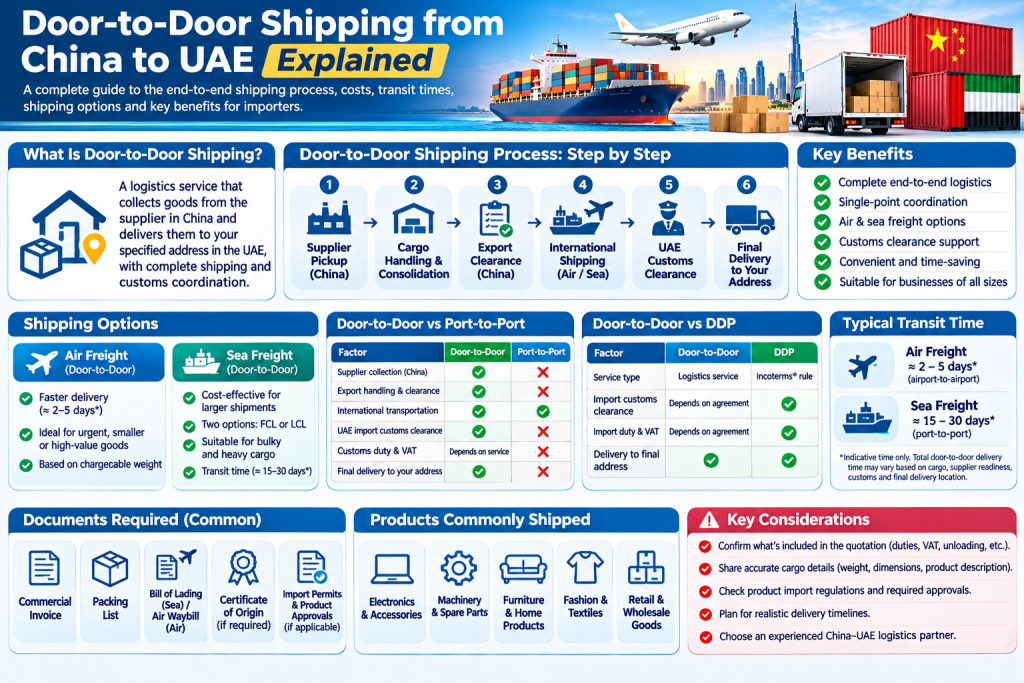
Door to door shipping is a logistics service whereby the goods are picked up from the supplier’s factory or warehouse in China and shipped to a specified delivery address in the UAE.
Depending on the agreed service, the logistics provider may coordinate:
- Supplier pickup in China.
- Cargo inspection and warehouse handling.
- Shipment consolidation.
- Export documentation and customs clearance.
- International air or sea freight.
- UAE destination handling.
- Import customs clearance coordination.
- Final transportation to the delivery address.
The primary benefit is that the buyer doesn’t need to coordinate each individual stage of transportation.
For example a Dubai based retailer buying from a manufacturer in Guangzhou may arrange for collection from the factory, the international carriage and delivery to its warehouse via a single logistics provider.
The actual service scope should always be confirmed in writing, particularly for import clearance, duties, VAT and final delivery.
2. How Does Door-to-Door Shipping from China to UAE Work?
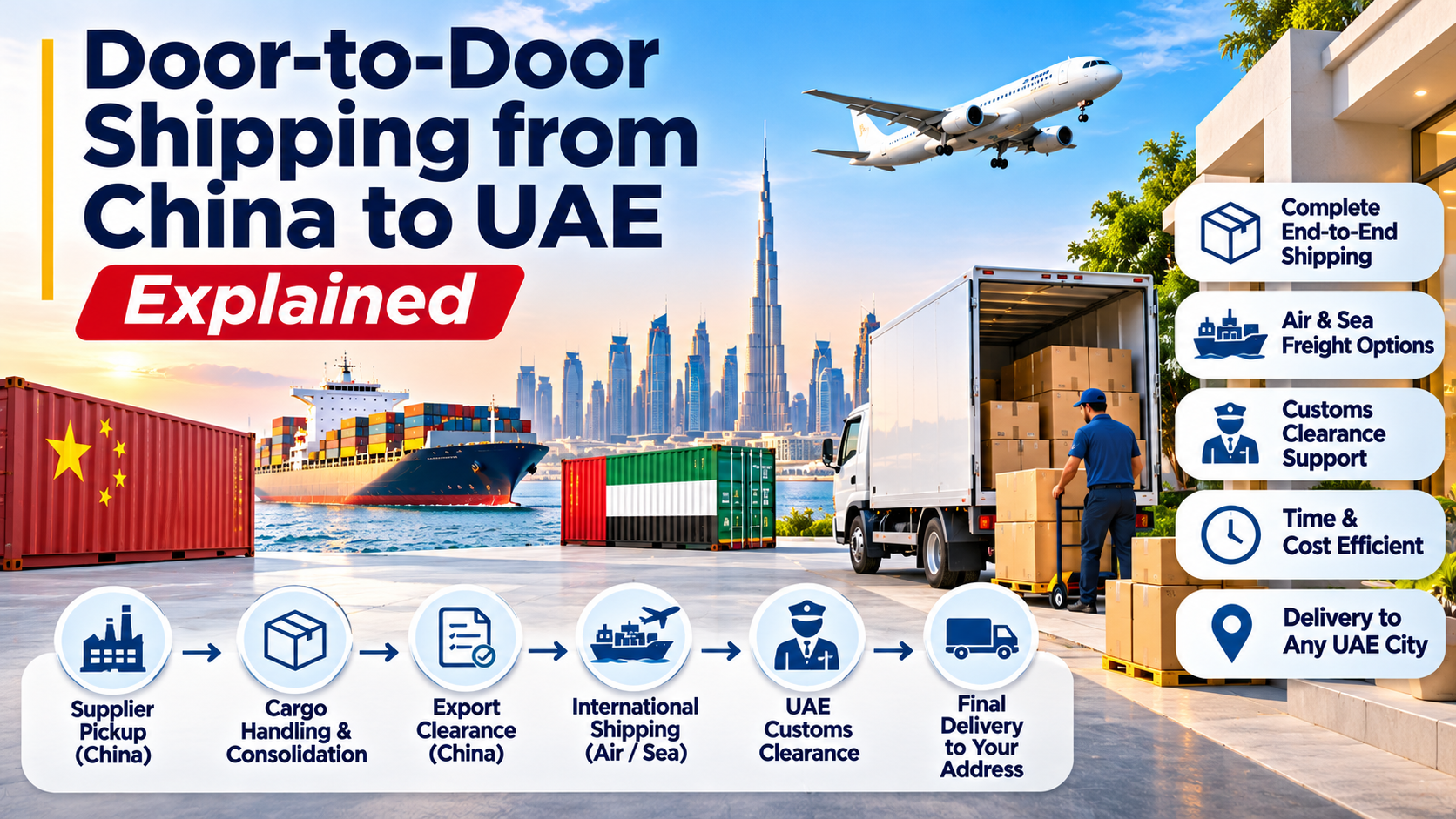
A standard door to door shipment goes through a number of stages, from collection by the supplier right through to delivery to the buyer’s address.
Step 1: Supplier Pickup in China
The process begins when the goods are ready at the supplier’s factory or warehouse.
The logistics provider arranges collection based on the agreed pickup location and cargo details.
The information generally required includes:
- Supplier name and address.
- Product description.
- Number of cartons or packages.
- Gross weight.
- Package dimensions.
- Cargo date of readiness.
- Any special handling requirements.
If you’re buying from a number of different suppliers then you may be able to consolidate at a warehouse in China prior to international shipping.
Step 2: Cargo Inspection and Consolidation
After collection, the cargo may be received at a warehouse for checking and preparation.
This stage can include:
- Counting packages.
- Checking package dimensions and weight.
- Reviewing shipping marks.
- Inspecting external packaging.
- Consolidating shipments from multiple suppliers.
- Preparing cargo for export.
Consolidation can help businesses combine smaller orders into one shipment, depending on the cargo type and shipping arrangement.
Step 3: Export Documentation and Customs Clearance in China
Before international transportation, the required export documentation must be prepared.
Common documents include the commercial invoice, packing list and applicable export declarations.
The exporter or its authorised representative completes the relevant export customs procedures before the cargo is released for transportation.
Step 4: International Transportation
The cargo is transported from China to the UAE using the selected shipping method.
The two main options are:
- Sea freight for larger, heavier or less urgent shipments.
- Air freight for urgent, smaller or higher-value shipments.
The choice depends on shipment volume, weight, cargo type, delivery schedule and transportation budget.
Step 5: Arrival and UAE Customs Clearance
Once the cargo arrives in the UAE, it goes through the applicable import customs procedures.
The required documents and product information are submitted for customs formalities.
Depending on the shipment, this stage may involve:
- Import declaration.
- Commercial invoice verification.
- Packing list verification.
- Transport document submission.
- Customs duty and tax assessment.
- Product-specific permits or clearances.
- Customs inspection, if required.
Import clearance must be completed before the goods can be released for final delivery.
Step 6: Final Delivery to Your UAE Address
After customs release and completion of the agreed handling procedures, the cargo is transported to the buyer’s specified destination.
The delivery address may be a:
- Business warehouse.
- Retail store.
- Distribution centre.
- Commercial premises.
Confirm whether unloading is included, as it is not automatically part of every door-to-door arrangement.
3. Shipping Methods for Door-to-Door Delivery from China to UAE
The two principal international transport options are air freight and sea freight. Each is appropriate for different business needs.
Sea Freight Door-to-Door Shipping
Sea freight is commonly used for larger commercial shipments and products that do not require urgent delivery.
It can be suitable for:
- Furniture and home products.
- Industrial machinery.
- Construction materials.
- Wholesale retail products.
- Large-volume orders.
- Heavy or bulky cargo.
Businesses can choose between two common container arrangements.
FCL (Full Container Load)
FCL means the shipment is in a dedicated container. It’s generally appropriate for larger volumes of cargo or where you need the container all to yourself.
LCL (Less than Container Load)
LCL allows you to share container space with other consignments. It can be a good option for smaller volumes of cargo that don’t need a full container.
For more information on container shipping, see our Sea Freight from China to UAE: Complete Business Guide.
Air Freight Door-to-Door Shipping
Air freight is suitable for businesses that need faster transportation or are importing relatively small, high-value, or urgent shipments.
Common examples include:
- Electronics and accessories.
- Computer components.
- Product samples.
- Machinery spare parts.
- Fashion products.
- Urgent stock replenishment.
Air freight charges are generally based on chargeable weight which is the greater of the actual weight and the volumetric weight.
For a full breakdown of air cargo, have a read of our Air Freight from China to UAE: Costs, Transit Times & Benefits.
Sea Freight vs Air Freight for Door-to-Door Shipping
Comparison | Sea Freight | Air Freight |
Transportation | Cargo vessel | Aircraft |
Delivery speed | Slower | Faster |
Cost per kg | Generally lower for suitable bulk cargo | Generally higher |
Best suited for | Large and heavy shipments | Urgent and smaller shipments |
Cargo capacity | High | Limited by aircraft capacity |
Common use | Furniture, machinery, bulk goods | Electronics, samples, spare parts |
The most suitable option depends on the total shipment cost, cargo requirements and delivery deadline.
4. How Long Does Door-to-Door Shipping from China to UAE Take?
Total delivery time will of course be a function of the mode of transport, the location of the supplier, the readiness of the cargo, the shipping schedule, the customs process and the final delivery arrangements.
The following are indicative transportation planning ranges, not guaranteed door-to-door delivery times.
Shipping method | Indicative transportation time |
Sea freight | Approximately 15–30 days port-to-port |
Air freight | Approximately 2–5 days airport-to-airport |
Express courier | Often approximately 3–7 days door-to-door, depending on service |
The complete door-to-door process may take longer because it includes collection, export handling, international transportation, customs clearance and final delivery.
Factors That Can Affect Delivery Time
Supplier Readiness
If products are not ready for collection, the shipment schedule may be delayed.
Pickup Location in China
The distance between the supplier and the selected warehouse or airport can affect collection time.
Shipping Schedule
Airline capacity, vessel schedules and seasonal demand can influence departure dates.
Customs Clearance
Incomplete documents, customs inspections or product approval requirements can delay release.
Final Delivery Location
Delivery to a destination outside the main logistics hubs may require additional transportation time.
Always request an estimated end-to-end delivery schedule instead of relying only on the international freight transit time.
5. How Much Does Door-to-Door Shipping from China to UAE Cost?
The cost depends on the cargo, shipping method, shipment size, collection location and final UAE destination.
A complete door-to-door quotation may include multiple cost components.
Main Factors Affecting Door-to-Door Shipping Costs
- Cargo Weight and Dimensions
For air freight the charges are generally based on the higher of the actual weight and the volumetric weight.
For sea freight, the price may depend on cargo volume, container size and whether the shipment uses FCL or LCL.
- Supplier Pickup Location
The distance between the supplier’s factory and the collection warehouse or export gateway can affect domestic transportation costs.
- Shipping Method
Sea freight and air freight have different pricing systems. Air freight generally costs more per unit of weight, while sea freight may be more economical for suitable bulk shipments.
- Cargo Type
Fragile, oversized, regulated or dangerous goods may require additional handling, packaging or records.
- Customs Duty and VAT
Applicable customs duty and VAT can affect the total landed cost. The treatment depends on product classification, customs valuation and the import arrangement.
- Final Delivery Address
The distance to the destination, cargo size, unloading requirements and delivery access can influence local transportation charges.
What Should a Door-to-Door Quotation Include?
Before confirming a shipment, request a concise breakdown of:
- Supplier pickup.
- Origin handling.
- Export customs clearance.
- International freight.
- Destination handling.
- UAE import customs clearance.
- Customs duty and VAT, if included.
- Final delivery.
- Additional handling or special service charges.
A quotation should clearly state which costs are included and excluded.
Do not assume that a door-to-door price automatically includes import duties, VAT, insurance, unloading or product certification.
6. Door-to-Door Shipping vs Port-to-Port Shipping
Door-to-door and port-to-port shipping are different logistics arrangements.
Door-to-Door Shipping
The logistics provider will be responsible for the transportation from the supplier’s site in China to the agreed delivery address in the UAE.
Depending on the service this could include collection, export handling, international freight, customs clearance and final delivery.
Port-to-Port Shipping
Port-to-port shipping covers the main international transportation between the selected origin and destination ports.
The buyer generally needs to arrange or coordinate additional services, such as:
- Collection from the supplier.
- Export handling.
- UAE import customs clearance.
- Destination handling.
- Transportation from the port to the final address.
Key Differences
Comparison | Door-to-Door | Port-to-Port |
Supplier collection | May be included | Usually arranged separately |
Export handling | May be included | Depends on agreement |
International freight | Included | Included |
Import customs clearance | Depends on quotation | Usually arranged separately |
Customs duties and VAT | Only if agreed/included | Usually buyer’s responsibility |
Final delivery | Included to named address | Not included |
Door to door shipping may be the more convenient option for a business that doesn’t want to have all those separate logistics arrangements. Port to port can be appropriate for an experienced importer who has their own customs broker and their own local haulage arrangements.
7. Is Door-to-Door Shipping the Same as DDP?
No. Door-to-door shipping and DDP are related, but they are not the same.
Door-to-door describes the transportation service scope. It means cargo is collected from a specified origin address and delivered to a specified destination address.
DDP (Delivered Duty Paid) is an Incoterms® rule that defines the seller’s responsibilities for costs, risks and customs formalities in a sale contract.
Under DDP, the seller is responsible for arranging delivery to the named destination, completing applicable import formalities and paying applicable import duties and taxes.
A door-to-door shipment may be arranged under different commercial terms. For example, customs duty and VAT may be excluded from the logistics quotation, leaving the buyer responsible for them.
Door-to-Door vs DDP: Quick Comparison
Particular | Door-to-Door Service | DDP |
Meaning | Transportation service scope | Incoterms® trade rule |
Supplier collection | Depends on service | Seller arranges |
International transportation | Depends on service | Seller arranges |
Import customs clearance | Must be confirmed | Seller responsible |
Import duty and taxes | Must be confirmed | Seller responsible |
Delivery to named destination | Included in a door-to-door booking | Seller responsible |
Before choosing DDP, confirm that the seller can legally and operationally fulfil the UAE import requirements, including the importer-of-record and tax arrangements.
For a complete explanation, read our DDP Shipping from China to UAE: Complete Guide.
8. Documents Required for Door-to-Door Shipping from China to UAE
Accurate documentation is important for export procedures, international transportation and UAE import customs clearance.
Common documents include:
Commercial Invoice
Contains details about the exporter, importer, products, quantities, declared value, currency and country of origin.
Packing List
Provides package quantities, dimensions, gross weight, net weight and packaging information.
Bill of Lading or Air Waybill
The transportation document depends on the selected shipping method.
- Bill of Lading for sea freight.
- Air Waybill for air freight.
Certificate of Origin
Identifies the country where the goods originate. It may be required depending on the shipment and applicable customs procedures.
Import Permits and Product Approvals
Certain regulated goods may require additional certificates, permits or conformity approvals before import into the UAE.
Examples include selected food products, cosmetics, pharmaceuticals, medical products, telecommunications equipment and electrical products.
Dangerous Goods Documents
Some products (e.g. certain lithium batteries and chemicals) will be subject to dangerous goods transport requirements.
Additional declarations, packaging and airline or carrier approvals may be necessary.
Not every shipment requires every document listed above. Requirements depend on the goods, transport method and applicable regulations.
9. UAE Customs Clearance for Door-to-Door Shipments
UAE import customs clearance is an important stage of international shipping.
When the shipment arrives, the importer or authorised customs representative must complete the applicable import declaration and provide supporting documents.
The procedure generally involves:
- Preparing the commercial invoice and packing list.
- Providing the relevant transport document.
- Confirming the correct HS code and product description.
- Submitting the import customs declaration.
- Providing required permits or product approvals.
- Paying applicable customs duty and taxes.
- Completing any required inspection.
- Obtaining customs release before final delivery.
UAE Customs Duty
Many goods imported into the UAE mainland are subject to a standard customs duty of 5% of the customs value, commonly calculated using the CIF value.
However, the actual rate depends on the product’s HS code, exemptions and applicable customs regulations.
UAE VAT
The standard VAT rate in the UAE is 5%.
The applicable import VAT treatment depends on the transaction, customs valuation and the importer’s VAT registration status.
Businesses should verify the actual duty and VAT treatment before calculating their landed cost.
10. Can You Combine Products from Multiple Suppliers in China?
Yes. Shipment consolidation can be a useful option for businesses purchasing products from multiple Chinese suppliers.
Instead of arranging separate international shipments, eligible goods can be collected and moved to a warehouse for consolidation.
A typical consolidation process involves:
- Collecting goods from different suppliers.
- Receiving the products at a designated warehouse.
- Counting packages and checking shipment information.
- Reviewing dimensions and weight.
- Preparing consolidated shipping documents.
- Loading the cargo for international transportation.
- Arranging UAE customs clearance and final delivery.
Benefits of Shipment Consolidation
- Combines multiple supplier orders.
- Reduces the requirement for separate international bookings.
- Helps coordinate shipments from different locations.
- Can improve cargo planning.
- May decrease transportation costs for suitable shipment volumes.
Consolidation is subject to cargo compatibility, documentation, storage arrangements and carrier requirements.
Businesses should also confirm whether the consolidated shipment will have one or multiple transport documents and how customs declarations will be handled.
11. What Products Can Be Shipped Door-to-Door from China to UAE?
Door-to-door shipping can be used for many commercial product categories, subject to transportation restrictions and UAE import regulations.
Common examples include:
Electronics and Accessories
Computer accessories, electronic components and selected consumer electronics.
Furniture and Home Products
Home furniture, decorative products, lighting and household items.
Machinery and Spare Parts
Industrial components, equipment parts and replacement machinery items.
Fashion and Textiles
Garments, fabrics, bags, footwear and fashion accessories.
Retail and Wholesale Products
General merchandise, packaging materials and products intended for retail distribution.
Product Samples
Eligible samples for product testing, evaluation and business development.
Some goods require special permits, conformity assessments, dangerous goods documentation as well as other regulatory approvals. Always confirm cargo eligibility before arranging transportation.
12. Benefits of Door-to-Door Shipping from China to UAE
Convenient Logistics Management
A single logistics provider can coordinate multiple transportation stages, lessening the need for separate service arrangements.
Simplified Supplier Collection
Businesses can arrange collection from supplier factories or warehouses in China rather than organising domestic transportation themselves.
Flexible Shipping Options
Importers can choose between sea freight and air freight depending on shipment volume, urgency and budget.
Better Shipment Coordination
Combining collection, transportation and delivery arrangements can make shipment planning easier.
Suitable for Different Business Sizes
Small businesses, retailers, wholesalers and larger importers can use door-to-door services depending on their cargo and delivery requirements.
Delivery to a Specified Address
The service can go beyond the destination airport or seaport to an agreed warehouse or business address in the UAE.
13. Common Challenges in Door-to-Door Shipping
Although door-to-door shipping streamlines logistics coordination, businesses should be aware of possible challenges.
Unexpected Charges
A quotation may exclude destination handling, customs duty, VAT, storage or special delivery services.
Incorrect Cargo Information
Incorrect weight, dimensions or product descriptions can lead to revised charges and customs queries.
Incomplete Documentation
Missing or inconsistent invoices, packing lists and transport documents can hold up processing.
Product Compliance Requirements
Certain goods require import permits, approvals or extra documentation.
Customs Inspection
Authorities may inspect cargo or request further information before granting release.
Delivery Delays
Supplier readiness, carrier schedules, customs procedures and local transportation conditions can affect the final delivery date.
Clear documentation and a detailed shipping quotation help reduce these risks.
14. How to Choose a Door-to-Door Shipping Partner
Choosing a suitable logistics provider is important for coordinating shipments from China to the UAE.
Before booking, consider the following:
Experience with China-to-UAE Shipping
Choose a provider familiar with the relevant transportation routes, export procedures and UAE import requirements.
Clear Quotation
Seek a detailed quotation covering supplier collection, international transportation, destination handling, customs clearance and final delivery.
Customs Clearance Support
Confirm who will prepare the import declaration and whether the required importer-of-record arrangement is in place.
Shipment Tracking and Communication
Ask how shipment milestones and delivery updates will be communicated.
Product Handling Capabilities
Check whether the provider can handle your cargo type, especially if it requires special packaging or regulatory documentation.
Transparent Service Terms
Confirm delivery address, unloading arrangements, insurance, duties, VAT and any excluded charges before confirming the shipment.
15. Why Consider DDU Express for Shipping from China to UAE?
Businesses importing from China need logistics arrangements that suit their cargo requirements, transportation budget and UAE delivery destination.
DDU Express provides international logistics solutions for businesses shipping goods across global markets.
Depending on the shipment requirements and agreed service, businesses can explore:
- International air freight arrangements.
- Sea freight transportation.
- Cargo handling and coordination.
- Shipping documentation support.
- Customs clearance coordination.
- Final delivery arrangements.
- Shipment status updates.
Whether you are importing electronics, machinery parts, retail products or other commercial goods, choosing the right transportation arrangement is important for managing your supply chain.
Contact DDU Express with your supplier location, cargo details, package dimensions, total weight and UAE delivery address to discuss suitable shipping options.
Frequently Asked Questions About Door-to-Door Shipping from China to UAE
What is door-to-door shipping from China to UAE?
Door-to-door shipping is a logistics arrangement in which cargo is collected from a supplier’s location in China and delivered to a specified address in the UAE. The included services depend on the quotation.
How long does door-to-door shipping from China to UAE take?
Transit time depends on the transportation method and shipment arrangements. Sea freight may take approximately 15–30 days port-to-port, while air freight may take approximately 2–5 days airport-to-airport. Collection, customs clearance and final delivery can add time.
How much does door-to-door shipping from China to UAE cost?
The cost depends on cargo weight, dimensions, shipping method, supplier location, destination address, customs requirements and included services. A shipment-specific quotation is needed to calculate the total cost.
Is door-to-door shipping cheaper than port-to-port shipping?
Not necessarily. Door-to-door shipping covers more logistics stages, so the quoted price may be higher. However, port-to-port shipping can involve additional costs for collection, customs clearance and final delivery. Compare the complete cost rather than only the international freight rate.
Does door-to-door shipping include customs duty and VAT?
Not automatically. Some door-to-door quotations include import clearance and applicable duties and taxes, while others exclude them. Confirm the exact inclusions before booking.
What is the difference between door-to-door shipping and DDP?
Door-to-door describes the transportation service from an origin address to a destination address. DDP is an Incoterms® rule that assigns the seller responsibility for import clearance and applicable duties and taxes.
Can I combine shipments from multiple suppliers in China?
Yes, eligible products from different suppliers can be collected and consolidated at a warehouse before international transportation. This depends on cargo compatibility, documentation and the agreed service.
Which is better for door-to-door shipping: air freight or sea freight?
Air freight is generally better for urgent, smaller or higher-value shipments. Sea freight is often more economical for large, heavy or bulky shipments where delivery deadlines are flexible.
Can door-to-door shipping deliver to any UAE city?
Delivery availability depends on the logistics provider, cargo type and destination. Confirm the exact delivery address and any additional local transportation charges before booking.
What information is needed to get a door-to-door shipping quotation?
You generally need to provide the supplier location in China, product description, package quantity, gross weight, dimensions, cargo readiness date and final UAE delivery address.

Weiworld is an experienced logistics and shipping professional with more than 20 years of industry experience, with extensive knowledge of international shipping, freight forwarding, cargo movement, and logistics operations.
Over the course of his career, he has developed deep practical expertise in Middle East logistics and operations, including shipping processes, international cargo transportation, customs-related procedures, and supply chain coordination.
At DDU Express, Weiworld shares practical insights and industry knowledge to help businesses better understand international shipping, freight forwarding, DDP services, cargo transportation, and logistics solutions across the Middle East and global markets.
His extensive industry experience provides valuable perspective for businesses looking to simplify international shipping and make informed decisions when moving cargo between countries.