The shipment of goods from the UAE to India is a significant element in the supply chains of many businesses. If you are importing commercial products, machinery, spare parts or e-commerce inventory, freight charges will have an impact on your total product cost and profit margin.
It is not always the case that selecting the lowest quote is the best method of saving money, since the final amount you pay is affected by factors such as packaging, the volume of the cargo, the mode of shipping, destination charges, the documentation and the delivery requirements.
The best method is to find out what causes your shipping costs and then make thoughtful decisions before booking the cargo.
This article sets out practical methods by which businesses can cut down on the cost of shipping between the UAE and India while at the same time keeping delivery times and handling standards suitable.
For a complete overview of shipping methods, documentation, customs and delivery options, read our complete guide to shipping from UAE to India.
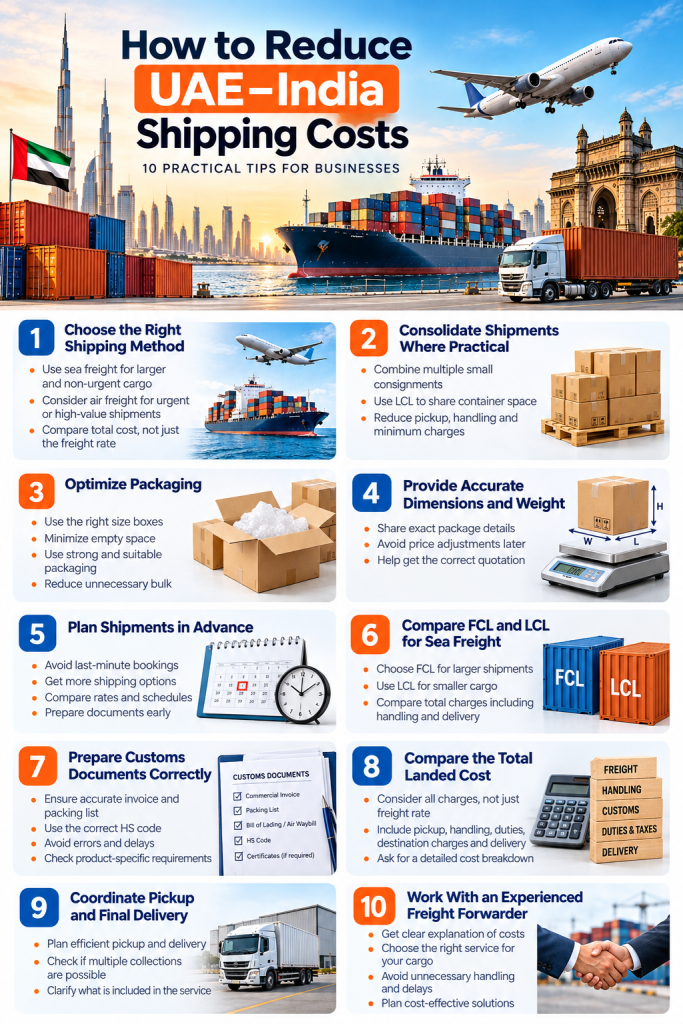
1. Choose the Right Shipping Method
One of the major choices influencing the cost of freight is whether to send the goods by sea or by air.
Sea freight should generally be taken into account when the consignment is large, heavy or not urgent. If delivery speed is important then air freight is usually the better option, although the final cost will depend on the cargo and the service chosen.
Requirement | Option to consider |
Large commercial shipment | Sea freight |
Full container of goods | FCL sea freight |
Smaller shipment that doesn’t fill a container | LCL sea freight |
Urgent spare parts | Air freight |
Time-sensitive inventory | Compare air freight with the cost of delayed delivery |
Heavy machinery | Assess sea freight and specialized cargo options |
You should not look at the transport rates by themselves and must take into account the cost of waiting, inventory shortages, storage and delivery to the final destination.
For a closer look at the options, read our guides to Dubai to India sea freight and Dubai to India air freight.
2. Consolidate Smaller Shipments Where Practical
If your company is sending a number of small consignments to India, you should see whether or not it is possible to combine them into one shipment.
Consolidation can lead to a reduction in the number of pickups, handling charges or minimum shipment fees. With respect to sea freight, less-than-container-load (LCL) services enable cargo from various shippers to share the space in a container.
For instance, rather than sending a number of small consignments individually, a business could arrange to collect all the goods and then ship them at one time when they are all ready.
Before consolidating, consider:
- Whether all goods will be ready at the same time
- Whether the cargo has compatible handling requirements
- Additional storage or waiting costs
- The destination and delivery deadlines
- Consolidation and deconsolidation charges
That doesn’t mean that consolidation is always going to be cheaper in all cases, so request a comparison between the total charges for individual shipments and those for a combined shipment.
3. Optimize Packaging and Reduce Unused Space
The way in which goods are packaged has an impact on both the protection of the cargo and on the transportation cost.
Oversized cartons, excessive fillers and ill-arranged pallets can cause the space taken up by your cargo to increase. This is particularly important in the case of air freight, since volumetric weight can affect chargeable weight.
To improve packaging efficiency:
- Choose boxes that are appropriate for the size of the product.
- Avoid excessive space where it can safely be reduced.
- Choose packaging that protects the goods without adding unnecessary bulk.
- Arrange goods efficiently on pallets.
- Check package dimensions before requesting a quotation.
- Follow any packaging requirements for fragile, heavy or regulated cargo.
You should not go so far as to reduce packaging that the products will be at risk of damage.The expenses resulting from damaged goods, the need for replacement shipments and the claims can exceed any freight savings.
4. Provide Accurate Cargo Dimensions and Weight
An inaccurate cargo description or measurement can result in an incorrect quotation and later price adjustments.
Before booking, prepare the following information:
- Cargo description
- Number of cartons, pallets or crates
- Dimensions of each package
- Gross weight
- Total shipment volume, where available
- Cargo value
- Pickup address in the UAE
- Delivery location in India
With regard to air cargo, you should ask the freight forwarder about the way in which the chargeable weight is calculated for the service you have chosen. The volumetric weight may be compared with the actual weight depending on the carrier’s pricing rules.
Giving the provider accurate information enables them to give the right service charge and lowers the chance of being billed unexpectedly after the measurement has been taken.
5. Plan Shipments in Advance
Bookings made at the last minute can limit the choices available, especially in the case where cargo has to reach India by a specific date.
It allows your business to take longer when comparing different methods of transport, when looking at sailing or flight schedules, when preparing the necessary documents and when arranging the collection of the cargo.
Where possible:
- Forecast inventory requirements.
- Set realistic delivery deadlines.
- Coordinate orders from multiple suppliers.
- Leave time for the processes of export and import.
- Avoid unnecessary urgent shipments.
- Inquire about services that are scheduled to match your timeline.
Just because you plan doesn’t mean that you’ll get a lower rate, but it may help you to avoid some unnecessary rush charges and make better use of the options available.
6. Compare FCL and LCL for Sea Freight
When businesses are shipping by sea they should decide between the full-container-load (FCL) and the less-than-container-load (LCL) options by taking into account the size of the shipment and its requirements.
FCL involves booking a container that is solely for your consignment, and it is appropriate for large consignments or cargo that takes advantage of having its own container space.
Through LCL your cargo can share the container with other consignments. This arrangement may be advisable if you do not have enough cargo to fully load a container.
When comparing quotations, check:
- Freight charges
- Origin handling
- Consolidation or deconsolidation charges
- Destination handling
- Customs clearance arrangements
- Delivery costs
- Expected transit time
Just because the basic freight rate is lower doesn’t mean that the total cost will be lower; therefore, request a itemised breakdown of the charges so that you can compare the costs directly.
For more detail, see our Dubai to India sea freight guide.
7. Prepare Customs Documents Correctly
Errors in the documentation can result in customs enquiries, delays and extra costs such as storage or handling charges.
Before sending the shipment, make sure that the commercial invoice, the packing list and the transport documents give an accurate description of the goods being shipped; furthermore, other documents or approvals might be necessary according to the type of goods.
Review the following details carefully:
- Product description
- Quantity and package count
- Declared value
- Importer and exporter details
- Country of origin, where relevant
- HS code and applicable import requirements
- Product-specific certificates or approvals, where required
Guessing the HS code or declaring a wrong value in order to lower costs is not advisable since incorrect declarations may result in compliance issues and could potentially incur penalties.
For further guidance, see our article on customs requirements for shipping goods from UAE to India.
8. Compare the Total Landed Cost, Not Just Freight
The freight quotation makes up only a portion of the total sum that your business might have to pay in order to get goods from the UAE to India.
Depending on the shipment and service, the overall cost may include:
- Pickup and origin handling
- Export documentation and clearance
- International freight
- Insurance, if selected
- Destination handling
- Customs clearance
- Applicable duties and taxes
- Inland transportation
- Storage or other additional charges
If you are comparing different providers, find out what is included and what is not included in each quotation.
For instance, one quote might comprise both the pickup and the final delivery, while another could cover only the transport between the port or airport locations.
It is easier to spot the truly more economical choice when the figures are clearly laid out and you can then plan your entire shipment budget accordingly.
9. Coordinate Pickup and Final Delivery
The cost of local transport can make a big difference, particularly in the case where goods have to go from a supplier to a port or airport and then from the destination facility to a warehouse.
To improve coordination:
- Make sure that the pickup place and the cargo are ready.
- Provide accurate loading and access requirements.
- See if you are able to coordinate multiple collections.
- Make sure the final delivery address is confirmed.
- Make sure the provider is informed of any delivery restrictions or special equipment requirements.
- Please clarify if unloading is included.
In certain businesses, having a coordinated door-to-door service can make things simpler by arranging for several transport stages through one agreement. Yet, it is necessary to compare the total cost of this service with that of other options before making a decision.
Our guide to UAE to India door-to-door cargo shipping explains how pickup, international transport, customs coordination and final delivery fit together.
10. Work With a Freight Forwarder Who Explains the Costs
A freight forwarder is able to assist in comparing appropriate transport options, in arranging the movement of the cargo and in spotting possible problems before dispatch takes place.
When requesting a quotation, provide complete cargo information and ask for a clear explanation of the service scope.
Useful questions include:
- Is the quotation for sea freight, air freight or another service?
- Which charges are included?
- Does it include destination handling and final delivery?
- What customs documentation is required?
- Are there any cargo-specific handling requirements?
- What could cause the quotation to change?
- What is the estimated end-to-end delivery time?
For commercial shipments, a freight forwarder familiar with your cargo type and destination requirements may help you avoid unnecessary handling and planning errors.
If you are shipping business inventory, equipment or products for resale, our guide on how to ship commercial cargo from UAE to India covers the wider shipping process.
Common Mistakes That Can Increase Shipping Costs
Even a well-priced freight service can become expensive if you miss key details.
Avoid these common mistakes:
- Choosing a service based only on its advertised freight rate
- Providing incorrect cargo dimensions or weight
- Using oversized packaging
- Booking urgent transport when it is not necessary
- Ignoring destination charges
- Preparing documents too late
- Overlooking product-specific import requirements
- Failing to confirm who handles customs clearance
- Assuming duties and taxes are included in the quotation
- Comparing quotations with different service scopes
The best way to control costs is to identify these issues before the cargo is collected.
How to Request a More Accurate UAE–India Shipping Quote
To receive a useful quotation, prepare the following details before contacting your freight forwarder:
Information | What to provide |
Origin | UAE pickup city and address |
Destination | Indian city, address or PIN code |
Cargo | Product description |
Quantity | Number of packages |
Dimensions | Length, width and height |
Weight | Gross weight of the shipment |
Cargo value | Commercial value |
Shipping preference | Sea, air or door-to-door |
Timing | Required dispatch or delivery date |
Special requirements | Fragile, oversized, heavy or regulated cargo |
Complete details help providers recommend a suitable option and make quotations easier to compare.
Frequently Asked Questions
How can you get the lowest cost for shipping goods from the UAE to India?
Sea freight should often be compared with air freight when it comes to large and non-urgent shipments. LCL can be appropriate for smaller sea shipments, while FCL is suitable for larger volumes. The most cost-effective choice will depend on the cargo’s dimensions, weight, destination and the total charges.
What are some ways of reducing the cost of sea freight from the UAE to India?
Wherever possible, combine the cargo, compare the full container load and the less-than-container-load options, plan the shipments in advance, optimise the packaging and then check all the charges at both the origin and destination before booking.
What are some ways of reducing the cost of air freight?
Give the exact dimensions and weight, reduce the amount of packaging space without sacrificing protection, compare the different service options and don’t pay for urgent delivery if the timeline permits you to use a slower service.
Does cargo consolidation always result in cost savings?
Certainly, consolidation can lead to a reduction in duplicated costs, but the total cost may be influenced by storage, handling, waiting time and delivery requirements. You should compare the full cost of consolidated shipments with that of separate shipments.
Can incorrect documentation lead to higher shipping costs?
Certainly. Documentation errors may result in queries and delays, possibly leading to extra handling, storage or other charges, since the requirements differ according to the product and the shipment.
Should I go for the cheapest freight forwarder?
It doesn’t have to. You should compare the full quotation, the services included, the destination charges, the communication and the ability to meet your cargo requirements. A low first price might exclude the services that you will need later.
Is the amount of customs duties included in the shipping costs?
It isn’t always the case that freight charges, customs clearance service fees, duties and taxes are given together. You should ask the provider to explain what is included.
Conclusion
Reducing UAE–India shipping costs starts with understanding the full shipment, not just choosing the lowest freight rate.
Select a suitable transport method, optimize packaging, consolidate cargo where practical and plan and provide accurate shipment information. Just as importantly, prepare the required documents and compare the full cost of getting the goods from the UAE pickup point to the final destination in India.
Every shipment is different, so the best cost-saving approach depends on the cargo, volume, timing and delivery requirements.
Need help planning a shipment from the UAE to India? Contact DDU Express with your cargo details and destination to discuss suitable freight options and request a quotation.

Weiworld is an experienced logistics and shipping professional with more than 20 years of industry experience, with extensive knowledge of international shipping, freight forwarding, cargo movement, and logistics operations.
Over the course of his career, he has developed deep practical expertise in Middle East logistics and operations, including shipping processes, international cargo transportation, customs-related procedures, and supply chain coordination.
At DDU Express, Weiworld shares practical insights and industry knowledge to help businesses better understand international shipping, freight forwarding, DDP services, cargo transportation, and logistics solutions across the Middle East and global markets.
His extensive industry experience provides valuable perspective for businesses looking to simplify international shipping and make informed decisions when moving cargo between countries.