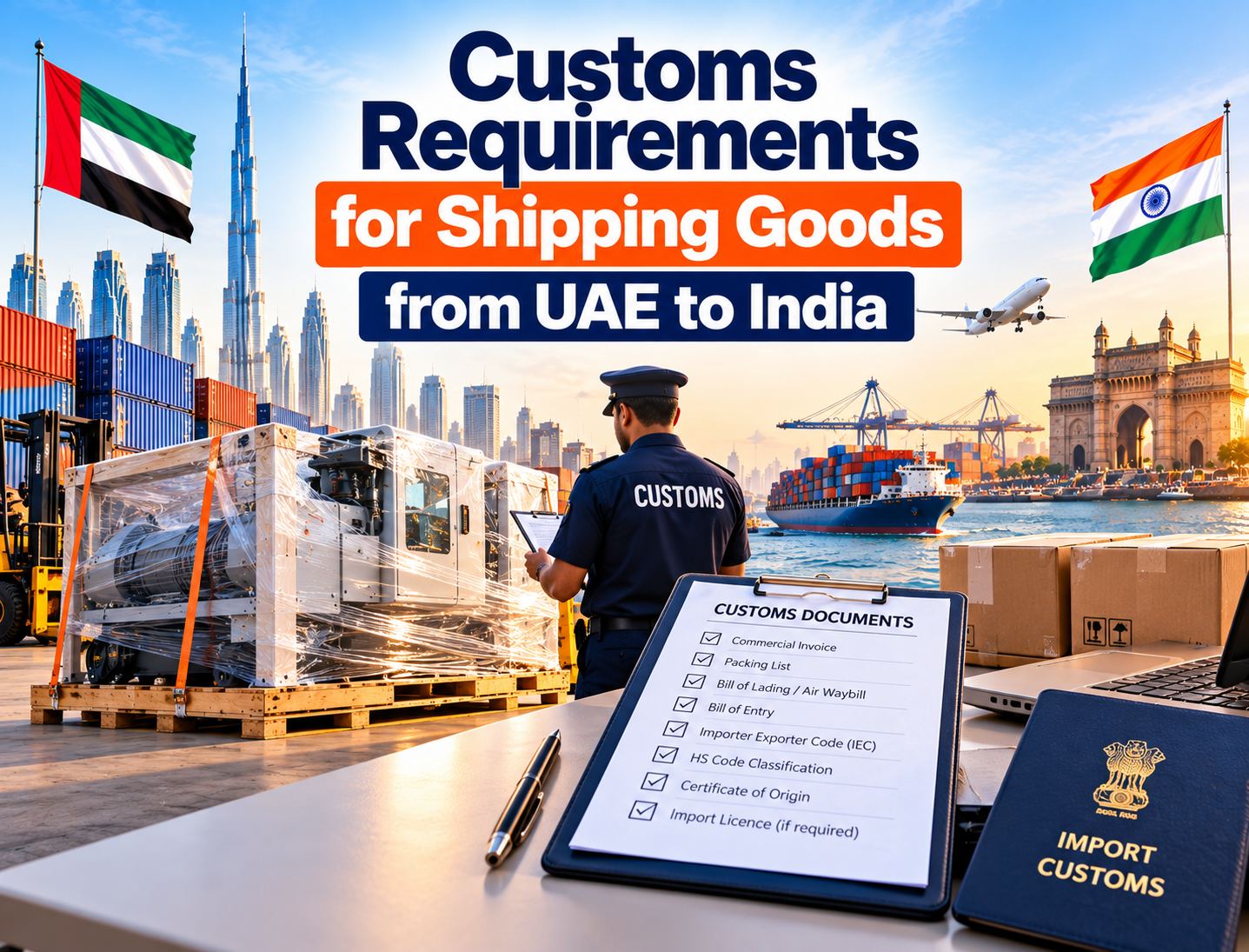
Getting goods from the UAE to India includes more than just arranging for sea or air transport; the cargo has to go through the relevant import customs procedures before customs will release it for delivery.
The importer will have to supply the commercial documents, identify the right HS classification, submit a Bill of Entry, pay the customs duties and taxes that apply, and meet any regulatory requirements which are specific to the product.
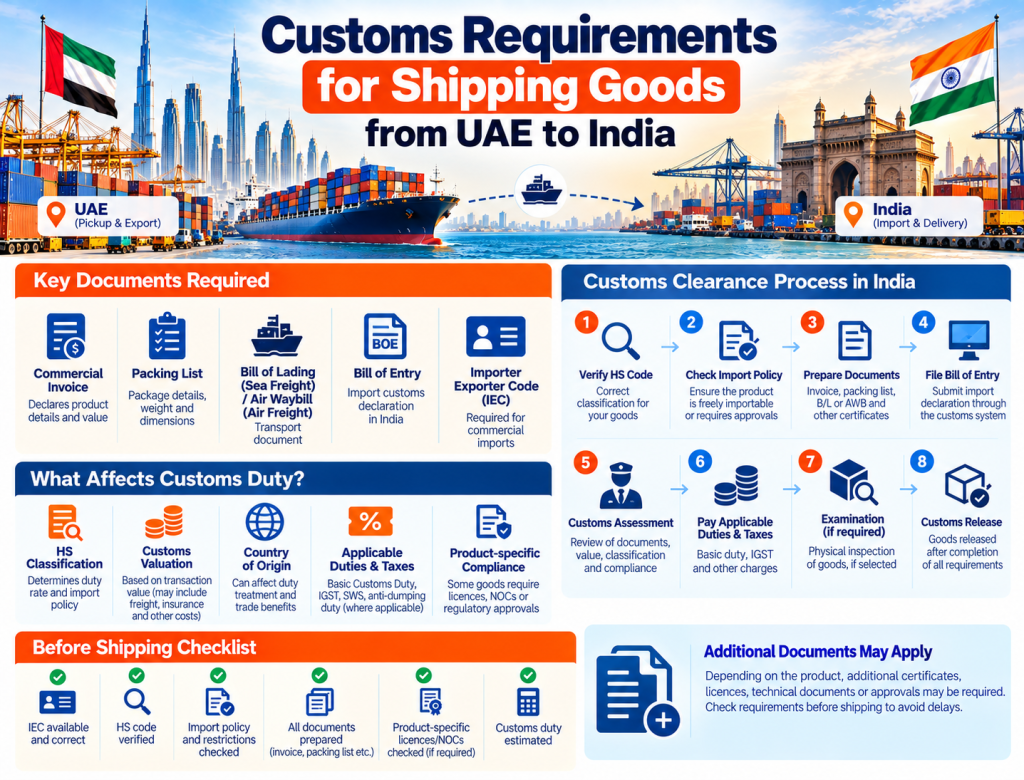
For standard imports the DGFT regards the Bill of Lading/Airway Bill, the commercial invoice-cum-packing list and the Bill of Entry as essential import documents; it also accepts a commercial invoice and a separate packing list. In the case of goods which are subject to restrictions, policy conditions, NOCs or product-specific compliance, further documents may be required. (DGFT)
The guide outlines the key customs requirements that businesses should be aware of when importing goods from the UAE to India.
It should be noted that customs requirements depend on the product, its HS classification, its value, its point of origin, the importer, and the relevant regulations. The information given below is a general guide and must not be used in place of specific customs or regulatory advice for a product.
For a broader overview of shipping methods, transportation options, costs and logistics arrangements, read our complete guide to shipping from UAE to India.
How UAE to India Customs Clearance Works
A typical commercial shipment follows this general sequence:
UAE Supplier → UAE Export Clearance → International Freight → Indian Port/Airport → Bill of Entry → Customs Assessment → Duty/Tax Payment → Examination if Required → Customs Release → Final Delivery
The customs procedure starts when the goods have arrived, even though a great deal of the preparation can and should be carried out before the goods are shipped.
Arranging for the customs requirements will help to cut down on documentation errors and prevent unnecessary delays.
1. Importer-Exporter Code (IEC)
For commercial imports into India, importers generally need an Importer-Exporter Code (IEC).
DGFT’s Foreign Trade Policy states that the IEC is a 10-character alphanumeric number and that no import or export of goods shall be made without an IEC unless specifically exempted. Under the current framework, DGFT issues the IEC and links it to the entity’s PAN. (DGFT)
Before arranging a commercial shipment from the UAE, the Indian importer should therefore confirm that:
- The IEC is available.
- The IEC details are correct.
- The importer details match the commercial documentation.
- The IEC is appropriately updated where required.
For businesses that import regularly, keeping importer details consistent across invoices, customs documents, and registrations is particularly important.
Businesses arranging international shipments should also understand the wider shipping process. Read our guide on how to ship commercial cargo from UAE to India for more information about cargo preparation, documentation and shipping arrangements.
2. Correct HS Code Classification
One of the most important customs requirements is identifying the correct HS/ITC(HS) classification for the imported goods.
The HS code is used to identify the product for customs purposes and can affect:
- Import policy
- Basic Customs Duty
- IGST
- Other applicable duties
- Product-specific regulations
- Licenses or approvals
- Preferential duty treatment where applicable
- Customs assessment
India’s ICEGATE Trade Guide lets users search by tariff heading or description and provides information on import policy, applicable duties and compulsory compliance requirements for the selected classification. (IceGate)
Do not guess the HS code.
A supplier’s product code or a UAE tariff classification should not automatically be treated as the correct Indian classification.
The Indian importer should verify the classification applicable in India.
3. Commercial Invoice
The commercial invoice is a key document used during customs clearance.
It generally contains information such as:
- Exporter details
- Importer details
- Invoice number
- Invoice date
- Product description
- Quantity
- Unit price
- Total value
- Currency
- Country of origin
- Terms of sale
- Other relevant transaction details
The description should be sufficiently specific to identify the goods.
For example, instead of:
Machine
a more useful description could identify the actual machine type, model and intended function.
The invoice should also match the packing list and shipping document.
4. Packing List
The packing list provides details about how the shipment is packed.
It may include:
- Number of packages
- Package type
- Gross weight
- Net weight
- Dimensions
- Product description
- Package markings
- Container details where applicable
For machinery or large commercial shipments, accurate dimensions and weights are especially important.
DGFT specifically lists the commercial invoice-cum-packing list among the mandatory import documents and also accepts separate commercial invoice and packing list documents. (DGFT)
5. Bill of Lading or Air Waybill
The transportation document depends on the shipping method.
Sea freight
Shipments normally use a Bill of Lading.
If you are planning a larger commercial shipment, explore our guide to Dubai to India sea freight to understand sea freight options and their role in business logistics.
Air freight
Shipments use an Air Waybill (AWB).
For time-sensitive consignments, our guide to Dubai to India air freight explains when air cargo may be suitable and which shipment factors to consider.
These documents provide information about the shipment and transportation arrangement.
DGFT lists the Bill of Lading/Airway Bill and equivalent prescribed transport documents among the mandatory import documentation. (DGFT)
6. Bill of Entry
The Bill of Entry is a key document in India’s import customs process.
The importer or authorized customs representative files the import declaration through the customs electronic system.
ICEGATE provides facilities for electronic filing of Bills of Entry and other customs documents. (IceGate)
The Bill of Entry contains important information including:
- Importer details
- Supplier/exporter
- Product description
- HS classification
- Quantity
- Value
- Country of origin
- Customs-related information
- Applicable declarations
Incorrect information can result in customs queries, reassessment or delays.
7. Country of Origin
Country of origin can affect customs treatment.
Shipping goods from the UAE does not necessarily mean the goods are of UAE origin.
For example, a Dubai-based distributor could export goods originally manufactured in another country.
Therefore, the importer should distinguish between:
Country of shipment: UAE
and
Country of origin: The country where the goods qualify as originating under the applicable rules.
This distinction can become important when determining preferential treatment, trade measures or other customs requirements.
8. Certificate of Origin
A Certificate of Origin may be required or useful depending on the shipment and the applicable customs or trade arrangement.
It provides information about the goods’ origin.
Whether a particular certificate is required depends on:
- Product
- Country of origin
- Trade arrangement
- Customs treatment
- Import requirements
Do not assume that every UAE-to-India shipment requires a Certificate of Origin.
Confirm the requirement for the specific goods before shipment.
9. Customs Valuation
It does not have to be the case that customs duty is calculated merely by referring to the purchase price of the product.
The rules concerning the valuation of goods by Indian customs specify the figure to be used for customs purposes. When the applicable conditions are satisfied, the transaction value is the basis for valuation, and customs valuation may cover the specified costs and services. (Tax Information)
Potential valuation considerations can include:
- Price actually paid or payable.
- Freight
- Insurance
- Loading/unloading and handling
- Certain commissions and brokerage
- Engineering/design-related costs
- Royalties or license fees in applicable circumstances
This is one reason why simply applying a duty percentage to the supplier’s invoice amount may not produce the correct final customs calculation.
10. Customs Duty and Import Taxes
The amount payable depends on the product and applicable tariff treatment.
Potential components can include:
- Basic Customs Duty (BCD)
- IGST
- Social Welfare Surcharge
- Anti-dumping duty, where applicable
- Safeguard duty, where applicable.
- Other product-specific duties or cess
Not every shipment is subject to every type of duty.
ICEGATE provides a Custom Duty Calculator and an import trade guide to help you review applicable duties and compliance requirements based on tariff classification and other inputs. (IceGate)
How to Check Import Duty Before Shipping
Before sending the goods from the UAE, the importer should identify:
- Product description
- Indian HS/CTH classification
- Country of origin
- Assessable value
- Applicable customs notifications
- Import policy
- Product-specific compliance requirements
ICEGATE’s import tools let users search by tariff heading or product description and check applicable duty information and compliance requirements. (IceGate)
This is much better than estimating customs duty based only on the product category.
11. Import Policy: Free, Restricted or Prohibited
Not every product can be imported under the same conditions.
Depending on the product and classification, an item may be:
- Freely importable
- Restricted
- Prohibited
- Subject to specific conditions
DGFT’s policy framework states that import/export policy for individual items is governed by the applicable ITC(HS) classification and the policy in force on the relevant date. (DGFT)
Therefore, the importer should check the current import policy before shipping the goods.
12. Product-Specific Approvals and Compliance
Certain goods can require additional approvals, licenses, certificates or NOCs.
Depending on the product, this can involve regulatory agencies dealing with areas such as:
- Food products
- Plant and agricultural products
- Animal products
- Pharmaceuticals
- Chemicals
- Electronics
- Telecommunications equipment
- Medical devices
- Cosmetics
- Certain industrial products
DGFT specifically notes that goods subject to restrictions, policy conditions or product-specific statutory compliance can require additional documentation. (DGFT)
This is why customs clearance cannot be treated as a simple document submission exercise for every type of cargo.
13. E-Sanchit and Supporting Documents
Indian Customs uses electronic systems to submit and handle supporting documents.
ICEGATE’s guidance states that mandatory import documents include the transport document, commercial invoice/packing list and Bill of Entry. Other documents may be required depending on the commodity and the relevant government agency’s requirements. (IceGate)
Supporting documentation can include:
- Certificates
- Licences
- Product approvals
- Technical documents
- Insurance documents
- Origin documents
- Other regulatory records
The required documents depend on the shipment.
14. Customs Examination
Customs can examine the documents electronically, and in some cases a physical check will be necessary, this depending on the shipment and the customs procedure.
When an examination is needed, the customs authorities have the right to check the cargo in accordance with the declarations and the supporting documents.
Potential reasons for a customs query or examination can include:
- Classification questions
- Valuation issues
- Documentation discrepancies
- Product-specific compliance
- Risk-based customs controls
The importer or customs representative may need to provide additional information or documents.
15. Customs Queries
A customs officer may raise a query if they need additional clarification.
For example, customs could request clarification regarding:
- Product description
- HS classification
- Declared value
- Country of origin
- Technical specifications
- Import permissions
- Supporting documents
The response should be supported by appropriate documentation.
ICEGATE provides electronic processes for filing customs documents and handling queries. (IceGate)
16. Customs Release
When the relevant customs requirements have been fulfilled, this involving assessment, the preparation of the necessary documents, any examination that is required and the payment of the duties and taxes in question, the shipment may then be released.
ICEGATE’s customs service infrastructure includes processes to assess Bills of Entry and issue the Out of Charge (OOC) after completing applicable customs procedures. (IceGate)
After release, the cargo can move from the port or airport to its final destination.
UAE Export Customs Requirements
Indian import customs is only one part of the shipment.
The goods must also complete the applicable export procedures in the UAE.
For Dubai exports, Dubai Customs provides customs declaration services for movements including export, import, transit, transfer and temporary admission. (Dubai Customs)
For export from the Dubai local market to countries outside the UAE/GCC, Dubai Customs lists documents including:
- Export invoice
- Packing list
- Export permit for restricted exports, where applicable (Dubai Customs)
The exact UAE export process can vary depending on:
- Emirate
- Cargo origin
- Free-zone status
- Type of export
- Product
- Restrictions
- Shipping method
UAE to India Customs Clearance: Complete Process
A simplified commercial shipment can be viewed as follows:
Step 1 — Confirm the goods
Identify the exact product and quantity.
Step 2 — Verify HS classification
Check the Indian tariff classification and import policy.
Step 3 — Check restrictions
Determine whether the goods require licenses, NOCs or product-specific approvals.
Step 4 — Prepare commercial documents
Prepare the commercial invoice and packing list.
Step 5 — Arrange UAE export clearance
Complete the applicable UAE export declaration and follow the required procedures.
Step 6 — Ship the goods
Transport the cargo by sea or air.
Step 7 — File the Bill of Entry
The importer or authorized customs representative submits the import declaration.
Step 8 — Customs assessment
Customs assesses classification, value, duties and applicable compliance requirements.
Step 9 — Respond to queries/examination
If required, provide documents or make the cargo available for examination.
Step 10 — Pay applicable duties and taxes
Complete the required customs payments.
Step 11 — Customs release
After completion of applicable procedures, the goods can be released.
Step 12 — Final delivery
The cargo can be transported to the warehouse, factory, office or other destination.
Documents Checklist for UAE to India Imports
Document | Usually relevant? | Purpose |
Commercial Invoice | Yes | Declares transaction and value |
Packing List | Yes | Describes packages and cargo |
Bill of Lading | Sea freight | Transportation document |
Air Waybill | Air freight | Transportation document |
Bill of Entry | Import | Indian customs declaration |
IEC | Commercial imports | Importer identification |
Certificate of Origin | Depending on shipment | Origin information |
Import licence/NOC | Where applicable | Product compliance |
Product certificates | Where applicable | Regulatory compliance |
Insurance document | Where applicable | Cargo insurance |
Technical documents | Depending on product | Classification/compliance |
The present policy framework of the DGFT clearly lists the transport document, the commercial invoice-cum-packing list and the Bill of Entry as essential import documents; it should be noted that further documents might be necessary in the case of certain goods. (DGFT)
Customs Requirements for Different Types of Goods
The requirements can change significantly depending on the cargo.
Commercial Goods
Commercial imports generally require:
- Importer details
- IEC
- Commercial invoice
- Packing list
- Transport document
- Bill of Entry
- Correct classification
- Applicable customs duties
- Product-specific compliance where required
Machinery
Machinery may require additional information such as:
- Manufacturer
- Model
- Serial number
- Technical specifications
- Dimensions
- Weight
- New/used status
- Correct HS classification
For used machinery, the importer should check the current policy applicable to second-hand goods before shipment.
For more details about equipment preparation, transportation options and logistics planning, read our guide on how to ship machinery from UAE to India.
Electronics
The particular electronic products will have extra regulatory requirements according to the category of the product.
Food and Agricultural Products
Food, plant, animal and agricultural products can be subject to additional regulatory controls and documentation.
Chemicals
Chemical shipments may require additional documentation relating to the product, classification, safety and applicable regulations.
The key point is that customs requirements vary by product.
Common Customs Mistakes When Shipping from UAE to India
1. Incorrect HS Code
Choosing a code based only on the supplier’s description can cause problems.
2. Incomplete Product Description
Descriptions such as “parts,” “equipment,” or “machine” may not be sufficient for proper classification.
3. Incorrect Invoice Value
The declared transaction and customs value must be properly supported.
4. Invoice and Packing List Do Not Match
Differences in quantity, weight or description can trigger questions.
5. Ignoring Import Restrictions
A product may have specific policy conditions or approvals.
6. Shipping Before Checking Compliance
Identify product-specific requirements before the cargo leaves the UAE.
7. Assuming UAE Origin
Goods shipped from the UAE are not necessarily UAE-origin goods.
8. Underestimating Destination Charges
Customs duty is only one component of the total import cost.
9. Waiting Until Arrival to Prepare Documents
Documentation should be prepared in advance.
How to Avoid Customs Delays
Verify the HS code before booking.
Check classification before dispatch.
Use accurate product descriptions.
Describe the actual goods, rather than relying on broad descriptions.
Make documents consistent
The invoice, packing list and transport documents should contain consistent shipment information.
Check product-specific regulations
Find out whether the goods require a license, NOC, certificate or other approval.
Prepare supporting documents early.
Technical specifications and certificates may take time to obtain.
Work with an experienced customs broker or freight forwarder.
A customs professional can help coordinate document filing and respond to customs queries.
How Customs Duty Affects the Total Shipping Cost
Businesses sometimes look only at the freight quotation when calculating the cost of importing from the UAE.
The actual landed cost can include:
Product value
- International freight
- Insurance where applicable
- Customs duty
- IGST and other applicable taxes/cess
- Port/airport charges
- Customs clearance charges
- Inland transportation
- = Total landed cost
The applicable customs duty depends on the product classification and current tariff treatment.
ICEGATE provides tools for checking applicable customs duty and compliance requirements. (IceGate)
How to Check Customs Duty for UAE to India Imports
Use India’s official ICEGATE import tools to check applicable tariff information.
The ICEGATE Trade Guide allows searches by:
- Customs Tariff Heading
- Product description
- Country of origin
It can display applicable duties, import policy and compulsory compliance requirements. (IceGate)
This is particularly useful when estimating the landed cost before shipping.
Door-to-Door Customs Clearance
If you are using a door-to-door freight forwarding service, clarify whether the quotation includes:
- UAE export clearance
- Indian import customs clearance
- Customs broker charges
- Port handling
- Destination charges
- Duties and taxes
- Inland transportation
- Final delivery
Door-to-door does not automatically mean that every customs-related cost is included.
Ask your logistics provider for a clear breakdown of what’s included and what’s excluded.
Before booking, understand how the entire shipment is coordinated from collection to delivery. Our guide to UAE to India door-to-door cargo shipping explains the key transportation, customs and final-delivery stages.
Customs Clearance with DDU Express
DDU Express can coordinate the logistics stages involved in shipping goods from the UAE to India, including customs-related coordination.
Depending on the shipment, services can include:
- UAE cargo pickup
- Export documentation
- Sea freight
- Air freight
- Import customs clearance coordination
- Commercial cargo handling
- Machinery logistics
- Door-to-door transportation
- Final delivery
When requesting a quotation, provide:
- Product description
- Quantity
- Weight
- Dimensions
- Cargo value
- HS code if known
- UAE pickup location
- Indian delivery location
It is only when we have complete information that we can evaluate our shipment requirements before transportation starts.
UAE to India Customs Clearance Checklist
Before shipping, check:
- Indian importer has IEC, unless exempt
- Correct Indian HS/ITC(HS) classification confirmed
- Import policy checked
- Product restrictions checked
- Required licences/NOCs identified
- Commercial invoice prepared
- Packing list prepared
- Bill of Lading/Air Waybill details confirmed
- Country of origin established
- Certificate of Origin checked where applicable
- Customs valuation information available
- Applicable duties/taxes estimated
- UAE export documentation prepared
- Indian customs broker/forwarder arrangements confirmed
- Final delivery arrangements confirmed
Frequently Asked Questions
What documents are required for customs clearance from UAE to India?
The main documents needed in the case of a standard commercial import are the Bill of Lading/Airway Bill, the commercial invoice and packing list, and the Bill of Entry. The documents which may be required also depend on the product and the relevant regulations. (DGFT)
Does an IEC have to import goods from the UAE to India?
An IEC is generally required to import goods into India unless a specific exemption applies. (DGFT)
In India, how is customs duty worked out?
The amount depends on the relevant tariff classification, the customs valuation and the duties and taxes that apply to the specific goods. ICEGATE offers an official duty calculator and import tariff tools. (IceGate)
Do every shipment from the UAE to India need the same customs documents?
Not so much—standard import documents are generally applicable, but in the case of certain goods special licences, NOCs, certificates or other compliance documents may be required. (DGFT)
Does the fact that something is shipped from Dubai indicate that the goods are of UAE origin?
By no means are the place from which goods are shipped and their country of origin two separate ideas.
May I go through the customs duty before the goods are shipped?
Yes. ICEGATE provides an import duty inquiry and customs duty calculator to review tariff and duty information. (IceGate)
Can a freight forwarder carry out customs clearance?
A freight forwarder or customs broker will be able to arrange the relevant customs clearance procedure according to the terms of the service agreement. Make sure you confirm precisely which customs services are covered in the quotation.
What will occur if customs request further documents?
The importer or their authorised customs representative will have to supply the information or documents requested before the shipment can go through the relevant clearance procedure. ICEGATE provides electronic filing and customs query procedures. (IceGate)
How long does it take to clear customs when going from the UAE to India?
There is no fixed clearance time since it varies according to the type of cargo, the documentation, the classification, the customs valuation, any necessary examination, the regulatory approvals and other factors that are specific to the shipment.
Conclusion
Customs clearance plays a vital role in the process of shipping goods from the UAE to India. Before sending the cargo, companies should check the IEC requirement, the HS classification, the import policy, the product-specific regulations, the commercial documents and the relevant customs duties.
For a standard commercial import, the key documents include the Bill of Lading or Air Waybill, commercial invoice/packing list and Bill of Entry. In contrast, additional documents can apply depending on the product. (DGFT)
The safest approach is to check the customs and regulatory requirements before the goods leave the UAE. Accurate documentation, correct classification and advance compliance checks can help reduce avoidable customs queries and delays.

Weiworld is an experienced logistics and shipping professional with more than 20 years of industry experience, with extensive knowledge of international shipping, freight forwarding, cargo movement, and logistics operations.
Over the course of his career, he has developed deep practical expertise in Middle East logistics and operations, including shipping processes, international cargo transportation, customs-related procedures, and supply chain coordination.
At DDU Express, Weiworld shares practical insights and industry knowledge to help businesses better understand international shipping, freight forwarding, DDP services, cargo transportation, and logistics solutions across the Middle East and global markets.
His extensive industry experience provides valuable perspective for businesses looking to simplify international shipping and make informed decisions when moving cargo between countries.