

Introduction
Getting project goods to its destination successfully is only part of a successful logistics operation. If the target site is not ready to receive huge, heavy or specialised cargo, ultimate delivery can be difficult.
The site of the project may have limited access, limited points of entry, poor ground conditions, inadequate unloading area or lack of suitable lifting equipment. If these problems are not found until the cargo arrives, the shipment may be subject to unanticipated delays, increased expenses and complicated handling needs.
That is why project cargo site preparedness should be factored in well before the shipment leaves its point of origin.
Every little bit matters – from site access checks and unloading area preparations to crane positioning and co-ordinating delivery crews. This guide examines what firms need to consider while preparing a destination site for project cargo delivery.

What Is Project Cargo Site Readiness?
Project cargo site preparedness is the act of preparing the final destination so that large, heavy or specialised cargo may be securely received, unloaded, stored and transported into place.
The objective can be:
- A site for buildings
- A manufacturing plant
- A power station
- A manufacturer
- An infrastructure development
- A project for energy
- An offsite development site
- A warehouse or temporary storage unit
In contrast to regular freight delivery, project cargo logistics sometimes includes goods that require specific handling and close coordination.
Then the destination has to be ready when the shipment gets there.
Why does site readiness matter for project cargo?
Even a faultless logistics strategy from origin to destination can be marred by issues at the final delivery if the receiving site is not ready.
Poor site preparation might contribute to:
- Delays in delivery.
- Other storage charges
- Wait, charges
- Cost of renting equipment
- Problems of cargo handling
- Safety hazards
- Cargo or infrastructural damage
- Disruptions in schedules
Good planning of the project cargo will enable the firm to discover these concerns before the cargo gets to its final destination.
The goal is simple: when the cargo gets here, the facility should be ready to take it.
1. Confirming final delivery location
The initial step of project cargo site preparedness is to establish where the cargo will be delivered.
A project can have many entry points, storage or installation zones.
Logistics teams should explicitly define:
- Final delivery location
- Particular unloading place
- Installation site
- Temporary storage space
- Entry/Exit points
- Accessways available
If you give transport crews accurate position information, they can organise the final movement better.
Even if the difference is modest, the delivery location might have a big impact on the transportation plan for large goods.
2. Verify Site Access
One of the most crucial factors is whether the shipment can physically make it to the destination.
The access route should be examined for:
- Width of road
- Dimensions of gate
- Space is turning
- Surface of road
- Limitations bridge
- Gradients and slopes
- Overhead barriers
- Temporary buildings
- Building activities
A large specialised trailer can take up a lot more room than a typical delivery truck.
If the entrance is too tight, or the road does not offer enough space for manoeuvring, other arrangements may have to be made.
That is why you should plan for the last few km of project cargo transportation – not just the overseas voyage.
3. Ground Condition Assessment
Heavy cargo can put a lot of stress on roadways, yards and unloading areas.”
Prior to delivery, the receiving site should be evaluated to establish whether the earth can securely support:
- Weight of cargo
- Vehicles for transport
- Crane
- Heavy-lifting equipment
- Interim storage arrangements
The soil conditions can be quite tricky to work with – if the earth is weak or unstable.
Sometimes the location needs stabilisation or temporary renovation before the arrival of the shipment.
Knowing these needs in advance helps avoid last-minute surprises.
4. Preparation of the unloading area
The target site must have sufficient space to safely discharge the cargo.
You should inspect the unloading area for:
- free space
- Stability of the ground
- Vehicles placement
- Crane access
- Lifting radius
- Safety zones
- Temporary stockpiling
The technique of unloading should be decided before the shipment arrives.
Depending on the goods, unloading will be done with cranes, hydraulic systems, forklifts or special lifting equipment.
Detailed unloading planning can help to ensure it is done safely and effectively.
5. Selecting the Appropriate Lifting Equipment
Standard equipment can often not unload large and heavy loads.
The target site may require:
- Mobile cranes
- Crawler cranes
- Hydraulic lifting arrangement
- Forklifts, heavy-duty
- Gantry systems
- Special unloading equipment
The right equipment depends on aspects such as:
- Cargo weight
- Cargo volume
- Gravity center
- Lifting points
- Discharge location
- Working space available
The equipment should be adequately prepared in advance.
If you wait for the goods to arrive before arranging the lifting equipment, it can cause unnecessary delays.
6. Planning the final delivery path
The last leg of the delivery journey, from the main road or port to the project site, is often the most difficult.
The project cargo delivery may consist of:
- Industrial districts
- Neighbourhoods residential
- Tight roads
- Access roads – temporary
- Construction areas
- Far away places
The route should be inspected prior to the commencement.
Logistics teams may coordinate if necessary:
- Traffic Control
- Police Escort
- Road closures
- Provisional detours
- Coordination with utilities
This kind of preparation might help guarantee the final delivery is done as planned.
7. Co-ordination of Delivery Schedule
Timing is also a major component of project cargo site preparedness.
A delivery could need to be at a certain time, because:
- Cranes are reserved for a short time
- The location is open during particular hours
- Imposed traffic limitations
- Installation crews are expected to
- Other construction tasks are dependent on the cargo
If the shipment arrives too early it might not have a place to go.
If it is too late, it may influence the project timetable.
Thus, project cargo logistics involves good coordination between the logistics provider and the receiving location.
8. Setting up temporary storage facilities
Not every shipment can be transferred immediately from the transport truck to its ultimate installation place.
Sometimes it may be necessary to store cargo temporarily.
Storage space should be:
- Big enough for the cargo
- available for handling equipment
- Suitable for the weight of the load
- Safe
- Protected from unwanted exposure
- Ready for safe loading/unloading.
The storage place should also be considered in the planning of the overall movement of the goods.
9. Coordination with the project team
Good project cargo delivery involves communication between several parties.
This may include:
- Project managers
- Site managers
- Logistics companies
- Transport Firms
- Crane drivers
- Safety teams
- Engineers
- Installation contractors
Everyone concerned has to recognise that:
- Delivery Time:
- Cargo specs
- Discharging processes
- Safety regulations
- Responsibilities for equipment
- Access to site arrangements
Clear communication helps to prevent confusion in the final delivery procedure.
10. Check Safety Requirements
Safety must always be the first priority when handling huge and heavy cargo.
Before delivery the venue must have the necessary procedures in place for:
- Movement of vehicle
- Working crane
- Unloading of cargo
- Entry of personnel
- Off-limit regions
- Emergency Services
A safety zone may be established around the unloading activity.
All individuals engaged must know their responsibilities before the arrival of the cargo.
With proper preparedness, accidents and operational disruptions can be reduced.
11. Navigating Permits and Local Regulations
Final delivery may require extra approvals depending on region.
These might include:
- Large vehicle permits
- Heavy load permits
- Road Access Authorisation
- Traffic management consents
- Co- operation of local authorities
The standards are different for each destination and may also depend on the type of goods.
Planning for project cargo is about addressing these requirements early on.
12. Preparing for the unanticipated
Detailed planning can not prevent unanticipated problems from occurring.
Some potential issues are:
- Fast weather changes
- Road Closure
- Equipment failure
- Access limitations to the site
- Delays in construction
- Changes to the project timeline
Contingency arrangements should be included in a good project cargo logistics plan.
For example, logistics teams might need to identify:
- Different delivery times.
- Temporary storage facilities
- Backup gear
- Other ways of access
“Being prepared for the unexpected can help reduce the impact of disruptions.
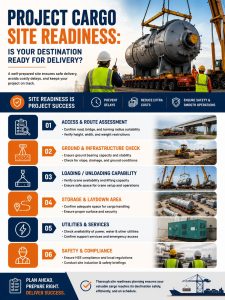
Project Cargo Site Preparation Checklist
Businesses should check before a complex shipment arrives:
✔ Delivery destination confirmed
✔ Access road evaluated
✔ Gate and entrance size suitable
✔ Ground conditions assessed
✔ Unloading area prepared
✔ Lifting equipment available
✔ Temporary storage arranged if required
✔ Delivery timing coordinated
✔ Required permits secured
✔ Site safety procedures established
✔ Stakeholders informed
✔ Contingency plans available
This checklist can help firms detect potential problems early on so they don’t impact delivery.
How Can DDU Express Help With Project Cargo Logistics
The management of project cargo transportation has to coordinate several levels within the supply chain.
DDU Express helps organisations with logistical solutions for complicated, specialised freight moves, helping to organise transportation requirements from origin to destination.
When transferring heavy gear, industrial equipment, infrastructure components and other specialised items, meticulous planning can make for an easier transition.
Logistics teams can design a more coordinated project cargo logistics plan by looking at the transportation needs, delivery requirements and final-site needs together.
A good logistics partner can assist companies navigate the difficulties of international cargo moves and final delivery.
Concluding Thoughts
The successful delivery of project cargo is not over once the cargo arrives at the target city or port.
The final project site must be suitable for safe reception, unload, storage and handling of cargo.
The success of the final delivery can be influenced by every factor from access roads and ground conditions to lifting equipment, delivery scheduling, permits and safety protocols.
By concentrating on project cargo site readiness early in the planning process, companies can reduce the risk of unforeseen issues and increase collaboration between logistics providers and project teams.
“It’s not just about planning the journey by itself, for complex cargo movements, preparation at the destination is equally important.
Planning your next cargo transport project?
Partner with DDU Express for coordinated project cargo logistics solutions designed to manage complicated global cargo shipments from origin to final destination.

Weiworld is an experienced logistics and shipping professional with more than 20 years of industry experience, with extensive knowledge of international shipping, freight forwarding, cargo movement, and logistics operations.
Over the course of his career, he has developed deep practical expertise in Middle East logistics and operations, including shipping processes, international cargo transportation, customs-related procedures, and supply chain coordination.
At DDU Express, Weiworld shares practical insights and industry knowledge to help businesses better understand international shipping, freight forwarding, DDP services, cargo transportation, and logistics solutions across the Middle East and global markets.
His extensive industry experience provides valuable perspective for businesses looking to simplify international shipping and make informed decisions when moving cargo between countries.