
Introduction
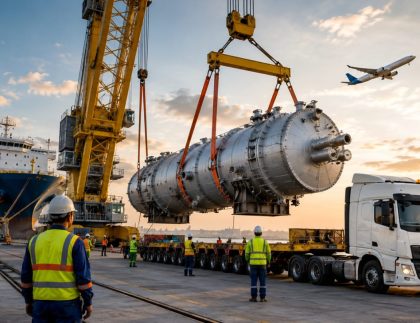
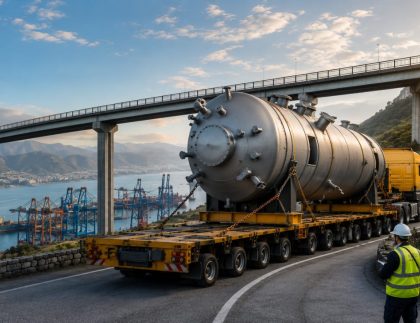
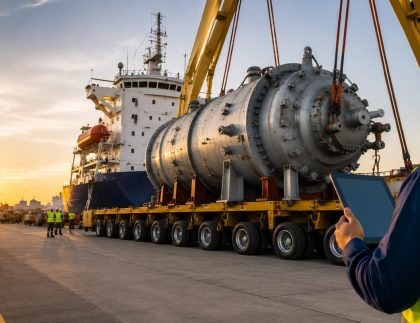
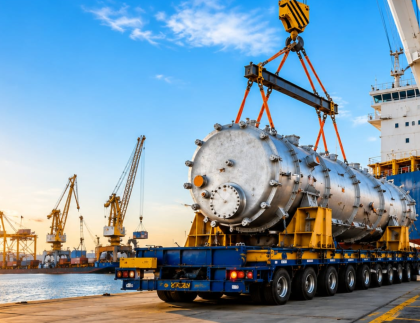
Transportation is merely a phase of the logistics process when it comes to ultra-heavy, enormous or specialised cargo. The goods, too, must be loaded, unloaded, shifted and positioned safely at various stages along the way.
This is when a project cargo lift strategy can come in handy.
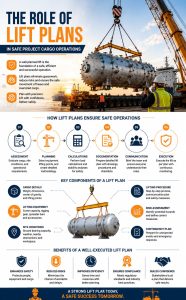
A lift plan is a formal procedure for handling lifts that include cranes and other specialist equipment. It takes into account the weight, dimensions, center of gravity, lifting points, equipment capability, site circumstances and other operational parameters of the cargo.
The execution of a proper lifting plan for project cargo has benefits for companies involved in industrial, construction, infrastructure, energy and engineering projects, leading to better safety, coordination and operational efficiency.
In this tutorial we consider what a lift plan is, why it’s important and how it promotes safer project cargo logistics operations.
What Is a Project Cargo Lift Plan?
A project cargo lift plan is a detailed document or operational plan that outlines how heavy or specialised cargo will be lifted and transported using cranes or other lifting equipment.
The plan is generally designed in accordance with the specific needs of the cargo and the lifting environment.
It could be:
Cargo weight.
Cargo size
Centripetal force
Lifting points
Selecting a crane
Lifting fittings
Location of crane
Geotechnical Conditions
Range of lift
Carrying capacity
Communication methods
Safety precautions
The idea is that everyone who is participating in the lifting operation knows how the lift should be done.

Why Lift Plans are Required for Project Cargo
Transporting large material without sufficient planning poses considerable operational and safety risks.
A good lift plan for project cargo allows teams to grasp the needs of the lift before the operation begins.
It may help to identify:
Proper lifting equipment
Crane capacity required
Possible site constraints
Concerns about ground stability
Load handling requirements
Potential lifting dangers
Communication process
Preparation is the key, especially in complex project cargo operations where the item may be too large or valuable to handle with normal equipment.
A lift plan gives a planned strategy for the operation and a better coordination for teams.
Know the Cargo Before the Lift
The first step in developing a lifting plan for project cargo is an understanding of the cargo itself.
Important information may include:
Total weight
Dimension Width Height
Center of gravity
Lifting locations
Form
Weakness
Instructions for handling
Accurate information is critical.
“If the weight or center of gravity of the cargo is miscalculated, it could affect the entire lifting operation.
For difficult shipments, logistics experts can collaborate with engineers, cargo owners, manufacturers and lifting specialists to check the technical details required.
The Center of Gravity Determined
When lifting heavy or unusually shaped cargo, the center of gravity is especially critical.
The cargo may be unstable during lifting if the center of gravity is not correctly understood.
The lift plan should consequently take into account:
Where the center of gravity is
How the load will balance when you lift
Position of lifting points
The lifting arrangement needed
Knowing these criteria, the lifting team will know how to link the cargo and where to put it.
This is a vital part of safe project cargo handling.
Choosing the Correct Crane
Not every crane is fit for every project cargo activity.
Crane selection procedure might consider:
Weight of the cargo
Cargo size
Lifting height required
Radius of Elevation
Access to Site
Floor conditions
Work space available
Environmental circumstances
Depending on the operation, numerous types cranes can be considered.
These may include:
Mobile cranes
Crawler Cranes;
Crawler Cranes
Towers cranes
Cranes Port
Special applications lifting systems
The equipment chosen should be suitable for the particular lifting requirements.
The correct equipment selection is an important aspect of the project cargo logistics planning.
Crane Capacity and Load Chart
A crane does not always have the same maximum capacity in each and every situation.
Factors that may affect real lift capability include:
radius of lift
Length of boom
Boom angle
Crane rigging
Balance weights
Soil conditions
That means that the crane has to be assessed against the real lifting situation, not just its highest rated capacity.
A detailed project cargo lift plan examines these elements in evaluating the suitability of the chosen crane for the proposed operation.
Lifting Radius Planning
The length of the lift from the crane to cargo can have a great influence on the lifting operation.
As the radius of lift grows the lifting capability of the crane available can be reduced.
Hence, the lift strategy should take into account:
Crane position
Position of cargo
Pick up point
Delivery point
Motion required
Maximum lift radius
By carefully situating the crane you can help to make sure it runs within acceptable capacity limitations.
Assessing Ground Conditions
Big cranes and big cargo can put a lot of stress on the earth.
Before starting any lifting operation, the location should be examined to see if the earth can securely carry the equipment.
Factors may be:
Soil conditions
Stability on the ground
Surface resistance
Draining
Slopes
Underground Construction
In some cases, reinforcing of the ground or temporary support systems may be required.
This assessment is particularly crucial for big project cargo operations with huge cranes and large loads.
How to Select the Right Lifting Equipment
The hoisting equipment is just one aspect of the operation.
The lift plan may additionally need to identify acceptable accessories such as:
Slings
Chains
Beam spreaders
Beams lifting
Chains Hooks
Other special lifting equipment
The accessories chosen should be suitable for the weight of the load, the lifting arrangement and handling requirements.
The lifting team must also ensure that equipment is properly examined and fit for use.
Lift Sequence Planning
A complex lift may include many steps.
For instance:
Position crane
Set up lifting equipment
Secure cargo
Conduct checks
Initiate lift
Move cargo
Place cargo
Lower cargo
Disconnect equipment
The steps should be thought of before starting the operation.
A clear lift sequence means everyone knows what’s coming up and who’s responsible for it.
It can enable the cooperation between the crane operators, the rigging teams, the site people, and the project management.
Communications During Lifting Activities
When it comes to heavy lifting, it’s all about communication.
The lift strategy should include how the team will communicate during the lift.
Depending on the environment, this may include:
Signals
Radio
Signalers who are dedicated
Communications systems on site
Everyone concerned should be aware of who is in charge of the lift.
Clear communication reduces misunderstanding and helps keep the activity moving in a coordinated manner.
Possible Risks to Be Identified
Identify possible dangers in a project cargo lift strategy prior to lifting.
Possible risks might be:
Equipment breakdown
Unsteady ground
Strong winds
Poor visibility
Limited working space
Unforeseen hurdles
Incorrect load placement
Communication difficulties
Then the team may put in place suitable controls and contingency arrangements.
This proactive strategy enables for the rectification of possible difficulties before they hinder the lifting process.
Environmental and Weather Conditions
Weather can influence the heavy lifting activities.
Factors like:
Gale winds
Rain heavy
Low visibility
High and low temperatures
Lightning
can impact the safety and feasibility of lifting operations.
The lift plan shall consider relevant environmental conditions and procedures for dealing with adverse weather.
Monitoring circumstances before and during the lift can be a key element of operational planning for complex project cargo operations.
Multi-Team Coordination
And large-scale lifting operations usually require numerous teams working together.
These can be:
a) Logistic companies
Crane drivers
Rigging crews
Engineers.
Site operators
security personnel
Vessel cargo owners
Project Management
It is necessary for everyone to grasp the lift sequence, duties, communication methods, and safety requirements.
Good coordination helps guarantee that the lifting operation is carried out according to the approved plan.
When do you require a lift plan?
Depending on the type of lifting operation and its complexity, you require a project cargo lift plan.
A precise strategy is especially crucial when the cargo is:
Very heavy
Oversized
High value
Irregular form
Difficult to reach
Lifting in a constrained environment
Specialised equipment needed
The more complex the lift operation, the more extensive the preparation and coordination.
How Lift Plans Assist with Project Cargo Logistics
Often lifting is part of a much larger logistics activity.
A typical cargo may consist of:
Factory → Land Transport → Port → Ocean Freight → Destination Port → Land Transport → Project Site → Final positioning
Along the way, goods needs to be lifted or shifted in many places.
A good project cargo logistics plan incorporates these lift requirements into the overall transportation plan.
This helps ensure that the goods can be moved seamlessly between different stages of the supply chain.
How DDU Express can help with project cargo operations
The movement of complex cargoes requires careful planning in the transportation, handling and delivery phases.
DDU Express provides logistical solutions for specialised and complex cargo moves, helping to organise transportation needs and international shipment processes.
Good planning can enable companies that ship industrial machinery, infrastructure components, construction equipment and other specialised cargo to better coordinate transportation and handling activities.
By understanding cargo features, transportation demands, lifting requirements and ultimate delivery conditions, organisations will be able to design a more structured project cargo logistics plan.
Closing Thoughts
We lift safely, not by accident. It starts with meticulous planning.
A complete project cargo lift plan provides the teams the knowledge about the cargo, the right equipment, site circumstances, the lifting sequence, and coordination of all parties engaged in the operation.
Lifting is typically one of the most important aspects of the logistics journey, especially with big and specialised products.
With the ability to prepare all details in advance, organisations may develop a more controlled and coordinated approach to project cargo operations.
With expert planning and experienced logistics coordination, moving complex merchandise, lifting and placing it safely, can be done more efficiently.
Planning a complex project cargo shipment?
Cooperate with DDU Express for integrated project cargo logistics options tailored for complex international supply chains and specialised cargo transportation.

Weiworld is an experienced logistics and shipping professional with more than 20 years of industry experience, with extensive knowledge of international shipping, freight forwarding, cargo movement, and logistics operations.
Over the course of his career, he has developed deep practical expertise in Middle East logistics and operations, including shipping processes, international cargo transportation, customs-related procedures, and supply chain coordination.
At DDU Express, Weiworld shares practical insights and industry knowledge to help businesses better understand international shipping, freight forwarding, DDP services, cargo transportation, and logistics solutions across the Middle East and global markets.
His extensive industry experience provides valuable perspective for businesses looking to simplify international shipping and make informed decisions when moving cargo between countries.