Introduction
International projects often require a business to move specialised equipment across borders for a limited period of time. Occasionally, construction machinery, industrial equipment, engineering tools, testing equipment, and other assets need to be brought into a country temporarily to support a specific project, and then removed again when the work is done. In such cases, companies may need to adopt interim import and re-export procedures. Unlike permanent imports, transitory movements are designed for commodities that are brought into a country for a specific reason and thereafter exported to another destination or returned to their country of origin. If you deal with project cargo logistics, being aware of these standards will help you plan better, avoid unnecessary problems, and let you move across borders more smoothly. This tutorial covers how temporary import and re-export solutions function, why they are vital for multinational projects, and what firms need to think about when transporting specialised cargo over borders.
What’s a Temporary Import?
Temporary import refers to bringing goods or equipment into a country for a limited period without intending to keep them there permanently. The cargo may be imported for purposes such as:- Construction works.
- Infrastructure development
- Industrial projects
- Civil engineering work
- Testing equipment
- Exhibitions
- Specialized installations
- Maintenance operations
What is Re-Export?
Re-export means export of goods which have been imported into a country. In the context of international project logistics, this can occur when specialized equipment is imported into a country temporarily and then shipped out again after completing the project. The equipment can be:- Return to the country of origin
- Moved to another project
- Shipped to another overseas destination
- Moved to a regional warehouse
Temporary Import: The Key to Project Cargo
For large worldwide projects there is often a need for equipment not available locally. Businesses may need to relocate:- Construction machinery
- Heavy industrial equipment
- Tools of the Trade
- Engineering equipment
- Testing machinery
- Power generation equipment
- Installation equipments
- Delays
- Additional duties or taxes
- Storage costs
- “compliance issues
- Re-export questions
Temporary Import vs. Permanent Import
The distinction between temporary and permanent import is the duration and purpose of the anticipated stay of the cargo in the country.Temporary importation
The equipment enters the country for a specified purpose and is expected to leave again.Permanent Import
Goods are imported into the destination country for continuous usage or ownership; For project cargo transportation, temporary import procedures may be significant when equipment is required only for the period of a given project. But the specific eligibility and customs procedure depends on local rules.Temporary import solutions when do businesses use them?
There are a number of potential uses of temporary import arrangements across a number of industries.Construction
Construction companies may deploy specialised machinery to the site of an international project on a temporary basis.Powers.
Energy projects may require specialised equipment for installation, maintenance or commissioning.Infrastructure
Large infrastructure projects may require equipment that is used only during specific construction phases.Engineering
Testing and technological equipment for unique tasks may be transferred by engineering businesses.Projects – Industrial
Manufacturers may temporarily transfer equipment for installation, commissioning or technical support. In all these circumstances, the project cargo logistics planning has to consider the expected length of the equipment in the target country.Getting To Grips With Customs Rules
Customs compliance is one of the most significant factors in temporary import and re-export. The procedures that may be needed are:- Country of entry
- Country of manufacture
- Type of cargo
- Value of equipment
- Use intended
- Length of stay
- Re-export requirements
- Commercial invoice
- Packing lists.
- Description of equipment
- Serial No
- Details of ownership
- Transport documentation
- Temporary Import Documents
The Significance of Correct Cargo Data
The detailed cargo information is critical to the organization of logistics for temporary import. Businesses must keep detailed records of:- Equipment description
- Model number
- Serial No.
- Size
- Weightlifting
- Amount
- worth
- Ownership Information
Planning the Re-Export From the Start
One of the most crucial parts of arranging a temporary import is thinking about the exit strategy before the equipment comes into the nation. Business should consider:- Duration of equipment stay in the country
- Where will it be when the project is done
- When the project is due to be completed
- If the equipment is going directly to another country
- What documents will be necessary for re-exporting
Controlling Temporary Import Timeframes
Temporary imports may be subject to time constraints or conditions. The permissible term can be different in each country and according to the customs regime used. Businesses should therefore watch out for:- Date of import
- Temporary import period approved
- Project delivery date
- Re-export time limit
- Customs regulations
What if there is a delay in the project?
Major worldwide initiatives aren’t always on time. Construction delays, technical challenges, weather conditions and other unforeseen issues can impact the project timeframe. If equipment brought in temporarily now has to remain in the nation for longer than originally intended, businesses may have to look at the applicable customs procedures. Depending on local rules this could mean:- Extension of temporary import period
- Docs update
- Seeking approval
- Re-export scheduling changes
Coordination of Temporary Import for Project Cargo Movement
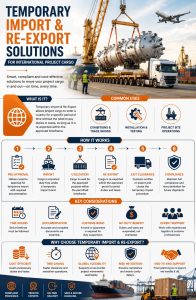
The temporary import requirements should be considered in the overall project cargo transportation plan. A typical movement might be: Equipment Availability ↓ Export From Country of Origin ↓ International Shipping ↓ Temporary Import into the Destination Country ↓ Project Site Delivery ↓ Use of equipment ↓ Project Completion ↓ Re-exporting ↓ The Endgame Coordination between logistics providers, customs teams, project managers, transporters and equipment owner may be necessary at each level. A coordinated approach might assist organisations to maintain more control over the international voyage of the equipment.Temporary Import and Equipment Tracking
Businesses should keep clean records of equipment imported on a temporary basis. This can include:- Numbers serial
- Equipment ID
- Documents of import
- Logs of locations
- Assignment to project
- Re-export information
Transfer of Equipment Between Projects Internationally
Some companies run many projects in multiple countries. In these cases, equipment may be moved from one project to another instead of being returned immediately to its original place. For instance: Country A. Source of equipment ↓ Country B. Project 1 ↓ Nation C Project 2 ↓ Country D Project #3. Different customs and transportation regulations may be involved in any overseas movement. This makes it all the more crucial to coordinate project cargo logistics properly. The business must know the customs status of the equipment at each stage and organise the next movement accordingly.Challenges of Temporary Import and Re-Export
There are various issues businesses could face while temporarily transferring equipment across borders. These may include:Documentation bugs
Incorrect or insufficient information might delay customs processing.Changes to Project Schedule
The re-export timetable is planned, although unforeseen delays in the project may occur.Equipment Recognition
If your records are bad, it can be difficult to prove that the same equipment is being re-exported.Changing Perspectives
This may mean the equipment needs to be reassigned to another project, with the associated logistics and customs implications.Multiple Stakeholders
Logistics providers, customs teams, project managers and the owners of the equipment may often need to work together to make temporary moves. Thru efficient planning, companies may better deal with these issues.How a Logistics Partner Can Help
Temporary import and re-export might have several implications in logistics and compliance. An expert logistics partner can help a company coordinate:- International transport
- Shipping documents
- Special procedures
- Cargo operation
- Project schedule
- Re-exportation Planning
- Stakeholder Communications
How can DDU Express assist with International Project Cargo
DDU Express offers logistics solutions to organisations who need to transfer international cargo and meet complex supply chain needs. Special equipment shipments for projects require close co-operation between the shipping and customs processes. By mapping the journey from initial export thru temporary import, project delivery and final re-export, companies may build a more structured process for managing international equipment transfers. Having a professional logistics partner can assist organisations organise the various steps involved in project cargo shipping and provide greater visibility throughout the shipment lifecycle.Summary
Specialised equipment for international projects is often required for a short duration only. Temporary import and re-export arrangements provide a systematic approach for companies to move equipment across borders for special project requirements. But the successful move of temporary equipment demands planning carefully. All stages should be considered before the equipment begins its voyage, including precise cargo records, customs paperwork, timetable management, and re-export planning. For companies working on complicated international projects, including temporary import requirements in the overall project cargo logistics plan can help to produce a more organised and predictable movement of specialised equipment. The point is to plan the whole voyage, not just the first import. Do you have an international project cargo movement planned? Work with DDU Express for full project cargo logistics solutions to facilitate complex cargo movements across international supply chains
Weiworld is an experienced logistics and shipping professional with more than 20 years of industry experience, with extensive knowledge of international shipping, freight forwarding, cargo movement, and logistics operations.
Over the course of his career, he has developed deep practical expertise in Middle East logistics and operations, including shipping processes, international cargo transportation, customs-related procedures, and supply chain coordination.
At DDU Express, Weiworld shares practical insights and industry knowledge to help businesses better understand international shipping, freight forwarding, DDP services, cargo transportation, and logistics solutions across the Middle East and global markets.
His extensive industry experience provides valuable perspective for businesses looking to simplify international shipping and make informed decisions when moving cargo between countries.